Redirecting a Rottweiler That Grabs Clothing
It's incredibly frustrating, even a little embarrassing, when your otherwise wonderful Rottweiler decides your pants leg, sleeve, or even your bathrobe is the perfect chew toy. One minute you're enjoying a quiet moment, the next you're doing a frantic dance as your big, powerful dog clamps down on your clothing, often shaking their head as if it's the most exciting game ever. This guide is here to walk you through exactly why this happens and, more importantly, how to effectively redirect that grabby mouth onto more appropriate outlets, restoring peace and keeping your wardrobe intact.
Understanding Why Your Rottweiler Grabs Clothing
When your Rottweiler, be it a clumsy puppy or an enthusiastic adult, starts latching onto your clothes, it’s rarely out of malice. Instead, it’s usually a natural canine behavior that’s been misdirected or misunderstood. Understanding the root cause is the first step to a lasting solution.
Puppy Teething and Exploration
Think about a human baby: everything goes in the mouth. Puppies are no different, but with a Rottweiler, those puppy teeth are sharp and their jaws are incredibly strong, even at a young age. They're exploring their world, and your clothes, with their interesting textures and your scent, become prime targets for investigation.
This exploratory mouthing is entirely normal. They're learning about textures, pressure, and what's edible versus what's not. The problem arises when they don't learn what is appropriate to chew on. If they aren't provided with a diverse array of appealing chew toys and guided towards them consistently, your favorite sweater or the hem of your jeans will inevitably become their go-to. It's not a sign of aggression; it's a puppy trying to make sense of its environment and relieve those itchy gums. For more on this critical early stage, you might find Teaching Bite Inhibition to a Rottweiler Puppy helpful.
Attention-Seeking Behavior
Rottweilers are intelligent, social dogs who thrive on interaction with their people. Sometimes, that clothing grab is a learned behavior designed to get your attention, even if it's negative attention. Think about it: if your Rottweiler grabs your sleeve and you immediately turn, push them away, or even shout "No!", they've successfully achieved their goal – they've engaged you.
They might have tried polite nudges or a soft whine, but if those went ignored and grabbing your clothing got a reaction, they quickly learn what "works." It's a classic example of operant conditioning. They don't differentiate between positive and negative attention; any attention is better than no attention when they're craving interaction. This behavior often escalates when they are bored, feeling neglected, or simply don't have enough appropriate stimulation.
Play Solicitation or Over-Arousal
Many Rottweilers have a robust play drive, and grabbing clothing can be their way of saying, "Let's play!" especially if they haven't been taught more appropriate ways to initiate games, like bringing a toy or bowing. They might tug on your pant leg as an invitation to a game of chase or tug-of-war.
This can also stem from over-arousal. When a Rottweiler gets overly excited, perhaps during greetings, during a vigorous play session, or when anticipating a walk, their impulse control can go right out the window. They might jump, mouth, and grab clothing as an outlet for that pent-up energy. It’s not aggression, but an inability to regulate their excitement levels, leading them to use their mouths in an inappropriate way. Recognizing these cues and understanding how to manage them is crucial, especially if you have children in the house. You'll want to review Rottweiler Puppy Play Biting With Children for more context.
Immediate Strategies for Stopping the Behavior
When your Rottweiler latches onto your clothing, your immediate reaction is critical. The goal is to make the behavior stop immediately and to prevent it from being reinforced.
The "Be a Tree" Technique and Disengagement
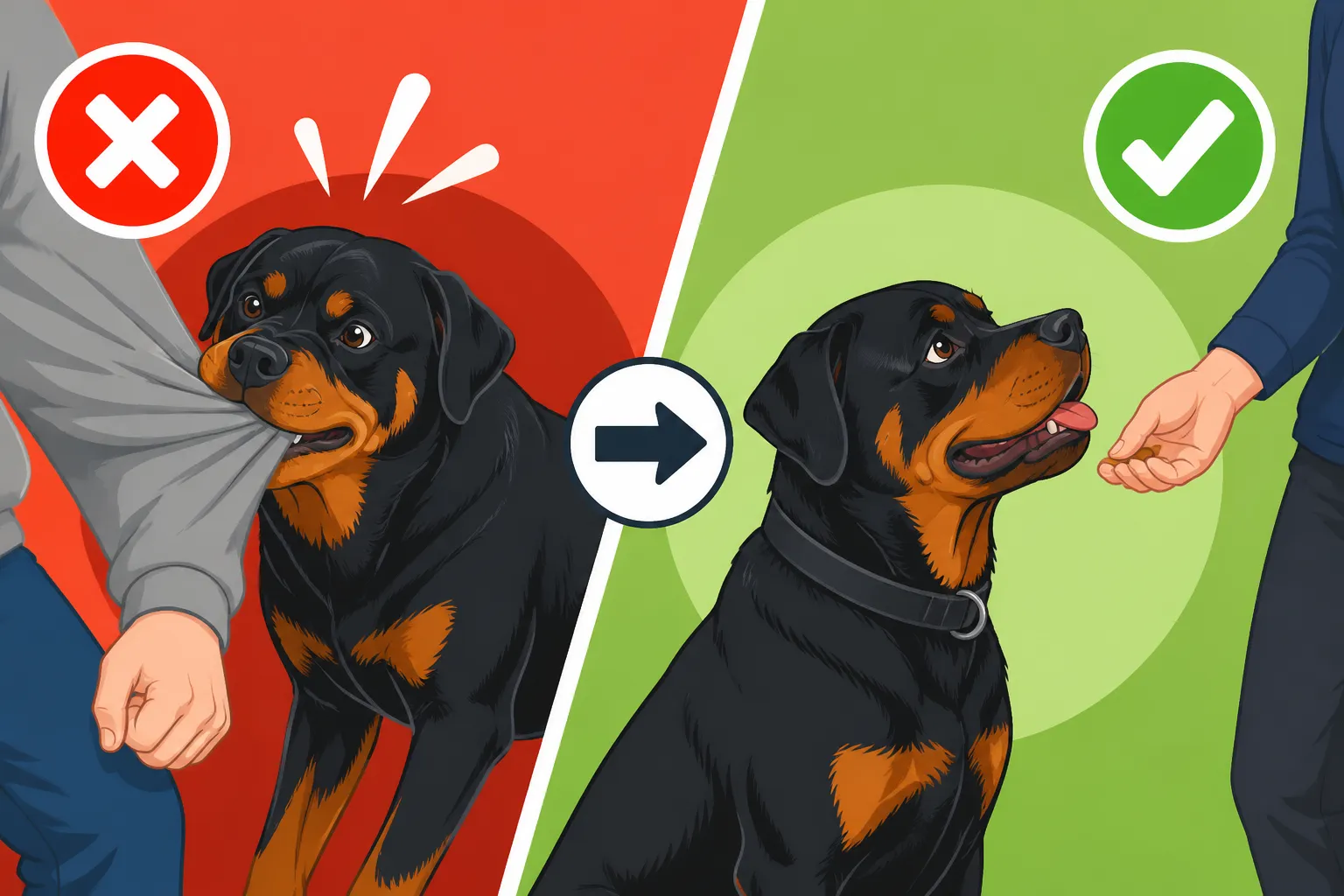
This is a classic and highly effective technique, especially for puppies and young dogs. The moment your Rottweiler’s teeth touch your skin or their mouth clamps onto your clothing, you need to completely disengage.
Here's how it works:
- Freeze: Stop all movement. Don't pull away, don't push, don't talk. Any movement or sound can be interpreted as part of the game by your Rottweiler, fueling their excitement.
- Turn Away: Turn your back to them, making yourself utterly uninteresting. Cross your arms if they are reaching for your sleeves. Look at the ceiling.
- Wait: Remain frozen and silent until your Rottweiler disengages their mouth from your clothing. This might take a few seconds initially, but consistency is key.
- Reward Calm: The instant they let go, calmly offer them an appropriate chew toy. Do not praise them for letting go; praise them for taking the toy and engaging with it. If they re-engage with your clothing, repeat the "be a tree" process.
This teaches your Rottweiler that grabbing clothing makes you boring and inaccessible, while letting go and engaging with a toy makes good things happen. It removes the reinforcement (your attention or perceived play) and redirects their mouth to an acceptable item.
Redirection to Appropriate Chews and Toys
This strategy goes hand-in-hand with disengagement. You need to be prepared! Always have a variety of sturdy, appealing chew toys readily available in every room your Rottweiler spends time in. When your Rottweiler shows any sign of wanting to mouth (even if it's just looking at your hand), preemptively offer a toy.
For a Rottweiler, "appropriate" means durable. Their powerful jaws can make short work of many toys. Look for toys made from tough rubber, reinforced nylon, or those designed for aggressive chewers. Some excellent options include:
- Kongs: Fill these with peanut butter, yogurt, or wet food and freeze them for a long-lasting challenge.
- Benebones or Nylabones: These non-edible chews come in various shapes and flavors and are built to withstand strong chewers.
- Heavy-duty rope toys: These are great for tug-of-war when you initiate it, but supervise closely to prevent ingestion of strands.
You can often find a fantastic selection of these durable toys on platforms like Amazon, making it easy to stock up. When you redirect, make the toy exciting! Wiggle it, throw it gently, and praise them enthusiastically when they take it in their mouth. The goal is to make the toy more appealing than your clothing. Want some specific recommendations? Check out Rottweiler Chew Toys That Survive the Jaw.
Leash Management and Spatial Control
Sometimes, especially with persistent puppies or dogs who get overly excited, simply disengaging isn't enough to prevent the behavior. This is where active management comes into play.
Consider using a lightweight "house line" (a short, light leash) attached to your Rottweiler’s collar when they are inside and you are supervising. This house line should be short enough not to get tangled but long enough for you to gently step on it or pick it up to interrupt an unwanted behavior without having to grab your dog.
If your Rottweiler is getting overstimulated or is repeatedly trying to grab your clothing, you can use the house line to:
- Gently guide them away: If they lung for your pants, step on the line to prevent them from reaching you, then redirect them to a chew toy or a designated "place" bed.
- Create a short timeout: If the behavior persists despite redirection, gently lead them to their crate for a brief cooldown period (5-10 minutes). The crate should be a positive, safe space, not a punishment, so ensure they have a comfortable bed and a suitable chew toy inside. For guidance on appropriate crate sizing, read The Crate Size a Hundred Twenty Pound Rottweiler Needs.
Spatial control also involves preventing access to you when you know they are likely to grab clothing. If you're coming home from work and they tend to get over-excited, greet them calmly, perhaps with a toy in hand, and keep your interactions low-key until their initial excitement settles. If they're prone to grabbing when you're cooking, consider a baby gate or keeping them on their house line in a different part of the room.
Long-Term Training to Prevent Clothing Grabbing
While immediate strategies help manage the problem in the moment, long-term training and consistent habits are what truly prevent your Rottweiler from grabbing clothing altogether. This involves teaching them alternative behaviors and ensuring their fundamental needs are met.
Teaching "Leave It" and "Drop It" Reliably
These two commands are absolute lifesavers for any dog owner, especially when you have a powerful breed like a Rottweiler. "Leave It" teaches them to ignore something undesirable, and "Drop It" teaches them to release something they already have in their mouth.
Training "Leave It":
- Start with low value: Place a low-value treat on the floor, cover it with your hand.
- Say "Leave It": The moment your Rottweiler looks at the treat, say "Leave It."
- Wait for disengagement: Wait for them to look away from your hand, even for a split second.
- Reward: Immediately mark the behavior (with a clicker or a verbal "Yes!") and reward them with a different, higher-value treat from your other hand. Don't let them have the covered treat.
- Increase difficulty: Gradually uncover the treat, then place it on the floor without covering it, increasing the distance and duration they must "leave it."
- Generalize: Practice in different environments, with different items, and eventually, with your clothing. When they lunge for your pants, calmly say "Leave It," and when they back off, reward them with a treat.
Training "Drop It":
- Start with a toy: Get your Rottweiler to engage with a toy they like.
- Introduce a better reward: Offer a high-value treat (like a piece of chicken or cheese) near their nose.
- Say "Drop It": The moment they open their mouth to take the treat, say "Drop It."
- Reward: Let them have the treat, then immediately pick up the toy.
- Repeat: After they eat the treat, offer the toy back. Repeat until they reliably drop the toy for the treat.
- Increase difficulty: Slowly phase out the need for a treat every time, eventually using "Drop It" to get them to release your clothing, then immediately redirecting them to an appropriate toy.
Consistency is paramount with these commands. Practice them daily in short, fun sessions.
Providing Sufficient Mental and Physical Exercise
A tired Rottweiler is usually a well-behaved Rottweiler. These dogs were bred for demanding work, and they need more than just a quick stroll around the block. A lack of adequate physical and mental stimulation is a common culprit behind many unwanted behaviors, including clothing grabbing.
Physical Exercise:
- Daily walks: Aim for at least 45-60 minutes of brisk walking, twice a day, once their growth plates have closed. Remember, too much strenuous exercise too early can harm a growing Rottweiler. For details, see A Growing Rottweiler's Joints and Overexercise.
- Play sessions: Incorporate fetching, flirt poles, or controlled tug-of-war (with rules) into their routine.
- Swimming: A fantastic low-impact exercise option that many Rottweilers enjoy.
Mental Exercise:
- Puzzle toys: These make your Rottweiler "work" for their food, engaging their minds.
- Training sessions: Even 10-15 minutes of obedience practice each day can be mentally fatiguing.
- Scent work: Hide treats around the house or yard and let them sniff them out.
- New experiences: Safely introduce them to new sights, sounds, and smells (after full vaccinations).
A Rottweiler who has had their physical and mental needs met is far less likely to resort to attention-seeking behaviors like grabbing your clothing. Think about different ways to keep them engaged with Rottweiler Enrichment Beyond Walks.
Consistent Positive Reinforcement for Calm Behavior
Positive reinforcement isn't just about training specific commands; it's about shaping overall behavior. Actively reward your Rottweiler when they are calm and not grabbing your clothing.
- Catch them being good: When your Rottweiler is lying quietly, chewing an appropriate toy, or simply relaxing by your feet, calmly offer praise, a gentle scratch behind the ears, or a small, high-value treat.
- Use a marker: A clicker or a consistent verbal marker like "Yes!" followed by a reward, precisely tells your dog what they did right.
- Reward engagement with toys: When you offer a toy and they choose it over your clothing, make a big deal about it! This reinforces the positive choice.
This positive feedback loop encourages them to repeat desirable behaviors. For those looking for structured training programs that emphasize positive reinforcement from puppyhood, online platforms can be incredibly helpful. For example, some owners find programs like BAXTER & Bella provide comprehensive, step-by-step guidance on positive reinforcement methods, covering everything from basic manners to more complex behaviors, which can be invaluable for consistent training across the family.
Common Pitfalls and When to Seek Professional Help
Even with the best intentions, it's easy to fall into certain traps or become overwhelmed. Knowing what to avoid and when to ask for help is crucial for success.
Avoiding Punishment and Physical Corrections
It's tempting to react harshly when a powerful dog like a Rottweiler grabs your clothes, especially if their teeth make contact with your skin. However, physical corrections or harsh verbal reprimands (like yelling) are almost always counterproductive and can even be dangerous.
Why punishment fails:
- Fear and anxiety: It can make your Rottweiler afraid of you, damaging the bond of trust. They might learn to avoid you or hide the behavior rather than stopping it.
- Increased mouthing: For some dogs, punishment can actually escalate the behavior, making them more frantic or even leading to fear-based nipping.
- Lack of clear communication: Punishment tells them what not to do, but it doesn't teach them what you want them to do instead. They're left confused and frustrated.
- Aggression: In a guarding breed like a Rottweiler, repeated punishment can lead to defensive aggression, especially if they feel cornered or threatened. They might learn to growl or snap to avoid punishment, which is a far more serious problem than clothing grabbing. You can learn more about this in Why You Should Never Punish a Rottweiler Growl.
Focus entirely on redirection, management, and positive reinforcement. Make the desired behavior rewarding and the unwanted behavior unrewarding.
Ensuring Everyone in the Household is Consistent
This is probably one of the biggest hurdles in any dog training journey. If one person uses the "be a tree" technique, another pushes the dog away, and a third thinks it's funny when the dog tries to play tug with their sleeve, your Rottweiler will be incredibly confused. They will quickly learn that rules are inconsistent and they can get away with certain behaviors with certain people.
Before you start, gather everyone in the household – adults and children alike – and ensure everyone understands:
- The agreed-upon rules: No playing tug with clothing, ever.
- The chosen techniques: Everyone must use the "be a tree" technique and redirect to toys consistently.
- The designated toys: Make sure everyone knows which toys are appropriate and keeps them accessible.
- The language: Use the same cues ("Leave It," "Drop It").
Hold regular "training updates" if needed to reinforce the rules and discuss any challenges. This united front will accelerate your Rottweiler's learning and prevent frustration for both dog and human.
When to Consult a Professional Trainer or Behaviorist
While most cases of clothing grabbing can be resolved with consistent training and management, there are times when seeking professional help is the wisest course of action.
Consider a professional if:
- The behavior escalates: If the grabbing becomes harder, more frantic, or includes growling, snapping, or skin breaking despite consistent positive training.
- It's causing significant stress: If you or family members are genuinely afraid or consistently frustrated by the behavior.
- You're seeing no improvement: If, after several weeks of dedicated and consistent effort using the techniques above, you see no reduction in the frequency or intensity of the behavior.
- Other behavioral issues emerge: If the clothing grabbing is part of a larger pattern of reactivity, aggression, or anxiety.
A certified professional dog trainer or a veterinary behaviorist can observe your Rottweiler's behavior in person, identify underlying causes you might have missed, and develop a customized training plan. They can also provide hands-on guidance and troubleshoot challenges. For tips on finding the right expert, you might want to read Finding a Rottweiler-Experienced Trainer Near You.
Remember, getting professional help is not a sign of failure; it's a responsible step toward ensuring your Rottweiler is a well-adjusted, happy member of your family.
| Strategy | What it Involves | When to Use It | Benefits |
|---|---|---|---|
| "Be a Tree" | Freeze, turn away, ignore until disengagement. | Immediate response to any clothing grab. | Breaks the reinforcement cycle, teaches disengagement. |
| Redirection | Offer an appealing, appropriate chew toy immediately. | After "Be a Tree" works, or preemptively when mouthing starts. | Teaches appropriate outlets for chewing, prevents boredom. |
| Leash Management | Use a house line or leash for gentle control and interruption. | For persistent grabbers, or in high-excitement situations. | Prevents access to clothing, allows for immediate, gentle interruption. |
| "Leave It"/"Drop It" | Teach commands to ignore/release items on cue with positive reinforcement. | Ongoing training, practice daily in short sessions. | Builds impulse control, gives you verbal control over their mouth. |
| Exercise/Enrichment | Provide daily physical activity and mental challenges. | Ongoing, part of daily routine for all Rottweilers. | Prevents boredom, reduces pent-up energy, promotes calm behavior. |
| Positive Reinforcement | Reward calm, non-mouthing behaviors consistently. | Ongoing, integral to all training. | Reinforces desired behavior, builds a positive relationship. |
By implementing these strategies consistently and with patience, you can successfully redirect your Rottweiler's grabby habits and teach them to interact with you and their environment in more appropriate and enjoyable ways.
Disclaimer
This article is for general informational purposes only and does not constitute professional advice. Laws, prices and regulations vary by location and change over time. Consult a qualified professional for guidance on your specific situation.