Emergency Recall Cues for a Rottweiler
There are few things scarier for a Rottweiler owner than watching their powerful, hundred-plus-pound companion ignore a call, heading straight for a busy street, a strange dog, or another unpredictable situation. Standard recall is one thing, but when the stakes are truly high, you need an emergency recall cue that cuts through all distractions. This guide will walk you through how to establish, train, and maintain a rock-solid emergency recall that could literally be a lifesaver for your Rottweiler.
Why a Standard Recall Isn't Always Enough for a Rottweiler
It's easy to get complacent when your Rottweiler usually comes when called in the backyard or a quiet park. But an emergency recall is an entirely different beast, designed for those moments when a normal "come!" just isn't going to cut it. We're talking about situations where hesitation can have severe consequences, and your Rottweiler's sheer size and strength mean those consequences are magnified exponentially.
The Stakes Are Higher with a Large, Powerful Breed
Let's be brutally honest: owning a Rottweiler means you carry a higher degree of responsibility. Their impressive stature and inherent guarding instincts, while wonderful traits in the right context, also mean that an uncontrolled encounter can quickly become a serious incident. Imagine your Rottweiler, off-leash (perhaps accidentally, or you’re in an allowed area), spots a squirrel across a four-lane road. A regular "Fido, come!" might work if they're mildly interested, but if that prey drive kicks in hard, they might be halfway into traffic before you finish the command.
Or picture this: you're at a dog park, and an argument erupts between two smaller dogs. Your Rottweiler, who might usually be calm, decides to intervene, perhaps with good intentions but with a force that could easily escalate the situation. Their sheer weight and power mean a gentle nudge from them could flatten a smaller dog or even a person. The potential for injury, legal repercussions, and heartache is immense. This isn't about fear-mongering; it's about being a responsible owner of a magnificent, strong animal. Having an emergency recall isn't a luxury; it's a non-negotiable safety net. This is part of Training a Rottweiler Before It Outweighs You – preparing for the worst-case scenarios from the start.
When Adrenaline and Distraction Take Over
Dogs, like humans, can get hyper-focused. For a Rottweiler, this focus can be incredibly intense, especially when their instincts are engaged. That squirrel on the other side of the road isn't just a fleeting distraction; it might activate their deeply ingrained prey drive. The strange dog isn't just another canine; it might trigger their protective instincts or, conversely, an overwhelming desire to play. In these high-adrenaline moments, your dog's brain chemistry actually changes. Their hearing narrows, their tunnel vision kicks in, and the familiar sound of your voice, especially if it's mixed with panic, might simply register as background noise.
A standard "come" command, which relies on consistent reinforcement in various settings, might not have the sheer emotional weight to break through this intense focus. An emergency recall needs to be different – it needs to be a signal so unique and so heavily weighted with positive association that it overrides every other sensory input. It needs to say, "Drop everything, right now, because something incredible is happening over here!" Without that absolute power, you're leaving your Rottweiler's safety and the safety of others to chance, which, as any experienced owner knows, is a gamble you never want to take.
Choosing Your Emergency Recall Cue and Its Rules
Building an emergency recall is like setting up a secret code with your Rottweiler, one that only means "come here, NOW, for the best thing ever." The success of this cue lies not just in the training, but in the cue itself and the strict rules you enforce around its usage.
The "Life or Death" Word or Sound
The very first step is selecting your emergency recall cue. This isn't just another command; it's the one you will use only in dire circumstances. Therefore, it needs to be distinct and never contaminated by everyday use.
Here's what to look for in a good emergency cue:
- Unique and Unfamiliar: Choose a word you rarely, if ever, say. Think "Pineapple," "Whistle," "Bananasaurus," or even a specific, high-pitched whistle, clap pattern, or a mouth click you don't typically use. The less it sounds like anything else in your vocabulary, the better. Avoid common names, "come," "here," or even "treat" if you use it often.
- High-Pitched or Sharp: Dogs often respond better to higher-pitched sounds, especially over distance or amidst other noises. A sharp, clear sound can cut through distractions more effectively than a low rumble.
- Multi-syllable (Optional but helpful): Sometimes a slightly longer word or a two-word phrase can be more distinct than a single syllable, giving it a unique auditory signature.
The key here is exclusivity. Once you pick it, that word or sound is reserved only for emergency recall training and actual emergencies. Not for calling them for dinner, not for a casual backyard romp, and certainly not for when you're just feeling lazy. If you dilute its meaning by using it casually, it will lose its power in a true emergency.
No Repeats, No Warnings, No Chasing
This is where many owners unintentionally sabotage their recall. An emergency cue comes with a set of iron-clad rules:
- One and Done: You say the cue once. Period. If your Rottweiler doesn't respond immediately, you don't repeat it. Repeating trains them to ignore the first command, waiting for multiple prompts. In an emergency, you don't have time for multiple prompts.
- No Warnings or Setup: Don't yell their name first ("Fido, BANANASAURUS!"). The emergency cue stands alone. It should be unexpected and attention-grabbing.
- Never Chase Them: If you use your emergency cue and your Rottweiler doesn't come, do not chase them. Chasing often turns into a fun game for dogs, reinforcing the idea that running away leads to more interaction and excitement. If they don't respond, and you absolutely must get them, you'll need a different strategy (which we'll cover later), but never let chasing be the consequence of ignoring the emergency cue. Your goal is to make coming to you the most rewarding thing imaginable, not a pursuit.
- No Punishment for Return: This is paramount. Even if your Rottweiler takes five minutes to finally come to you after the emergency cue, you must never scold, punish, or even look disappointed. Their return, however delayed, must always be met with ecstatic praise and the absolute highest value reward. If you punish them, you teach them that coming back is unpleasant, and they'll be even less likely to respond next time. This positive association is crucial for Rottweiler Recall Training That Holds.
The High-Value Reward Protocol
For an emergency recall, your reward needs to be a game-changer. It needs to be something so unbelievably good that your Rottweiler will drop everything – that squirrel, that strange dog, that tempting smell – and sprint back to you. This is not the time for kibble or a regular biscuit.
Think about what your Rottweiler goes absolutely nuts for:
- Food Rewards: Cooked chicken breast, prime roast beef, hot dogs, chunks of cheese, liverwurst, or a dollop of peanut butter (check ingredients for xylitol!) from a squeeze tube. These should be treats they never get otherwise, elevating their status to mythical levels.
- Toy Rewards: If your Rottweiler is highly toy-motivated, a special squeaky toy or a tug toy that only comes out for emergency recall practice could work. The catch is that you need to be able to immediately produce it and engage them.
The key is variety and novelty. Keep your emergency treats hidden and fresh. Don't let your Rottweiler see where they come from normally. When you deliver the reward, make it an event: enthusiastic praise, multiple small pieces of the incredible treat, and maybe even a brief, happy fuss. The more exciting the payoff, the stronger the association. Some owners keep a special pouch with these treats readily available (easily found on platforms like Amazon) for instant access during training and potential emergencies.
The Step-by-Step Process of Building a Bulletproof Emergency Recall
Training an emergency recall isn't a race; it's a marathon built on consistency, patience, and a meticulous increase in difficulty. You're essentially rewiring your Rottweiler's brain to prioritize your chosen cue above all else.
Starting in a Controlled, Low-Distraction Environment
Before you even dream of an open field, you start in the most controlled environment possible: indoors.
- Indoors, Close Range: Begin in a quiet room with no distractions. Say your emergency cue clearly and happily, then immediately produce your ultimate high-value reward. Shower your Rottweiler with praise as they approach and devour the treat. Do this 5-10 times in a short session, then stop before they get bored. Repeat these short sessions throughout the day. The goal is to create an immediate, overwhelming positive association: "That word = AMAZING things happening!"
- Gradual Distance and Movement: Once they're reliably responding at close range, start increasing the distance. Walk across the room, call the cue, and reward. Have a family member hold them briefly while you go to another room, call them, and reward. Don't make it a game of "catch me if you can." The goal is always for them to want to come to you.
- Moving to a Fenced Yard: Once they're stellar indoors, transition to a securely fenced yard. Begin just as you did indoors: low distractions, close range. Practice the cue, reward lavishly. Gradually increase distance and introduce very mild, controllable distractions (e.g., a calm family member walking by, not a thrown ball). Remember, the emergency cue is for emergencies, so keep normal "come" for everyday requests.
Consistency is vital here. You're building muscle memory and a deeply ingrained emotional response. Consider structured online programs, like those offered by BAXTER & Bella, which can provide a systematic approach to foundational obedience and recall training, making this advanced step easier. This foundational work is crucial for Rottweiler Puppy Training Through the First Year.
Gradually Introducing Distractions and Distance on a Long Line
This is where the magic really starts to happen, transitioning from theory to real-world application, but always with a safety net.
- The Indispensable Long Line: Invest in a sturdy long line – 20, 30, or even 50 feet. For a Rottweiler, you need a line made of strong, durable material that you can grip reliably. Nylon or biothane are good choices. The Long Line Strength a Rottweiler Needs cannot be underestimated; a flimsy leash will snap or burn your hands. Attach it to a well-fitting harness, not directly to their collar, to prevent neck injury if they hit the end of the line.
- Controlled Distraction Practice:
- Low-Level Distractions: Go to a quiet park or open area during off-peak hours. Let your Rottweiler explore on the long line. When they are mildly distracted (sniffing something interesting, looking at a distant bird), give your emergency cue. The instant they turn, reel them in gently if needed, praise like crazy, and deliver that high-value reward.
- Increasing Difficulty: Gradually introduce more challenging distractions. This could be a friend walking a calm, known dog at a distance, someone jogging by, or children playing far away. Never practice near roads, unknown aggressive dogs, or situations where failure could be catastrophic.
- Vary the Scenery: Practice in different locations to generalize the behavior. The local park, a friend's fenced acreage, a schoolyard after hours – each new environment adds a layer of proofing.
- Preventing Failure: The long line is your safety net. If your Rottweiler ignores the cue, use the line to gently guide them back to you. Do not tug or yank aggressively; the line is there to prevent them from truly escaping, not to punish. The moment they reach you, even if you had to guide them, still give them praise and a smaller reward. The idea is to make sure they always get to you when the cue is given, eventually reinforcing the desired response. This is also important for building Rottweiler Leash Manners at a Hundred Pounds.
Proofing the Cue in Real-World Scenarios
"Proofing" means practicing a behavior in various environments, with different distractions, people, and weather conditions, to ensure it holds up no matter what.
- Simulated Scenarios: Can you recreate common real-world distractions? Have a friend walk by with a remote-controlled car. Have someone pretend to drop food. Practice with the sound of a distant ambulance siren playing on your phone. The more varied and realistic your practice scenarios, the more robust your recall will be.
- Timing is Everything: Practice when your dog is engrossed in something, but not utterly unhinged. If they're 100% committed to chasing a deer, that's not the time to test your emergency recall; that's a time to acknowledge that you shouldn't have been in that situation without total control.
- Never Set Them Up to Fail: Until your emergency recall is 1000% reliable, do not use it off-leash in unfenced or high-risk areas. The integrity of this cue depends on it always having a positive outcome where your dog always comes back and gets rewarded. One failure can severely damage its power.
- The Table of Training Stages:
| Stage | Environment | Distractions | Recall Cue Used | Reward Value | Key Focus |
|---|---|---|---|---|---|
| Foundation | Quiet indoor room | None | Emergency Cue | Ultra-High (Meat/Cheese) | Building core association: cue = incredible |
| Controlled | Fenced backyard | Mild (family member, distant sound) | Emergency Cue | Ultra-High | Increasing distance, introducing mild distractions |
| Transitional | Quiet park (long line) | Moderate (squirrels, other dogs afar) | Emergency Cue | Ultra-High | Proofing with safety, maintaining success |
| Advanced | Varied open spaces (long line) | High (joggers, bikes, closer dogs) | Emergency Cue | Ultra-High | Generalizing in diverse real-world settings |
| Maintenance | Regular outings (long line/off-leash in safe areas) | All levels | Emergency Cue (sparingly) | Ultra-High | Keeping cue powerful, never dilute |
Remember to keep training sessions short, fun, and always end on a positive note. You're building a vital skill, not just teaching a trick. Consider adding Rottweiler Impulse Control Games to your routine, as these can indirectly strengthen their ability to disengage from distractions.
What to Do When Your Emergency Recall Fails (and How to Avoid It)
Let's be real: no dog is 100% perfect, 100% of the time. Sometimes, despite our best efforts, things go sideways. Knowing how to react when your emergency recall doesn't work is almost as important as training it. More importantly, understanding how to prevent those failures in the first place is crucial.
Managing Your Environment to Prevent Failure
The best way to handle a failed emergency recall is to never need one in a truly life-threatening situation. This means being proactive and managing your Rottweiler's environment with extreme care.
- Leash Laws Are There for a Reason: Unless you are in a designated, secure off-leash area, your Rottweiler should always be on a leash. Period. It's not just about obeying local ordinances; it's about protecting your dog and others. Even if you trust your dog implicitly, you cannot trust every other dog, every child, or every driver.
- Secure Fencing: If your yard isn't escape-proof, don't leave your Rottweiler unsupervised. A determined Rottweiler can dig, jump, or squeeze through surprisingly small gaps. Regularly check your fence for weaknesses, loose boards, or potential digging spots.
- Realistic Expectations: Understand your Rottweiler's limits. Is your dog still a teenager, prone to testing boundaries? Do they have a high prey drive that's triggered by certain animals? Are they easily distracted by Rottweiler Reactivity That Starts on Walks? Don't put them in situations where they're likely to fail. If you know they struggle with certain distractions, avoid those until their training is stronger. For example, if a specific park always has too many squirrels, choose a different spot for your walks.
- Ongoing Reinforcement: Even after your emergency recall is "trained," you need to maintain it. Occasionally, in a safe, controlled setting (like a large, empty, fenced field), use your emergency cue and reward with the same enthusiasm and high-value treats. Keep it fresh. This reinforces the memory and emotional weight of the cue, even if you only use it once a month or less in practice. Don't let it become rusty. This also ties into Rottweiler Enrichment Beyond Walks, ensuring their mental stimulation helps their focus.
When All Else Fails: The "Catch" Strategy
If you've given your emergency cue and your Rottweiler is still heading off, seemingly deaf to your pleas, you need a different plan. Panicking and chasing is usually the worst thing you can do.
- Stay Calm (Outwardly, at least): Your Rottweiler can sense your panic. Try to keep your voice even and avoid yelling their name repeatedly, which can simply add to the noise.
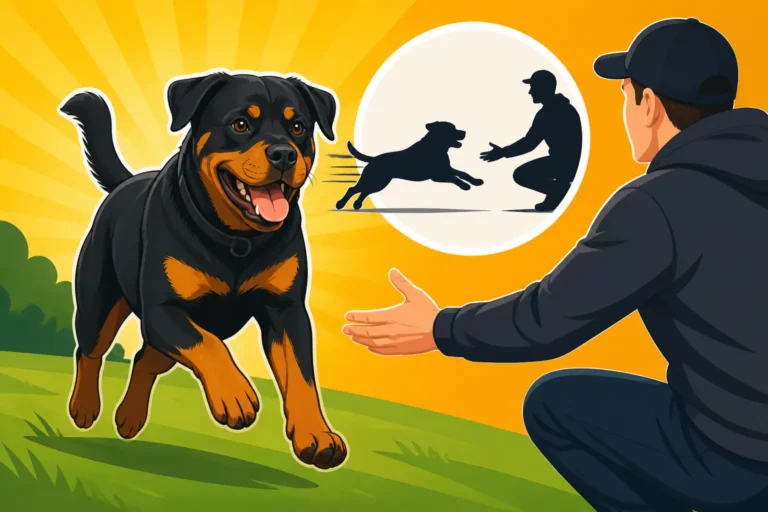
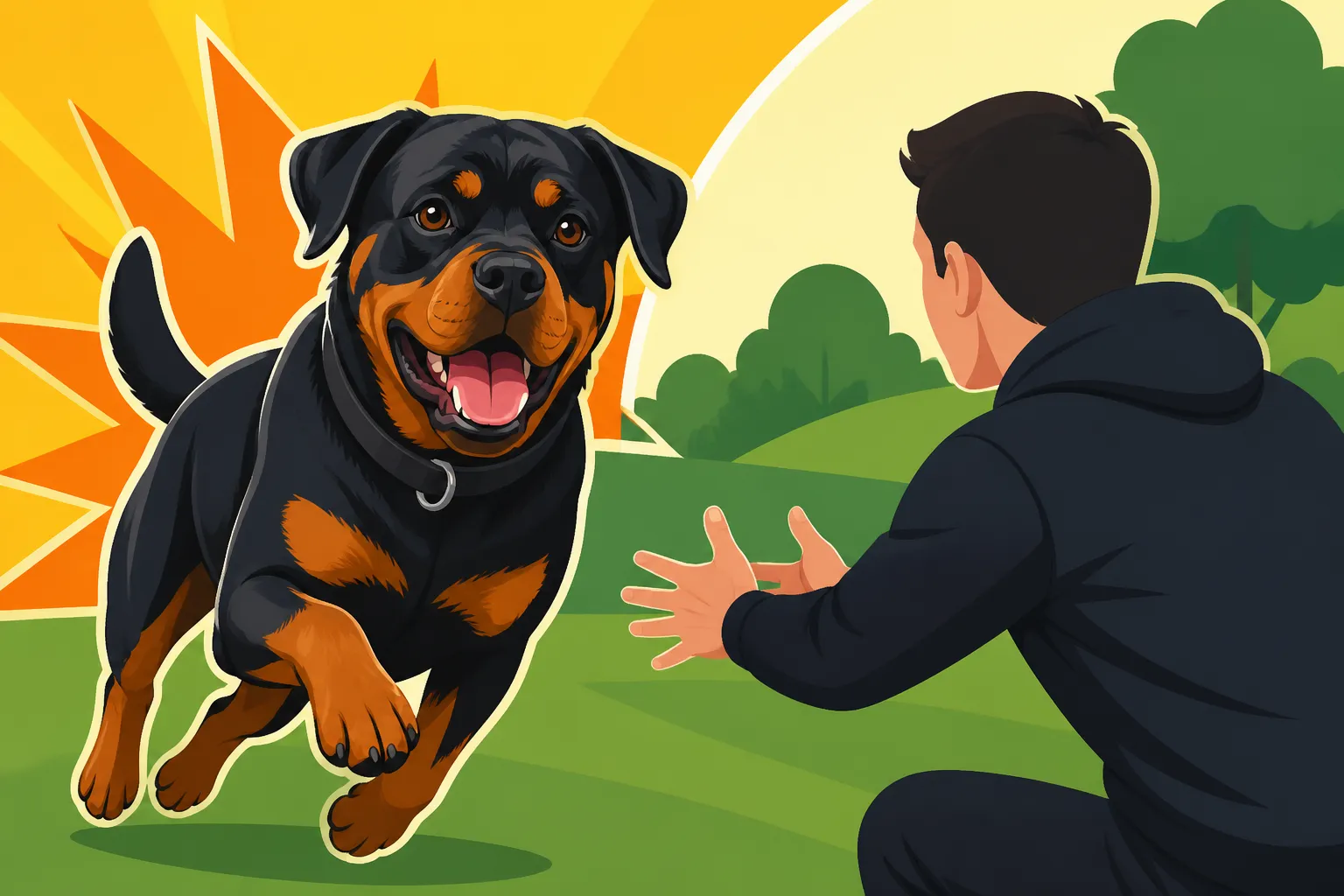
- Kneel Down and Be Inviting: Make yourself small and inviting. Kneel or sit down, spread your arms, and use a happy, excited voice. Your body language should say "fun and safety," not "angry human."
- Enticing Lures: If you have any food on you (even if it's not the emergency recall-level treat), wave it enticingly. Sometimes, a visible piece of chicken can break their trance better than an auditory cue. Make a kissing sound or an exaggerated sniffing sound to pique their curiosity.
- Run Away From Them: This is often counterintuitive but can be surprisingly effective for some dogs. If your Rottweiler has a strong chase drive, turning and running away from them can trigger their instinct to pursue you. As soon as they start coming, turn and praise them profusely, rewarding them when they reach you. Use this cautiously and only if you know your dog's temperament well.
- Seek Help (If Safe): If your Rottweiler is heading into danger and you can't get them, and it's safe to do so, alert others around you. Yell "Dog! Loose dog!" to warn drivers or pedestrians. If they have a contact tag, call the number. If you're near a professional trainer or facility, they might have specific techniques or tools (like a catch pole) for safe retrieval.
- Assess and Learn: Once your Rottweiler is safely back with you, reflect on what happened. What was the distraction? Was the environment too challenging for their current training level? Did you make a mistake? Every failure is a learning opportunity to prevent the next one. This kind of assessment is vital for addressing Rottweiler Behavior Problems That Start Small.
Rebuilding Trust and Reinforcing the Cue
A failed emergency recall is a setback, but it doesn't mean your training is ruined forever. It simply means you need to go back to basics and rebuild.
- Back to Square One (or Two): Don't be too proud to regress in your training. If your emergency recall failed in a park with moderate distractions, go back to practicing it in your secure backyard with only mild distractions. Re-establish that immediate, enthusiastic response.
- Boost the Value of the Reward: Did your high-value treat lose its sparkle? Find something even more irresistible. Could it be a new type of meat, or a different brand of highly palatable soft treat? Your dog needs to believe that coming back to you for that specific cue is the single most incredible thing that can happen.
- Positive, Positive, Positive: Every single time your Rottweiler returns to you, especially after a period of struggle or a less-than-perfect recall, make it the happiest moment of their day. Over-praise, over-treat, make a huge fuss. You are literally reprogramming their brain to associate their return with immense joy. Never, ever punish a return, no matter how long it took or what trouble they got into. That punishment will teach them that coming back to you is risky, and they will choose to stay away next time.
- Consider Professional Help: If you're consistently struggling, a professional dog trainer specializing in large breeds or recall can be an invaluable resource. They can observe your interactions, identify subtle cues you might be missing, and offer tailored strategies. A good trainer can help you troubleshoot why your Rottweiler might be ignoring you and help you get back on track.
Building an emergency recall takes dedication and consistent effort, but the peace of mind it offers is truly priceless. It's a testament to the bond you share and your commitment to your Rottweiler's safety and well-being.
Disclaimer
This article is for general informational purposes only and does not constitute professional advice. Laws, prices and regulations vary by location and change over time. Consult a qualified professional for guidance on your specific situation.