The Crate Size a Hundred Twenty Pound Rottweiler Needs
One of the biggest headaches for Rottweiler owners, especially those with growing puppies or majestic adult males, is finding a dog crate that truly fits. You spend money, you set it up, and then you watch your beautiful, muscular dog either cram itself into a space far too small, or, conversely, have so much extra room that they decide one end is a perfectly acceptable toilet spot. It's frustrating, often leads to wasted purchases, and can seriously undermine your training efforts. This guide is here to cut through that confusion, giving you the precise measurements and considerations needed to choose the right crate size for a 120-pound Rottweiler, ensuring their comfort, safety, and a successful training journey.
Why Crate Size Matters So Much for a Rottweiler
Choosing the right crate size for a dog, especially a powerful breed like a Rottweiler, isn't just about making sure they can fit. It's fundamentally about their well-being, their training, and your peace of mind. A poorly sized crate can turn what should be a safe haven into a source of stress, discomfort, or even a training setback.
The Comfort and Safety Aspect
Imagine being stuck in a space where you can't stand up, turn around easily, or stretch out fully. That's what an undersized crate feels like for a Rottweiler. Not only is it incredibly uncomfortable, but it can also lead to physical issues over time, like stiff joints or even abrasions if they're constantly rubbing against the sides. A Rottweiler deserves to be able to stand up without their head touching the top, turn a full circle without bumping into the walls, and lie down comfortably stretched out. Anything less is simply not humane for an animal of their size and build.
On the flip side, a crate that is vastly too large can also be a problem. While it might seem like more space is always better, for crate training purposes, it actually defeats the primary goal: establishing a den-like space where your dog instinctively avoids soiling. If there's enough room for them to sleep at one end and use the other end as a bathroom, you've lost a crucial part of the house-training equation. This is especially true for puppies who haven't yet mastered bladder control.
Think about a young Rottweiler puppy who is rapidly outgrowing its initial smaller crate. You see them hunching to stand, their nose pressed against the front when they lie down. It’s a clear sign they’re uncomfortable, and that discomfort can quickly turn them against the crate altogether, making future training much harder. This is why anticipating their adult size is so important, even when they're tiny.
Impact on Training and Behavior
The crate, when used correctly, is an invaluable tool for house training and teaching a Rottweiler self-control and independence. The "den effect" relies on the dog's natural instinct not to soil their sleeping area. When the crate is appropriately sized, it encourages them to hold their bladder and bowels, teaching them control and leading to fewer accidents in the house. This is the cornerstone of successful house training, and it simply won't work with an oversized crate.
Beyond house training, a correctly sized crate provides a safe, quiet space for your Rottweiler to decompress. It becomes their personal bedroom, a place they can retreat to when they're overwhelmed, tired, or when you need them safely out from underfoot. This helps in teaching them to "settle" and practice impulse control. If the crate is too small, they'll feel trapped and anxious, rather than secure. If it's too big and they're having accidents, they'll never truly relax there.
A negative crate experience, often stemming from an ill-fitting crate, can create a lasting aversion. A dog forced into a cramped space might become fearful, associate the crate with punishment, or develop anxiety around confinement. This can manifest as whining, barking, destructive behavior inside the crate, or outright refusal to enter it. It's a difficult situation to undo once established, which is why getting it right from the beginning is paramount. For a young dog, positive early experiences with a correctly sized crate are essential, as discussed in Crate Training a Rottweiler That Cries at Night.
Measuring Your Rottweiler for the Perfect Crate Fit
Before you even start browsing for crates, the most crucial step is to get accurate measurements of your specific Rottweiler. While breed standards give general ranges, individual dogs can vary quite a bit, even within the 120-pound weight class. Don't rely on guesswork or a general "large breed" label; your Rottweiler deserves a custom fit.
Head-to-Tail Length Measurement
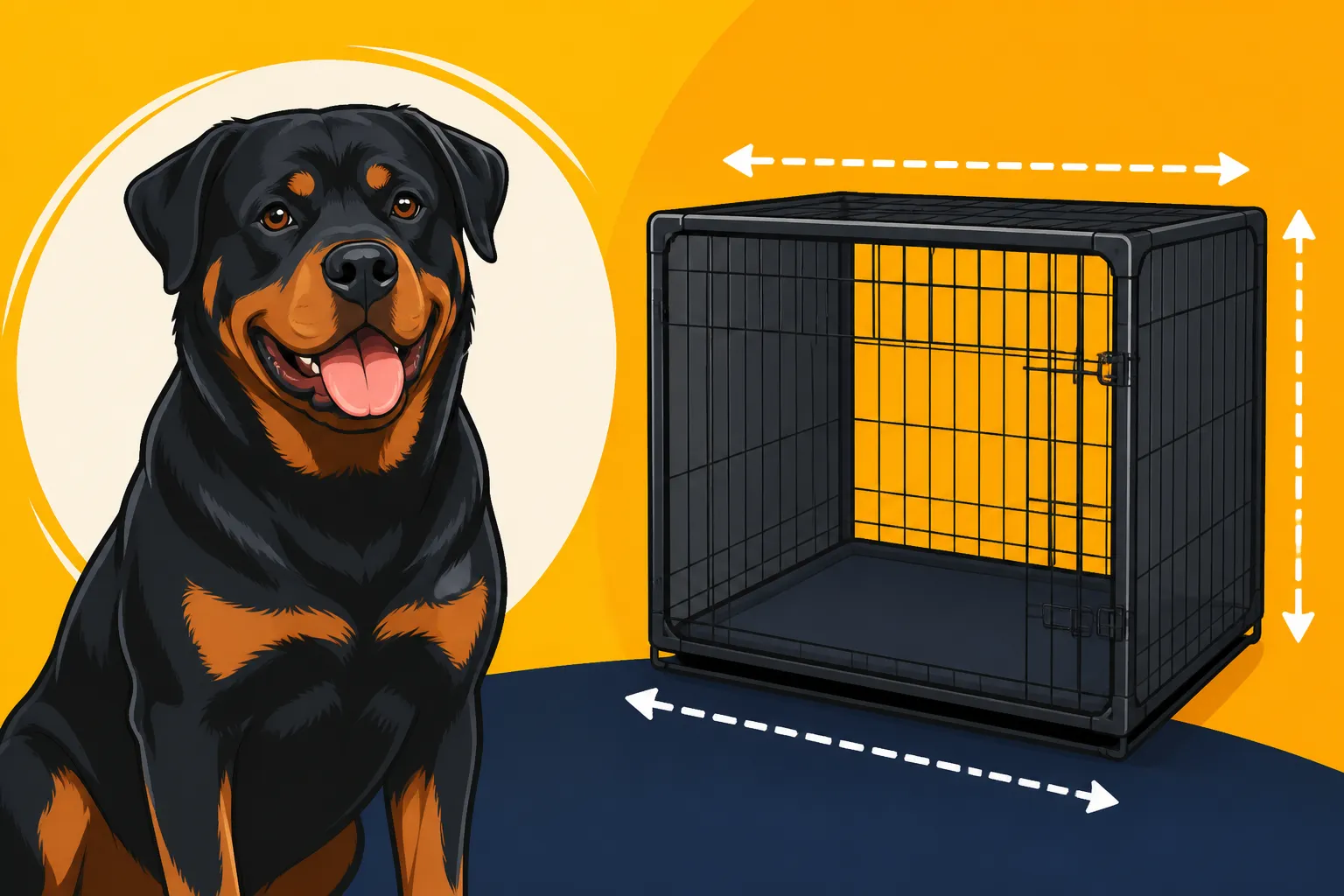
This is the primary measurement for determining the length of the crate. To get this right, have your Rottweiler stand in a natural, relaxed position. Take a tape measure and run it from the tip of their nose all the way to the base of their tail, where the tail meets their body. It's important not to include the length of their tail itself, as they won't be stretching their tail out in the crate.
Once you have this measurement, you'll want to add 4 to 6 inches. This extra space allows them to comfortably stretch out, turn around, and adjust their position without feeling cramped. For example, if your 120-pound Rottweiler measures 30 inches from nose to tail base, you'll be looking for a crate that is at least 34 to 36 inches long internally. Remember, a Rottweiler needs to be able to completely turn around and lie down naturally, so a few extra inches for maneuverability are a must.
This measurement helps prevent them from having to curl up tightly or have their nose pressed against one end and their rump against the other. The goal is easy movement within their personal space.
Standing Height Measurement
The second critical measurement determines the height of the crate. Again, have your Rottweiler stand tall and relaxed on all fours. Measure from the floor all the way up to the highest point of their head, or the tips of their ears if they stand erect (though most Rottweilers have drop ears, so it's usually the top of their skull). Just like with length, you'll add 4 to 6 inches to this measurement.
This allowance ensures that your Rottweiler can stand up fully, without having to crouch or hit their head on the top of the crate. This is particularly important for their comfort and dignity. Imagine trying to stand up in a room where your head brushes the ceiling; it feels oppressive. Your dog shouldn't feel that way in their crate.
Many crates have a "lip" or raised edge at the bottom where the tray slides in, so be sure you're measuring for the internal height from the very bottom of the crate pan to the ceiling. This ensures that the advertised height isn't misleading based on external dimensions. Rottweilers are substantial dogs, and their height at the shoulder combined with their strong heads means they need ample vertical space.
Weight and Build Considerations
While length and height give you the core dimensions, a 120-pound Rottweiler's overall weight and muscular build dictate the type and durability of the crate you'll need. This isn't a small, delicate dog. They are powerful and strong, and a flimsy crate simply won't hold up. The general rule of thumb for wire crates is that a heavier gauge wire means greater strength and durability. For plastic crates, look for robust, impact-resistant materials.
Beyond just the stated length and height, consider the width of the crate as well. While the turning-around rule covers this generally, a wider crate can offer more comfort for a broad-chested Rottweiler, allowing them to shift positions more freely or adjust how they lie down without feeling squished. A 120-pound Rottweiler needs space to sprawl a little, not just to exist. Many "large" crates might be long enough but surprisingly narrow, which won't work for the typical sturdy Rottweiler physique.
Always consider the general size and robust nature of the breed. Even if your 120-pound Rottweiler is on the leaner side for his weight, he still has significant muscle and bone structure. Therefore, buying a crate that can withstand his strength and provide adequate internal space is non-negotiable. This often means looking at what manufacturers classify as "giant" or "extra-large" for other breeds, but it's crucial to confirm the actual dimensions against your Rottweiler's measurements. For growing puppies, you might use a larger crate with a divider, as discussed in Crating a Rottweiler That Will Triple in Size.
Understanding Crate Dimensions and Types for Large Breeds
Once you have your Rottweiler's specific measurements, it's time to translate those into actual crate sizes. The market is flooded with options, but for a 120-pound Rottweiler, you'll quickly discover that many standard "large" crates simply aren't up to the task. You'll need to focus on heavy-duty, generously sized options designed for giant breeds.
Standard Crate Sizes for Giant Breeds
When you start looking, you'll notice crates often come in standard lengths, like 36", 42", 48", and 54". For a 120-pound Rottweiler, you're almost certainly going to be looking at the 48-inch range, and potentially even a 54-inch crate, depending on your dog's exact measurements.
A typical 48-inch crate might measure approximately 48L x 30W x 33H (length x width x height). For many adult male Rottweilers, this can be a good fit, allowing them to stand, turn, and lie down comfortably. However, if your Rottweiler is particularly tall or long, or if you prefer a little extra room, a 54-inch crate (which might be around 54L x 37W x 45H) would provide even more generous space. It's always best to compare the internal dimensions listed by the manufacturer directly against the measurements you took of your dog.
Remember, these are usually external measurements, so account for thicker wire or plastic, which will slightly reduce the internal space. Browsing on a platform like Amazon allows you to filter by size and often shows user reviews mentioning breed fit, which can be incredibly helpful. Always double-check the product description for the exact interior dimensions.
Wire, Plastic, or Furniture-Style Crates
Each crate material has its own set of pros and cons, especially when dealing with a powerful dog like a Rottweiler:
- Wire Crates: These are perhaps the most common and often the most practical for large breeds. They offer excellent ventilation, which is crucial for a black-coated dog, and good visibility for your dog to see what's happening around them. Many come with divider panels, making them ideal for growing puppies (you buy one crate for life, using the divider to adjust space). They are generally foldable for portability, though a 48-inch or 54-inch crate is still quite bulky. The main drawbacks can be noise (rattling wire), and some dogs prefer a more enclosed "den" feel. Look for heavy-gauge wire construction for a Rottweiler; flimsy wire can bend or break under their strength.
- Plastic Crates (or "Kennels"): These crates offer a more den-like, enclosed feel, which some dogs prefer. They are often lighter and more suitable for car travel, as they provide more protection than wire. However, they typically have less ventilation, which can be a concern in warmer climates or for dogs prone to overheating. They don't usually come with divider panels, meaning you'd need multiple plastic crates as your puppy grows, which can get expensive. Finding one large enough for a 120-pound Rottweiler can also be a challenge, as they might feel restrictive width-wise.
- Furniture-Style Crates: These are designed to blend into your home decor, looking more like an end table or piece of furniture than a dog crate. While aesthetically pleasing, they often come with a higher price tag and may not be as robust or durable as heavy-duty wire or plastic crates. The materials used might not be as strong, and finding one truly large enough for a 120-pound Rottweiler can be difficult and exceptionally costly. For a dog with the power of a Rottweiler, you need to be absolutely sure the construction is solid enough to prevent escape or damage.
For general daily use at home, a well-made, heavy-duty wire crate is often the most versatile and durable choice for a Rottweiler. For example, many owners find excellent robust options on Amazon that fit the bill.
Essential Features for a Rottweiler Crate
When you're sifting through the options, certain features become non-negotiable for a 120-pound Rottweiler:
- Secure Latches: This cannot be overstated. A Rottweiler is smart and strong. Flimsy, easily manipulated latches are an invitation for escape. Look for double-latching mechanisms, heavy-duty steel slides, or multi-point locks that require some dexterity to open.
- Durable Materials: As mentioned, gauge of wire matters. Thicker, heavier-gauge wire will withstand a Rottweiler's strength better. For plastic, look for high-density, impact-resistant polymers. You're investing in something that needs to last for years.
- Removable Tray: A slide-out, removable bottom tray made of durable plastic or metal is essential for easy cleaning. Accidents happen, and being able to quickly remove, wash, and replace the tray makes life much simpler.
- Divider Panel: If you're buying a crate for a Rottweiler puppy with the intention of it being their adult crate, a divider panel is an absolute must. It allows you to adjust the internal space, gradually expanding it as your puppy grows, thus facilitating house training and saving you from buying multiple crates. This is critical for getting the most out of your purchase from the puppy stage through adulthood.
- Multiple Doors: Crates with two doors (usually one on the front and one on the side) offer more flexibility in placement within your home and easier access for your dog, especially if your layout changes.
- No Sharp Edges: Inspect any crate carefully for rough spots, sharp wire ends, or poorly finished edges that could injure your dog.
- Portability (or lack thereof): A 48 or 54-inch heavy-duty crate for a Rottweiler is generally not "portable" in the sense of being lightweight and easy to move often. It will be heavy and cumbersome. Consider where it will live in your home, as you won't want to be constantly shifting it.
A reputable brand of heavy-duty wire crate, often found on Amazon, that offers a divider and robust construction will likely be your best bet for meeting these essential requirements.
| Crate Size (Length) | Approximate Internal Dimensions (L x W x H) | Best For | Considerations for Rottweilers |
|---|---|---|---|
| 36 inches | 36" x 23" x 25" | Small/Medium Breeds | Too small for any adult Rottweiler; only suitable for a very young puppy for a short time. |
| 42 inches | 42" x 28" x 30" | Large Breeds | Might fit a small female Rottweiler, but likely too snug for a 120-lb adult. |
| 48 inches | 48" x 30" x 33" | Extra Large/Giant Breeds | Often ideal for a 120-lb adult male Rottweiler. Ensure adequate height clearance. |
| 54 inches | 54" x 37" x 45" | Giant Breeds | Excellent for very large or tall Rottweilers, or if you prefer extra space. |
Note: Dimensions are approximate and vary by manufacturer. Always check the specific internal measurements.
Selecting the Right Crate for a Rottweiler Puppy
Bringing home a Rottweiler puppy is an exciting time, and the crate is one of the first important tools you'll introduce. Getting the crate size right at this stage is crucial, as it sets the foundation for all future crate training and helps manage their rapid growth.
The Grow-With-Me Approach with Dividers
The beauty of many heavy-duty wire crates is the inclusion of a divider panel. This feature is an absolute game-changer for Rottweiler puppies. Instead of buying a small puppy crate that they'll outgrow in a matter of weeks and then needing to purchase a larger adult crate later, you can buy one crate that will last their entire life.
Here's how it works: You purchase a crate that is sized for your adult 120-pound Rottweiler (likely a 48-inch or 54-inch model). Then, you insert the divider panel, adjusting it to create a smaller, snug space for your puppy. This smaller space should be just large enough for them to stand up, turn around, and lie down comfortably, but not so large that they can choose one end as a potty area. As your puppy grows, you simply move the divider back, gradually increasing the usable space until the divider is no longer needed.
This "grow-with-me" strategy is not only cost-effective but also incredibly beneficial for house training. It capitalizes on the puppy's natural instinct to avoid soiling their sleeping area. Without the divider, a large adult-sized crate would allow them to pee at one end and sleep at the other, making house training much more difficult and confusing for them.
Estimating Adult Size for a Puppy Crate
The key to the grow-with-me method is to accurately estimate your Rottweiler puppy's adult size. While no one has a crystal ball, you can make an educated guess based on their parents' sizes and the breed standard. Most male Rottweilers, when fully grown, will be in the 100-135 pound range, with some larger. Since you're targeting a 120-pound dog, plan for the upper end of common Rottweiler dimensions.
A good breeder should be able to give you an idea of the parents' heights and weights, which can serve as a guide. When in doubt, it's generally better to go slightly larger (e.g., a 54-inch crate instead of a 48-inch if your puppy has particularly large parents), knowing you can always make it smaller with the divider. Remember that Rottweilers grow for a significant period, with their growth plates not fully closing until around 18-24 months of age, as highlighted in Rottweiler Growth Plates Closing at Eighteen to Twenty-Four Months and Why a Rottweiler Keeps Growing Until Nearly Two. You'll be adjusting that divider for a long time!
The goal is to avoid needing to upgrade crates midway through their development. A well-chosen, adult-sized crate with a divider ensures a consistent, secure space for your Rottweiler from the day they come home to well into their senior years.
Introducing the Crate Positively
Regardless of the size, the success of crate training hinges on making the crate a positive and inviting place. For a Rottweiler puppy, this means never using the crate for punishment. It should always be associated with good things.
Start by placing soft, comfortable bedding inside – something cozy that smells like home. Toss in high-value treats and favorite chew toys. Feed meals inside the crate with the door open, gradually closing it for short periods while they eat. Use a calm, happy voice when directing them to their crate, and reward them generously when they enter voluntarily. Organizations like BAXTER & Bella offer excellent online puppy training resources that walk you through positive crate training techniques step-by-step, helping you build a positive association from day one.
Short, positive sessions are far more effective than long, forced ones. Gradually increase the time your puppy spends in the crate, always returning before they become distressed. This helps them build confidence and view the crate as their safe, personal den. This positive introduction is a critical part of their overall Rottweiler Puppy Training Through the First Year and will prevent many behavioral issues down the line. A strong chew toy, perhaps one of the durable options mentioned in Rottweiler Chew Toys That Survive the Jaw, can also make crate time more enjoyable.
Disclaimer
This article is for general informational purposes only and does not constitute professional advice. Laws, prices and regulations vary by location and change over time. Consult a qualified professional for guidance on your specific situation.