What a Rottweiler Pedigree Actually Shows
For many prospective Rottweiler owners, the idea of a "pedigree" conjures images of ancient lineage and guaranteed quality. Yet, when those papers arrive with a new puppy, they often look like a jumble of names and numbers, leaving you wondering what exactly you're supposed to be looking at. This guide will demystify the Rottweiler pedigree, explaining what information it truly contains, what it implies about your dog's heritage and potential health, and how to use it as a valuable tool.
Deconstructing the Rottweiler Pedigree Document
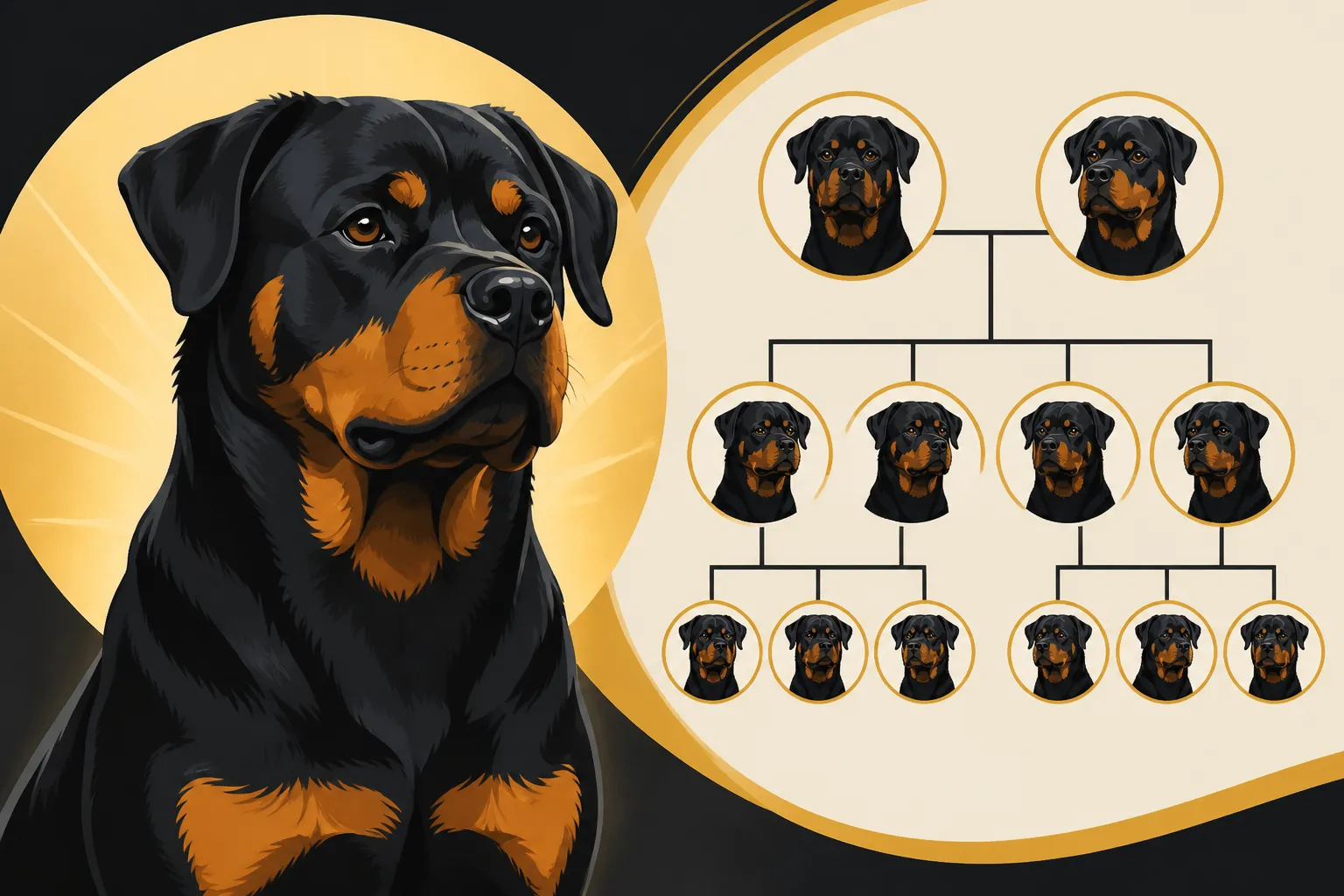
A Rottweiler pedigree is essentially a detailed family tree for your dog, going back multiple generations. It's not just a fancy certificate; it's a historical record of your dog's ancestry, registered with a reputable kennel club. Think of it like your own family tree, but specifically focused on the official lineage recognized by a governing body.
The Basic Information on Display
At its most fundamental, a Rottweiler pedigree will list your dog's registered name, its date of birth, and its registration number. But the real meat of the document lies in the generations that come before. You'll typically see a display that stretches back three, four, or even five generations, arranged in a way that clearly shows who bred whom.
Each entry for a past dog will usually include:
- Registered Name: This is often a formal name given by the breeder, sometimes quite lengthy, and distinct from any call name you might use. It usually includes the kennel name.
- Registration Number: A unique identifier assigned by the kennel club (like the American Kennel Club, or AKC, in the US, or the Allgemeiner Deutscher Rottweiler-Klub, ADRK, in Germany). This number is crucial because it's how you can look up records for that specific dog.
- Date of Birth: Knowing the birth dates of ancestors can give you an idea of their lifespan, which can be a valuable piece of information as your own dog ages.
- Titles (if any): This is where it gets really interesting! You might see prefixes or suffixes next to a dog's name, indicating achievements. These could be conformation titles (like "Ch." for Champion), obedience titles (like "CD" for Companion Dog), working titles (like "SchH" or "IPO" for Schutzhund), or even health-related designations.
Imagine looking at a pedigree and seeing a dog listed as "Ch. Von Blitzen's Iron Duke, CD, BH." That tells you this ancestor was not only a conformation champion but also achieved titles in obedience and working disciplines, hinting at both beauty and brains in their lineage.
Generations Deep and Why It Matters
Most pedigrees will show at least three generations, which means you'll see your dog's parents, grandparents, and great-grandparents. Some breeders provide pedigrees that go even further back, offering a broader view of the genetic pool. Why is this important? Because it allows you to trace trends, identify common ancestors, and understand the depth of the lines your dog comes from.
For instance, if you see the same kennel name appearing repeatedly throughout the pedigree, it suggests that the breeder is consistently using their own lines, which can be a sign of a well-established breeding program. Conversely, a pedigree with very diverse, unrelated names might indicate an outcross, which also has its own set of potential benefits and drawbacks. Understanding the generations helps you appreciate the intentionality (or lack thereof) behind the breeding choices that led to your Rottweiler. It's a snapshot of the genetics that contribute to What a Rottweiler Was Actually Bred to Be.
The Link Between Pedigree and Health Clearances
Here's where many new Rottweiler owners get a bit confused, and it's a completely understandable frustration. A pedigree document itself does not contain the results of health tests. It's a common misconception that simply having a pedigree means the dogs in it are healthy or fully health-tested. What a pedigree does provide is the roadmap to find those health clearances.
Pedigrees as a Roadmap to Health Data
Think of the pedigree as a directory. Each dog listed has a unique registration number, and for ethical breeders, this number is a key to publicly verifiable health information. Organizations like the Orthopedic Foundation for Animals (OFA) maintain vast databases of health test results. If a dog in your Rottweiler's pedigree has undergone health testing for common breed issues like hip and elbow dysplasia, cardiac health, or eye conditions, those results are often linked to their registration number and publicly accessible.
This means you, or your breeder, can use the pedigree to look up the OFA results for the parents, grandparents, and sometimes even earlier generations. This is incredibly important for assessing the genetic health background of your puppy. A responsible breeder will not only tell you about these clearances but will actively provide the links or certificates so you can verify them yourself. They understand that transparency is key, especially when dealing with breed-specific health challenges. You should always ask a Rottweiler breeder for Health Papers to Ask a Rottweiler Breeder For.
Common Rottweiler Health Concerns and How Pedigrees Point to Them
Rottweilers, like many large purebred dogs, are predisposed to certain genetic health issues. A pedigree, when properly investigated, helps you understand the risk profile.
- Hip and Elbow Dysplasia: These are probably the most well-known joint issues in Rottweilers. You'll want to see OFA or PennHIP clearances for hips and elbows on as many ancestors as possible. Seeing generations of "Good" or "Excellent" hip ratings on the parents and grandparents is a huge positive sign. You can learn more about Rottweiler Hips and Elbows and the 24-Month Rule.
- Cardiac Disease: Subaortic Stenosis (SAS) is a significant concern. Cardiac clearances, often performed by a veterinary cardiologist, are vital. A normal echocardiogram on a breeding dog indicates a healthy heart at the time of examination.
- Eye Conditions: Conditions like entropion can be hereditary. Eye certifications from organizations like the Canine Eye Registry Foundation (CERF) or OFA Eye Certification are important. Rottweiler Eye Certification and the Three Year Rule is a good topic to dive into regarding these issues.
- Juvenile Laryngeal Paralysis & Polyneuropathy (JLPP): This is a serious neurological condition specific to Rottweilers. DNA testing is available, and responsible breeders will ensure at least one parent is clear, meaning puppies will not be affected. The pedigree lets you see the registered names of the parents, enabling you to check for their JLPP status if the breeder hasn't already provided it. JLPP and the Rottweiler DNA Test explains this in more detail.
When you're looking at a pedigree, you're not just seeing names; you're seeing a story of genetic responsibility. For example, if a breeder uses a male dog that is "OFA Hips Excellent, OFA Elbows Normal, OFA Cardiac Normal, JLPP Clear," and they do the same for the female, the pedigree of their offspring means you can trace that strong health heritage. This is why some puppy prices seem higher; they reflect the investment in health testing. You might even find health-focused supplements for large breeds on sites like Chewy that could support joint health, though always discuss with your vet first.
| Health Clearance Type | What It Checks For | Relevant Pedigree Information | Why It Matters |
|---|---|---|---|
| OFA Hips/Elbows | Hip/Elbow Dysplasia | "OFA Hips [Grade], OFA Elbows [Grade]" next to parent's name | Avoids painful, expensive joint issues like Rottweiler Hip Dysplasia and the OFA Grade and Rottweiler Elbow Dysplasia and Front Leg Lameness. |
| OFA Cardiac | Subaortic Stenosis (SAS), Dilated Cardiomyopathy (DCM) | "OFA Cardiac Normal" (by Cardiologist) | Prevents life-threatening heart conditions. |
| OFA Eye Certification | Entropion, cataracts, progressive retinal atrophy | "OFA Eyes Normal" (current within 12 months) | Guards against hereditary vision problems. |
| JLPP DNA Test | Juvenile Laryngeal Paralysis & Polyneuropathy | "JLPP Clear," "JLPP Carrier" on parent's DNA panel | Essential to prevent a devastating neurological disorder. |
| Thyroid | Hypothyroidism | "OFA Thyroid Normal" | Avoids metabolic issues like Rottweiler Hypothyroidism and Unexplained Weight Gain. |
Tracing Temperament and Conformation Through the Pedigree
A pedigree isn't just about genes for health; it also offers insights into the physical appearance (conformation) and behavioral traits (temperament) that run in a particular line. This is where those titles you see on the pedigree become incredibly telling.
Titles and Achievements as Indicators
When you see a "Ch." (Champion) prefix before a dog's name, it means that dog has met the breed standard in conformation shows, assessed by multiple judges. This tells you that the dog likely embodies the desired physical characteristics of the Rottweiler breed, from its powerful build to its distinctive black and rust markings. If multiple champions appear in a pedigree, it suggests a strong line of dogs that consistently produce offspring true to type. This is important because the breed standard isn't just arbitrary; it's designed to ensure the dog can perform the tasks it was bred for.
Beyond conformation, working titles are extremely valuable for Rottweilers. Titles like "BH" (Bred to be a working dog), "IPO" (International Prüfung Ordnung, a working dog test), "SchH" (Schutzhund), or "IGP" (International Gebrauchshund Prüfung) indicate that a dog has proven its intelligence, trainability, nerve, and protective instincts in structured evaluations. A dog with these titles in its pedigree suggests a line that maintains the inherent working drive and steady temperament Rottweilers are known for. It implies they have the solid nerves needed for a guard dog, rather than being overly reactive or shy.
Even less specialized titles like "CGC" (Canine Good Citizen) can be indicators of a well-adjusted, trainable temperament. While a single CGC on an ancestor doesn't guarantee your puppy will be a saint, seeing multiple dogs with such titles suggests a commitment to training and good behavior within that line. These titles speak volumes about The Calm Confidence a Rottweiler Standard Asks For.
Looking for Consistency in Traits and Work Ethic
When you look at a pedigree with an eye for temperament and conformation, you're trying to spot patterns. Do many of the dogs have working titles? Are there multiple conformation champions? This consistency helps you predict what traits might be strong in your own puppy. If you're looking for a working dog, a pedigree filled with IPO and Schutzhund titles will be far more appealing than one with only conformation titles, and vice versa.
A good breeder will use the pedigree to demonstrate their commitment to preserving both the physical beauty and the inherent working ability of the Rottweiler. They'll tell you stories about the dogs on the pedigree – how "Grandpa Bruno" was a fantastic therapy dog, or "Great Aunt Hilda" had an incredible nose for scent work. This human connection to the pedigree makes the lineage come alive and helps you understand the living history behind your new companion. You can find many books and resources on breed standards and training methods on Chewy, which can help you understand these titles and their implications even better.
Red Flags and Misconceptions About Pedigrees
While a pedigree is a valuable document, it's also ripe for misunderstanding and, unfortunately, can be a tool for unscrupulous breeders. Knowing what a pedigree isn't and what red flags to watch for is just as important as knowing what it is.
The "Pedigree Papers" Scam and What Not to Expect
One of the biggest misconceptions is that "pedigree papers" automatically equate to a high-quality, healthy dog. This isn't true. A pedigree simply proves lineage; it doesn't guarantee health, temperament, or even that the dog is a good example of the breed. Anyone can get a pedigree for a purebred dog, even if that dog comes from a backyard breeder who did no health testing, training, or selective breeding.
Be wary of breeders who emphasize "papers" without being able to discuss the content of those papers—the specific health clearances, titles, and temperaments of the dogs listed. If a breeder is vague about health testing or tells you a dog is "pedigreed" as a substitute for verifiable health checks, that's a massive red flag. The true value of a pedigree comes from the information you can glean from it, not just the paper itself. For more on what breeders should be doing, look at The Five Evaluations a Rottweiler Needs for CHIC.
Another common pitfall is the claim of "rare" Rottweiler colors or traits, sometimes accompanied by a "special" pedigree. Reputable kennel clubs like the AKC have very clear breed standards for the Rottweiler, specifying the black and rust coat. Any claims of "blue Rottweilers" or "all-black Rottweilers" with unique pedigrees are usually a sign of unethical breeding, often involving mixed breeds or dogs that do not meet the breed standard, and such pedigrees are not recognized by legitimate clubs.
Why an "Unpapered" Rottweiler Is a Risk
Conversely, you might encounter a situation where a breeder offers a "purebred Rottweiler" but states they are "unpapered" or that papers can be purchased for an extra fee. This is almost always a huge risk and a warning sign. If a dog is truly purebred from health-tested lines, there's no reason for a reputable breeder to withhold registration papers or charge extra for them. The cost of registering a litter is minimal compared to the overall expense and effort of ethical breeding.
An "unpapered" Rottweiler often means one of several things:
- The parents weren't registered: This could indicate the breeder isn't involved with any reputable kennel club, making it impossible to trace the health or temperament history of the lineage.
- The parents weren't purebred: Despite appearances, without papers, there's no verifiable proof of purebred status.
- The breeder is violating a contract: Sometimes, papers are withheld if the puppy is sold on a limited registration or spay/neuter contract, but this should be transparently communicated from the outset, not hidden.
- The breeder is trying to avoid accountability: Without official registration, it's harder to track lineage and hold breeders responsible for genetic health issues that might emerge.
Choosing a Rottweiler from unpapered parents means you have no roadmap to health clearances, no way to verify the lineage, and no assurance of the breed's temperament or conformation standards. It's a gamble that often leads to heartbreak and significant veterinary bills down the line. You're losing the most valuable aspect of a pedigree: the ability to research the genetic health and temperament of your dog's ancestors. This often results in higher costs later in life, making you wonder Why an $800 Rottweiler Puppy Costs More Later.
Ultimately, a Rottweiler pedigree is a powerful research tool. It's not a magic bullet, but rather a starting point for understanding your dog's background. Learn to read it, ask questions of your breeder, and use it to delve into the verifiable health and achievement records of your Rottweiler's ancestors. This diligence will serve you well in bringing home a healthy, well-adjusted companion.
Disclaimer
This article is for general informational purposes only and does not constitute professional advice. Laws, prices and regulations vary by location and change over time. Consult a qualified professional for guidance on your specific situation.