Canine Good Citizen With a Rottweiler
It’s a frustration many Rottweiler owners know all too well: the sideways glances, the nervous reactions, or even outright fear from strangers when you’re simply trying to take your beloved companion for a walk. Society has unfortunately painted a picture of Rottweilers that often doesn't match the reality of these intelligent, loyal dogs. This guide is here to show you how pursuing the American Kennel Club's Canine Good Citizen (CGC) certification can be a powerful tool, not just for demonstrating your Rottweiler's impeccable manners, but for building confidence in both of you and changing hearts and minds along the way.
Understanding the Canine Good Citizen Program for Rottweilers
The Canine Good Citizen program is more than just a certificate; it’s a standard of behavior for dogs in our communities, promoting responsible pet ownership and well-behaved dogs. For a Rottweiler, achieving this title can be particularly impactful, providing tangible proof that your big, powerful dog is indeed a gentle giant with excellent manners.
What the CGC Certification Really Means
At its heart, the CGC certification means your dog has demonstrated good manners in everyday situations, proving they are a reliable and welcome member of the community. It’s a 10-step test that assesses a dog's ability to respond to basic commands, remain calm around strangers and other dogs, and tolerate handling, among other things. Think of it as earning a "good citizen" badge for your canine companion. It tells the world that you've put in the time and effort to train your Rottweiler, that they are under control, and that they understand how to behave appropriately in public spaces.
For a breed like the Rottweiler, which can sometimes face unfair stereotypes, this certification carries extra weight. It's a formal acknowledgment of their good temperament and your dedication as an owner. It shows that your Rottweiler isn't just a beloved pet at home but also a well-adjusted dog out in the world. It can even sometimes help with certain housing or insurance situations where breed restrictions might otherwise cause issues.
Why the CGC Standard Matters for a Large Breed
The sheer size and presence of a Rottweiler mean that their behavior, both good and bad, is magnified. A small dog jumping up might be annoying; a 100-pound Rottweiler doing the same can be intimidating or even dangerous, especially to children or the elderly. This is why the CGC standard is so crucial for large breeds. It establishes a baseline of control and predictability that helps ensure safety and comfort for everyone interacting with your dog.
The test items, such as "Accepting a Friendly Stranger" or "Walking Through a Crowd," directly address scenarios where a large, powerful dog needs to exhibit calm and polite behavior. Imagine navigating a busy street fair or a park with your Rottweiler. If they're pulling on the leash, lunging, or barking incessantly, it becomes a stressful experience for everyone. A CGC-certified Rottweiler, on the other hand, can move confidently and calmly through these environments, demonstrating that their size comes with a corresponding level of discipline. This not only makes life easier for you but also helps change negative perceptions about the breed one positive interaction at a time. This commitment to training from an early age is vital, as Why Rottweiler Training Cannot Wait Until Six Months covers in detail.
The Unique Advantages and Challenges for a Rottweiler
Training a Rottweiler for CGC has its own set of considerations. While their intelligence and desire to please are huge assets, their formidable size and the public's perception can present hurdles that owners of smaller breeds might not encounter.
Overcoming Public Misconceptions and Breed Stereotypes
Let's be honest, living with a Rottweiler often means navigating a world filled with preconceived notions. People might cross the street, pull their children closer, or give you nervous looks, even if your dog is behaving perfectly. This can be incredibly disheartening and frustrating when you know your Rottweiler is a sweetheart. The CGC title acts as an ambassador for your dog and the breed as a whole.
When your Rottweiler calmly sits and stays while a stranger approaches, or politely allows a neutral person to pat their head, it directly challenges those stereotypes. It’s one thing to tell someone your dog is friendly; it’s another to demonstrate it through a recognized certification. This can lead to more positive interactions, making public outings more enjoyable for both you and your dog. It also helps educate people, showing them that a Rottweiler's The Calm Confidence a Rottweiler Standard Asks For is a sign of a well-adjusted dog, not aggression. Each successful CGC test is a small victory against prejudice, opening doors for your dog in places like dog parks, pet-friendly businesses, and even rental properties where breed restrictions are common.
Leveraging the Rottweiler's Natural Intelligence and Desire to Please
Despite their tough exterior, Rottweilers are incredibly smart and, more often than not, possess a deep desire to please their owners. This is a huge advantage when it comes to training for CGC. They pick up on commands quickly and, once they understand what’s expected, they tend to perform with impressive consistency.
Their intelligence means they thrive on mental stimulation, and training provides an excellent outlet for this. Positive reinforcement methods work exceptionally well with Rottweilers, as they respond beautifully to praise, treats, and toys. This also strengthens the bond between you and your dog, turning training sessions into enjoyable, collaborative experiences. You'll find that their inherent focus, once properly channeled, can make them stellar students, often excelling in the precision required for CGC exercises. When they know they've done well, that characteristic "Rottie lean" against your leg feels even more rewarding.
Managing Size and Strength During Training
The flip side of a Rottweiler's impressive physique is the need to manage their size and strength, especially during tasks like loose-leash walking. A Rottweiler can easily pull an unprepared owner off their feet, making strong leash manners non-negotiable. This isn't just about the CGC test; it's about daily safety and enjoyment. Rottweiler Leash Manners at a Hundred Pounds is a skill you'll want to master well before test day.
Training tools like sturdy harnesses or head halters can be invaluable in giving you more control without resorting to harsh methods. You'll also need to build your own physical strength and handling skills. Practicing commands like "stay" and "come" with a long line in a secure area allows you to build reliability before transferring those skills to distractions. Remember, the goal isn't to suppress their natural strength but to channel it into controlled, polite behavior. It requires patience, consistency, and a realistic understanding of what it means to handle a powerful dog responsibly. You might even find sturdy, purpose-built harnesses and long lines for training on platforms like Amazon.
Essential Preparations: Foundations Before the Test
Before you even think about walking into a CGC test, you need to lay a solid foundation of trust, communication, and basic obedience. This isn't just about rote memorization of commands; it's about building a partnership with your Rottweiler.
Building a Strong Bond and Consistent Communication
The Canine Good Citizen test relies heavily on your Rottweiler’s willingness to respond to you, even under mild distractions. This willingness stems directly from the strength of your bond and the clarity of your communication. Start with positive reinforcement from day one. Reward desired behaviors immediately and enthusiastically. Use clear, consistent verbal cues and hand signals for every command.
Your Rottweiler should see you as a benevolent leader, someone they trust and want to work with. Spend quality time together, not just in structured training sessions, but also through play, grooming, and quiet companionship. This builds a deep connection that will make your dog eager to please you during the test. For instance, if your Rottweiler knows that responding to "sit" always leads to a tasty treat or a favorite toy, they'll be far more likely to perform, even with new people or dogs around. Remember, consistency from everyone in the household is key; if one person allows jumping while another corrects it, your Rottweiler will get mixed signals.
Mastering Basic Obedience Commands
The CGC test builds upon a set of fundamental obedience commands. Your Rottweiler should be rock-solid on "sit," "down," "stay," and "come" (recall). These aren't just commands; they are control mechanisms that ensure your dog's safety and polite behavior. A strong "stay," for example, is crucial for the "Stay in Place" item and many real-world situations, like preventing your dog from bolting through an open door. For more on building a reliable recall, check out Rottweiler Recall Training That Holds.
Practice these commands in various environments – at home, in the yard, at a quiet park, and eventually in busier locations. Start in a low-distraction setting and gradually increase the challenge. Use high-value treats to motivate your Rottweiler, especially when introducing new distractions. Online training programs, like those offered by BAXTER & Bella, can provide structured lessons and support for mastering these foundational skills before you even step into a group class. Remember, perfection isn't the goal, but reliable performance under mild distraction is.
Practicing in Various Environments
One of the biggest mistakes owners make is only practicing in the comfort of their home or backyard. The CGC test takes place in an unfamiliar environment, with strangers and other dogs present. Your Rottweiler needs to be exposed to a wide range of sights, sounds, and smells before the test day. This is an extension of Socializing a Rottweiler Puppy Properly, continuing into adulthood.
Take your Rottweiler to different parks, pet-friendly stores (if allowed), and even just walk them around your neighborhood during varying times of day. Expose them to people of all ages, other dogs (from a distance at first), bicycles, strollers, and unexpected noises. The goal is to habituate them to novel stimuli so that they remain calm and focused on you. Don't force interactions; simply allow them to observe and get comfortable. Practice all your CGC exercises in these new environments. This desensitization and counter-conditioning will build their confidence and make the actual test environment less overwhelming.
A Detailed Look at the Ten CGC Test Items
Let’s break down each of the ten items your Rottweiler will need to master to earn their Canine Good Citizen title. Each one is designed to demonstrate practical, real-world manners.
Item-by-Item Breakdown and Rottweiler-Specific Tips
Here’s a look at what each item entails and how to best prepare your Rottweiler:
-
Accepting a Friendly Stranger: The evaluator approaches your dog, speaks to you, and then politely greets your dog. Your Rottweiler should remain calm, allow a brief pat, and not show shyness or resentment.
- Rottweiler Tip: Given their naturally reserved nature, your Rottweiler might not greet with exuberance. This is perfectly fine. The key is to avoid aggression, shyness, or excessive jumping. Practice having friends and family members, especially those your dog doesn’t see often, approach calmly, talk to you first, and then offer a gentle pet. Reward calm acceptance. A Rottweiler That Ignores a Visitor Completely is acceptable, as long as it's not fear-based.
-
Sitting Politely for Petting: The evaluator pets your dog while you stand next to them. Your dog should allow this and not jump up.
- Rottweiler Tip: This is where their size can be a challenge. Start practicing "sit" and "stay" with various people petting them gently on the head or shoulder. If your Rottweiler tries to jump, gently block them with your knee and calmly guide them back into a sit. Reward heavily when all four paws stay on the ground.
-
Appearance and Grooming: The evaluator inspects your dog's coat, ears, and paws, and gently brushes them. Your dog should tolerate this calmly.
- Rottweiler Tip: This is a crucial life skill. Start early with handling your Rottweiler’s paws (think nail trims!), ears (for Rottweiler Ear Infections Under That Drop Ear), and gently brushing their coat. Make it a positive experience with treats and praise. The more comfortable they are with being handled, the easier vet visits and grooming sessions will be.
-
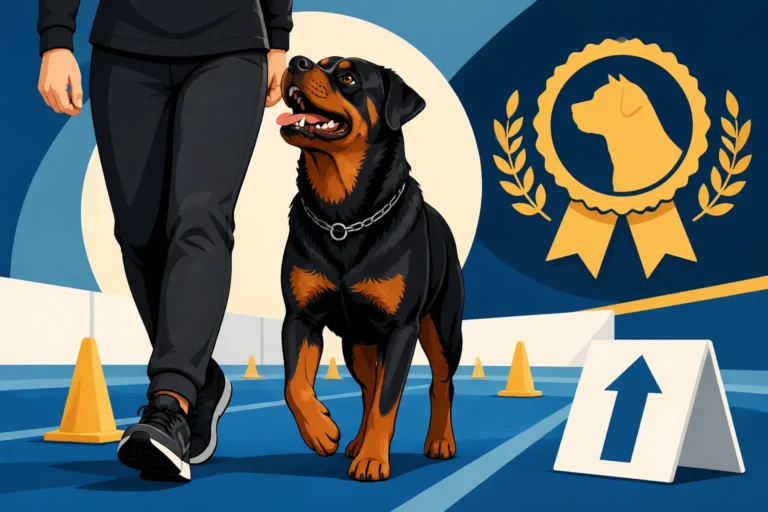
Out for a Walk (Walking on a Loose Leash): You and your dog walk together, demonstrating your dog's ability to walk politely on a leash without pulling. You'll make turns and stop.
- Rottweiler Tip: This is often the most challenging item due to their strength. You need to ensure your dog understands that a tight leash means "stop" or "change direction." Practice in a quiet area first, rewarding consistently for a slack leash. Use appropriate equipment – a front-clip harness or head halter can be very helpful here. Consistency is key, every walk is a training opportunity.
-
Walking Through a Crowd: You and your dog walk through a small group of people, demonstrating polite navigation without jumping or shyness.
- Rottweiler Tip: Again, a calm, neutral demeanor is preferred. Practice in slightly busy areas like a park path. Your Rottweiler should stay focused on you, even with people moving around. Reading a Still Rottweiler That Is Not Relaxed is an important skill for you; ensure your dog isn't just "shutting down" but truly calm.
-
Sit and Down on Command and Staying in Place: Your dog performs "sit" and "down" on command, and then remains in a "sit" or "down" stay for a short period while you walk away a short distance.
- Rottweiler Tip: Rottweilers are generally excellent at these commands. Focus on extending the duration and distance of the stay, especially with you out of sight briefly. Make sure their release word is clear. Practice in a variety of places, not just at home.
-
Coming When Called: You walk away from your dog (who is on a 20-foot line) and then call them to you. Your dog should come promptly.
- Rottweiler Tip: A reliable recall is perhaps the most important safety command. Practice with a long line in a secure area. Make coming to you the most rewarding thing ever. Run away from your dog, clap, use an excited voice, and give high-value treats upon arrival. Never call your dog for something unpleasant.
-
Reaction to Another Dog: Two handlers and their dogs approach each other, stop, shake hands, exchange pleasantries, and then continue walking. Dogs should not show aggression or over-exuberance.
- Rottweiler Tip: Your Rottweiler should be calm and ignore the other dog. Practice walking past other dogs at a distance, gradually decreasing the distance as your dog shows calm behavior. Reward them for looking at you instead of the other dog. Avoid situations where Rottweiler Dog Park Risks at Adult Size could create negative experiences before the test.
-
Reaction to Distractions: The evaluator creates a mild distraction (e.g., dropping a leash, a sudden noise). Your dog should not panic, run away, or show aggression.
- Rottweiler Tip: Exposure to varied sounds and sights, as mentioned earlier, is key. Practice dropping items, making unexpected noises, or having someone jog past you. Your Rottweiler should show curiosity but recover quickly and look to you for reassurance.
-
Supervised Separation: The evaluator holds your dog's leash for three minutes while you walk out of sight. Your dog should remain calm and not show excessive barking, whining, or pacing.
- Rottweiler Tip: This is a test of confidence and independence. Practice leaving your dog with trusted friends or family for short periods. Ensure your dog is comfortable being tethered (safely) for a few minutes while you step out of the room. This builds their resilience to being alone.
Addressing Common Pitfalls for the Breed
While Rottweilers generally excel, there are a few areas where they might face common challenges:
- Over-Arousal/Excitement: Sometimes their enthusiasm, especially when young, can manifest as jumping or excessive greetings. It's crucial to teach calm greetings and impulse control early on. Rottweiler Impulse Control Games can be a great way to practice this.
- Breed Prejudice: You might encounter an evaluator who is biased, though most are professional. If you feel this is the case, it’s worth finding another. However, the most effective way to combat prejudice is with an undeniably well-behaved dog.
- Physical Strength: Their sheer power can make leash walking or maintaining a stay difficult if not properly trained. Investing in the right equipment and consistent training is essential.
- "Wait and See" Temperament: While their aloofness (see Why a Rottweiler Waits Before Deciding) is a breed trait, it can sometimes be misinterpreted. Ensure your dog is comfortable being touched by strangers, even if they aren't seeking attention. The goal is polite acceptance, not necessarily enthusiastic engagement.
| CGC Test Item | Rottweiler Goal | Training Focus |
|---|---|---|
| 1. Accepting a Friendly Stranger | Calm, neutral, no shyness or jumping | Polite greetings, rewarding calm acceptance of strangers. |
| 2. Sitting Politely for Petting | Remain in a sit, allow petting, no jumping | Consistent 'sit-stay', blocking jumps, rewarding all four paws down. |
| 3. Appearance & Grooming | Calm acceptance of handling and brushing | Early positive exposure to ear checks, paw handling, brushing. |
| 4. Out for a Walk (Loose Leash) | Walk without pulling, responding to turns and stops | Consistent loose-leash training with appropriate equipment. |
| 5. Walking Through a Crowd | Calmly navigate distractions, focus on handler | Practice in varied, mildly busy environments. |
| 6. Sit/Down on Command & Stay | Reliable performance with duration and distance | Extend stay duration/distance in different settings. |
| 7. Coming When Called | Prompt recall with enthusiasm | High-value rewards for recall, practice with a long line. |
| 8. Reaction to Another Dog | Ignore other dogs calmly | Desensitization to other dogs, rewarding focus on handler. |
| 9. Reaction to Distractions | Brief curiosity, quick recovery, no panic/aggression | Exposure to varied sounds and sights, positive associations. |
| 10. Supervised Separation | Remain calm when handler out of sight | Practice short separations, building confidence being alone. |
Test Day Logistics and Choosing the Right Evaluator
The big day can be nerve-wracking for both you and your Rottweiler. Knowing what to expect and having the right support can make all the difference.
What to Expect on Evaluation Day
The CGC test is not a competition; it's an evaluation. The atmosphere should be supportive, and evaluators are looking for dogs that are consistently well-behaved, not perfectly robotic. You'll typically arrive at a designated location, which might be a dog club, a pet store, or a park. The evaluator will explain the process and then go through each of the ten items.
Your Rottweiler will be on a leash for all items, except for the "Coming When Called" item where they'll be on a 20-foot line you provide. You can use standard training collars or harnesses; choke chains, prong collars, and electronic collars are generally not permitted during the test. Treats and praise are usually allowed for encouragement, but excessive baiting or physical force is not. The evaluator will explain each item before you perform it, so you'll know exactly what's expected. Stay calm yourself, as your Rottweiler will pick up on your stress. Focus on encouraging your dog and celebrating their successes, even small ones. If an item doesn't go perfectly, you can usually retake the test at a later date.
Finding an Evaluator Who Understands Rottweilers
This can be a subtle but important factor. While all AKC-certified CGC evaluators are trained to be objective, finding one who has experience with large working breeds like Rottweilers can be beneficial. They often understand the breed's typical temperament – their confidence, their reserved nature with strangers, and their sometimes immense enthusiasm – and can differentiate between typical breed behavior and actual behavioral issues.
You can often find local evaluators through AKC-affiliated dog clubs, training facilities, or by asking for recommendations from other Rottweiler owners. A good evaluator will create a calm, fair environment and provide constructive feedback, whether your dog passes or needs a little more work on certain areas. Don't be afraid to ask about their experience with various breeds during your initial contact. A good connection with your evaluator can ease test-day jitters for both you and your dog. Sometimes, the same trainer who runs your Puppy Classes That Accept Rottweilers might also be a certified CGC evaluator.
Beyond Canine Good Citizen: Continuing Your Rottweiler's Training Journey
Achieving CGC is a fantastic milestone, but it's really just the beginning of a lifelong journey of learning and bonding with your Rottweiler.
Exploring Advanced Obedience and Dog Sports
Once your Rottweiler has their CGC, a whole new world of opportunities opens up! You might consider pursuing advanced obedience titles like Canine Good Citizen Advanced (CGCA) or Canine Good Citizen Urban (CGCU), which test skills in more challenging real-world scenarios. Or perhaps you'd like to delve into formal obedience competitions, where precision and teamwork are key.
Rottweilers often excel in various dog sports that provide both physical and mental stimulation. Consider activities like:
- Rally Obedience: A fun, fast-paced sport where you and your dog navigate a course of numbered stations, performing different exercises at each.
- Tracking or Scent Work: Leveraging their incredible noses, Rottweilers can be brilliant at finding hidden articles or following a scent trail.
- Draft Work/Carting: Honoring their heritage as working dogs, carting allows Rottweilers to pull small carts, demonstrating their strength and willing nature.
- Therapy Dog Work: A CGC title is often a prerequisite for therapy dog certification, allowing your calm, friendly Rottweiler to bring comfort to people in hospitals or nursing homes. Therapy Dog Certification for a Rottweiler can be a truly rewarding path.
These activities not only keep your Rottweiler mentally sharp and physically fit but also deepen your bond and continue to showcase the incredible capabilities of the breed.
The Lifelong Benefits of a Well-Trained Rottweiler
The skills learned for CGC aren't just for test day; they are skills that will serve you and your Rottweiler every single day of their life. A well-trained Rottweiler is a joy to live with, a respected member of the community, and a testament to responsible ownership. You'll enjoy greater freedom, knowing you can take your dog to more places and trust their behavior.
Beyond the practical benefits, ongoing training reinforces your relationship. It keeps your Rottweiler engaged, happy, and mentally stimulated, which is crucial for preventing boredom and potential behavioral issues. It allows them to use their intelligence and natural instincts in productive ways, rather than destructive ones. Ultimately, a trained Rottweiler is a confident Rottweiler, and a confident Rottweiler is a happier, healthier companion for many years to come. Remember, even senior Rottweilers can continue to learn and benefit from mental engagement, adapting activities as they age, as detailed in Senior Rottweiler Mobility Decline.
Disclaimer
This article is for general informational purposes only and does not constitute professional advice. Laws, prices and regulations vary by location and change over time. Consult a qualified professional for guidance on your specific situation.