The Five Minute Rule for Rottweiler Puppy Walks
One of the most exciting, yet potentially hazardous, times for a new Rottweiler puppy owner is that boundless energy phase. We all want to get our pups out and about, exploring the world, but over-exercising a fast-growing, heavy breed like a Rottweiler can set them up for a lifetime of painful joint problems. This guide is going to walk you through the essential "Five Minute Rule" for Rottweiler puppy walks, explaining why it's so critical and how you can ensure your growing giant develops strong, healthy joints.
Understanding Your Rottweiler Puppy's Unique Growth
Bringing home a Rottweiler puppy is like watching a little furry cannonball explode with energy. They're growing at an astonishing rate, sometimes gaining several pounds a week. It's easy to forget that beneath all that adorable puppy fluff and muscle, their skeletal system is still incredibly fragile and nowhere near fully formed. This rapid growth is what makes the "Five Minute Rule" so vital.
The Rapid Growth Phase and Joint Vulnerability
Rottweilers are a large breed, and they grow fast. Unlike smaller dogs that might be close to their adult size by six months, a Rottweiler will continue growing and filling out for much longer. This extended growth period means their bones are lengthening quickly, and their joints are constantly undergoing significant changes. Imagine building a skyscraper quickly; you wouldn't rush the foundation, right? You'd ensure each piece was properly set before adding the next. Our puppies are the same. Their bones are growing rapidly, but the soft tissues around those bones – ligaments, tendons, and cartilage – aren't always keeping pace in terms of strength and maturity. This imbalance makes them incredibly vulnerable to injury from high-impact or repetitive activities.
Every jump, every hard landing, every long, strenuous run puts stress on these still-developing structures. It's not just about immediate injury, though those certainly happen. It's about the cumulative wear and tear that, over months, can lead to chronic conditions. These conditions might not even show symptoms until they're much older, leaving you to wonder what went wrong. The truth is, often the damage starts subtly during those energetic puppy months.
What are Growth Plates and Why Do They Matter?
At the ends of your Rottweiler puppy's long bones, there are areas of soft, uncalcified cartilage known as growth plates (or epiphyseal plates). These are essentially "factories" where new bone is produced, allowing the bones to lengthen as your puppy grows taller. Think of them as open seams in the bone, full of busy cells making your puppy bigger. What's crucial to understand is that these growth plates are much softer and more easily damaged than the surrounding bone. They are the weakest link in the chain until they fully close and solidify into hard bone.
For a Rottweiler, these growth plates typically don't fully close until they are between 18 and 24 months old, sometimes even a bit later for very large individuals. That's a long time! Until they're closed, any excessive impact, twisting, or repetitive stress can injure them. A fractured growth plate can lead to abnormal bone growth, potentially causing limbs to be shorter or deformed, and severely predisposing a dog to lifelong lameness and conditions like Rottweiler Hip Dysplasia and the OFA Grade or Rottweiler Elbow Dysplasia and Front Leg Lameness. This is why protecting these delicate structures is paramount during your Rottweiler's entire puppyhood and adolescence. You can learn more about this in Rottweiler Growth Plates and Why They Close So Late.
Deciphering the Five-Minute Rule
The "Five Minute Rule" isn't some arbitrary guideline; it's a simple, easy-to-remember principle designed to protect your Rottweiler puppy's developing joints. It's all about balancing their need for exercise and exploration with the critical requirement to safeguard their long-term orthopedic health.
Applying the Rule to Daily Walks
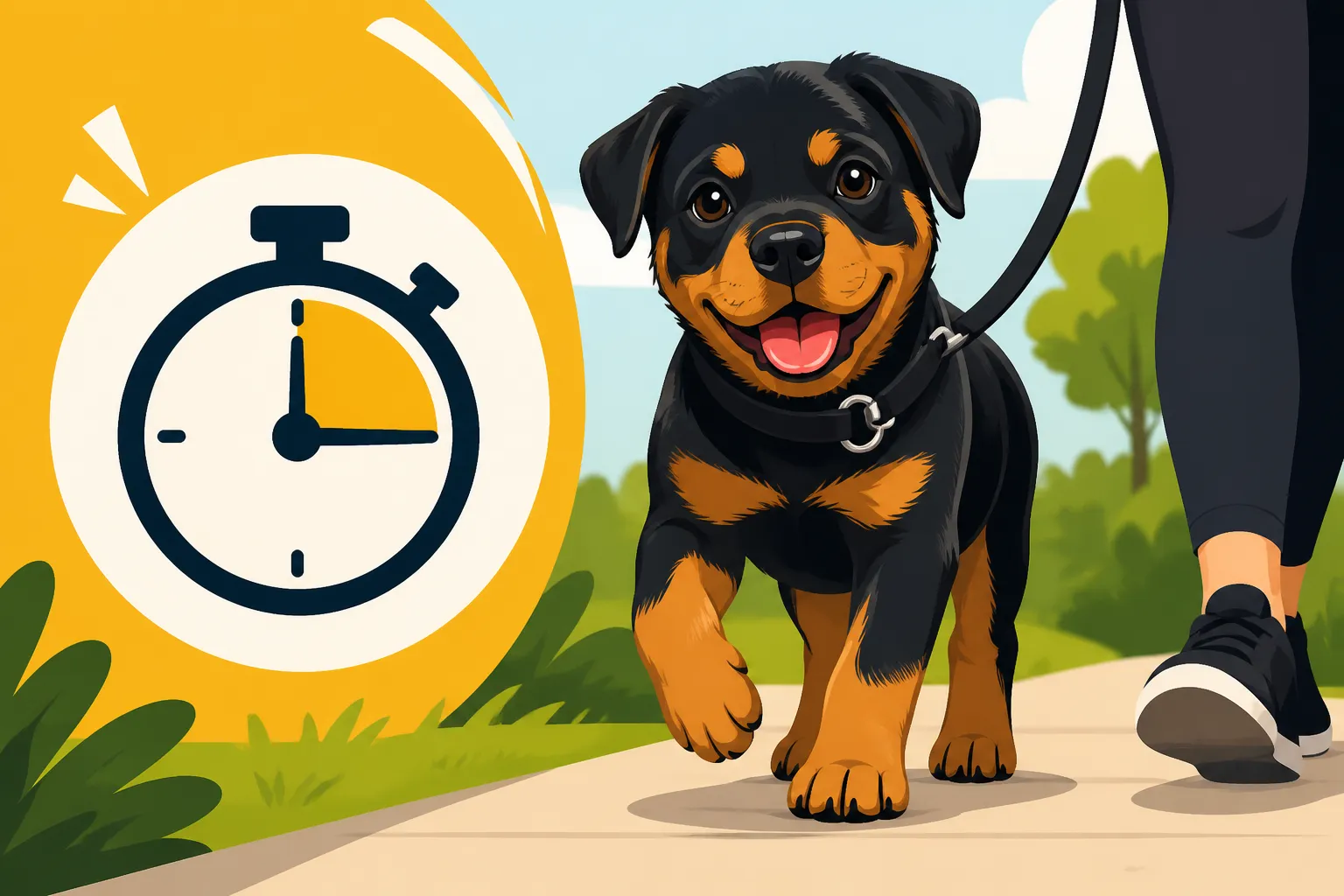
The rule states: your Rottweiler puppy should get five minutes of structured exercise per month of age, twice a day. This means if your puppy is three months old, they should have two daily walks of no more than 15 minutes each (3 months x 5 minutes = 15 minutes). If they're six months old, that's two 30-minute walks. This isn't a hard and fast law for every single moment of their day, but it’s a vital guideline for purposeful, sustained activities like leash walks.
"Structured exercise" is key here. We're talking about controlled leash walking where your puppy is moving at a steady pace, ideally on a soft surface like grass or dirt rather than hard pavement. This isn't about letting them run wild off-leash at full tilt, chasing a frisbee, or doing high jumps. Those types of activities, while fun, put immense strain on immature joints and should be avoided or severely limited during puppyhood. A gentle sniff-walk around the neighborhood or a park on a leash is perfect.
Here’s a quick glance at how the rule breaks down by age:
| Puppy Age | Max Walk Duration (Each Session, Twice Daily) | Total Daily Structured Exercise |
|---|---|---|
| 2 Months Old | 10 minutes | 20 minutes |
| 3 Months Old | 15 minutes | 30 minutes |
| 4 Months Old | 20 minutes | 40 minutes |
| 5 Months Old | 25 minutes | 50 minutes |
| 6 Months Old | 30 minutes | 60 minutes |
| 9 Months Old | 45 minutes | 90 minutes |
| 12 Months Old | 60 minutes (1 hour) | 120 minutes (2 hours) |
| 18-24 Months Old | Gradual increase to adult levels | Varies by individual |
Remember, these are maximums. If your puppy seems tired before the time is up, cut it short. It’s always better to do a little less than too much.
The "Why" Behind the Limit: Preventing Long-Term Damage
Ignoring the five-minute rule, or generally over-exercising a young Rottweiler, is a common mistake many well-meaning owners make. The immediate consequence might just be an overtired puppy, but the long-term impact can be devastating. We're talking about significantly increasing the risk of serious orthopedic conditions such as hip and elbow dysplasia, osteochondritis dissecans (OCD), and panosteitis. These aren't just minor aches; they are painful, degenerative conditions that often require expensive surgeries, lifelong medication, and can severely impact your dog's quality of life.
Consider Rottweiler Hip Dysplasia and the OFA Grade. This condition, where the hip joint doesn't form correctly, can be genetic, but environmental factors like excessive exercise during growth can exacerbate it or even trigger symptoms in a predisposed dog. The same goes for Rottweiler Elbow Dysplasia and Front Leg Lameness. Repetitive jarring and high-impact activities put unnatural stress on the soft, immature cartilage and bones, leading to inflammation, abnormal wear, and eventually, arthritis that sets in far too early. We want our Rottweilers to have strong, stable joints for their entire Rottweiler Lifespan and the Eight to Ten Year Average, and that starts with careful management in puppyhood.
Avoiding the "Weekend Warrior" Trap
Another common pitfall is the "weekend warrior" syndrome. You might be diligent about short walks during the week, but then on Saturday, you decide to take your five-month-old Rottweiler puppy on a two-hour hike or to the dog park for an hour of wrestling with adult dogs. This sporadic, intense burst of activity is often more damaging than consistent, slightly over-the-limit daily exercise.
Think of it like this: a consistent, moderate workload allows the body to adapt and strengthen gradually. Sudden, intense exertion on unprepared, immature joints is a recipe for disaster. It's like going from couch potato to running a marathon in one day – your body would rebel! Your puppy's joints are even more delicate. These intense, infrequent sessions can lead to acute injuries like sprains, strains, or even fractures of those vulnerable growth plates, as well as significantly increasing the risk of long-term degenerative joint disease. Consistency, moderation, and adherence to the five-minute rule are far more beneficial than heroic, but misguided, bursts of activity.
Beyond Structured Walks: Other Forms of Puppy Exercise
While the five-minute rule is critical for structured leash walks, it doesn't mean your Rottweiler puppy needs to be a couch potato. There are plenty of ways to keep them engaged, happy, and appropriately exercised without putting their growing joints at risk. Mental stimulation and gentle, controlled physical activity are your best friends during this delicate growth period.
Supervised Playtime and Its Importance
Unstructured playtime is vital for a puppy's development – it helps them learn social cues, develop coordination, and burn off energy. However, for a Rottweiler, "unstructured" doesn't mean "unsupervised and unrestricted." Gentle, supervised play on appropriate surfaces is key. Think about short bursts of play in your living room on carpet or a safe, fenced yard with soft grass. Avoid slippery floors or rough concrete, which can lead to slips, falls, and joint jarring.
Keep play sessions short, perhaps 5-10 minutes at a time, and spread them throughout the day. If your puppy is playing with other dogs, ensure the playmates are appropriate – calm, gentle, and of similar or smaller size. Avoid boisterous play with much larger, heavier adult dogs that could accidentally knock your puppy over or engage in rough, high-impact wrestling. Always be ready to intervene and redirect if play becomes too rambunctious. Tug-of-war can be fine in short bursts, but ensure your puppy isn't using jerky, twisting motions that could strain their neck or spine.
Mental Stimulation as a Crucial Alternative
One of the biggest misconceptions is that exercise always has to be physical. For a smart breed like the Rottweiler, mental stimulation is just as, if not more, tiring and fulfilling than physical exercise, and it comes with none of the joint risks. Engaging your puppy's brain can exhaust them in the best possible way.
Puzzle toys, for example, are fantastic. Filling a KONG or a snuffle mat with part of their daily Rottweiler Puppy Calories From Fourteen Hundred Up or some healthy treats from Chewy can keep them occupied and thinking for a good chunk of time. Teaching new commands or practicing existing ones in short, fun training sessions also works wonders. Five minutes of focused "sit, stay, come" can tire a puppy out more than a long, boring walk. You can explore many ideas for keeping their minds active in Rottweiler Impulse Control Games and Rottweiler Enrichment Beyond Walks. Even simply introducing them to new, safe sights, sounds, and smells during a short, slow sniff-walk provides immense mental enrichment without stressing their bodies.
Safe Indoor Activities and Restricted Environments
Sometimes, weather or other factors mean outdoor exercise is limited. That's where safe indoor activities really shine. Short games of fetch on carpeted floors, teaching your puppy to retrieve toys, or even just letting them chew on an appropriate, safe chew toy can be great. Interactive feeder toys (which you can often find from Amazon or even from fresh food companies like Ollie that prioritize healthy canine development) are another excellent way to provide mental and physical activity without high impact.
One often-overlooked area is stairs. While a few steps here and there are generally fine, letting a young Rottweiler puppy run up and down flights of stairs repeatedly is a definite no-no. The impact and twisting motion can be very damaging to their still-forming hips, elbows, and spine. If you have stairs in your home, consider carrying your puppy up and down until they are at least four or five months old, and then teach them to navigate stairs slowly and carefully on a leash, limiting repetitions. For more on this, check out Stairs and a Rottweiler Puppy Every Day. Crates are also wonderful for managing a puppy's activity, ensuring they get plenty of rest between short bursts of appropriate play and training.
Recognizing When You're Doing Too Much
Even with the best intentions and adherence to the five-minute rule, sometimes a puppy might overdo it, or you might misinterpret their energy levels. Learning to read your Rottweiler puppy's body language for signs of fatigue or discomfort is a critical skill for any owner. They can't tell you in words if something hurts, so you need to be their advocate.
Subtle Signs of Overtiredness and Pain
A puppy will often push past its limits because it's having fun. It's up to us to recognize when they've had enough. Look for subtle signs: excessive panting that doesn't quickly subside, lagging behind on a walk, reluctance to jump (even onto a low couch), stiffness after resting, or a change in their gait like a slight limp or an uneven stride. Sometimes, it's not a clear, obvious limp, but a more general awkwardness or reluctance to put full weight on a limb. This is sometimes called Shifting Lameness and Panosteitis in a Rottweiler Puppy.
More subtle signs can include irritability, snapping at you or other pets when they normally wouldn't, or seeking out a quiet spot to be alone. If a puppy who is usually eager for a game suddenly refuses to play, it could be a sign of discomfort. If you notice any of these signs, it's time to stop the activity immediately, allow them to rest, and monitor them closely. Persistent lameness or changes in behavior warrant a call to your veterinarian.
Consulting Your Veterinarian on Exercise Plans
Your veterinarian is your most valuable partner in raising a healthy Rottweiler. They can provide tailored advice based on your puppy's individual growth rate, genetics (if known), and any observations during routine check-ups. Don't hesitate to discuss your exercise plans with them. Ask about appropriate intensity, duration, and types of surfaces for your puppy's age. If your Rottweiler has a known predisposition to hip or elbow dysplasia based on parentage, your vet might recommend even stricter exercise limits or specific joint supplements.
Regular vet visits are not just for vaccinations; they are also opportunities for your vet to assess your puppy's musculoskeletal development. They can feel for any signs of discomfort or instability in the joints and offer guidance on ensuring optimal growth. If you ever have a concern about your puppy's gait, a limp, or any unusual stiffness, a prompt veterinary examination is always the best course of action. Early intervention can make a huge difference in the outcome of many orthopedic conditions.
The Transition to Adult Exercise
The five-minute rule is a guideline for puppyhood, but it's not forever. As your Rottweiler approaches maturity, typically between 18 and 24 months of age when their Rottweiler Growth Plates Closing at Eighteen to Twenty-Four Months have fused, you can gradually begin to increase their exercise levels. "Gradual" is the operative word here – don't jump from 60-minute walks to three-hour hikes overnight.
Start by adding a little more distance or time to your walks each week, watching carefully for any signs of fatigue or discomfort. Introducing new activities like swimming (which is low-impact and excellent for muscle development), light jogging, or longer hikes should be done slowly and progressively. Always ensure your adult Rottweiler is properly warmed up before strenuous exercise and cooled down afterward. Building their adult fitness safely and thoughtfully will set them up for a lifetime of activity without unnecessary wear and tear on their joints. You can find more detailed advice on this transition in Building Adult Rottweiler Fitness Safely.
Disclaimer
This article is for general informational purposes only and does not constitute professional advice. Laws, prices and regulations vary by location and change over time. Consult a qualified professional for guidance on your specific situation.