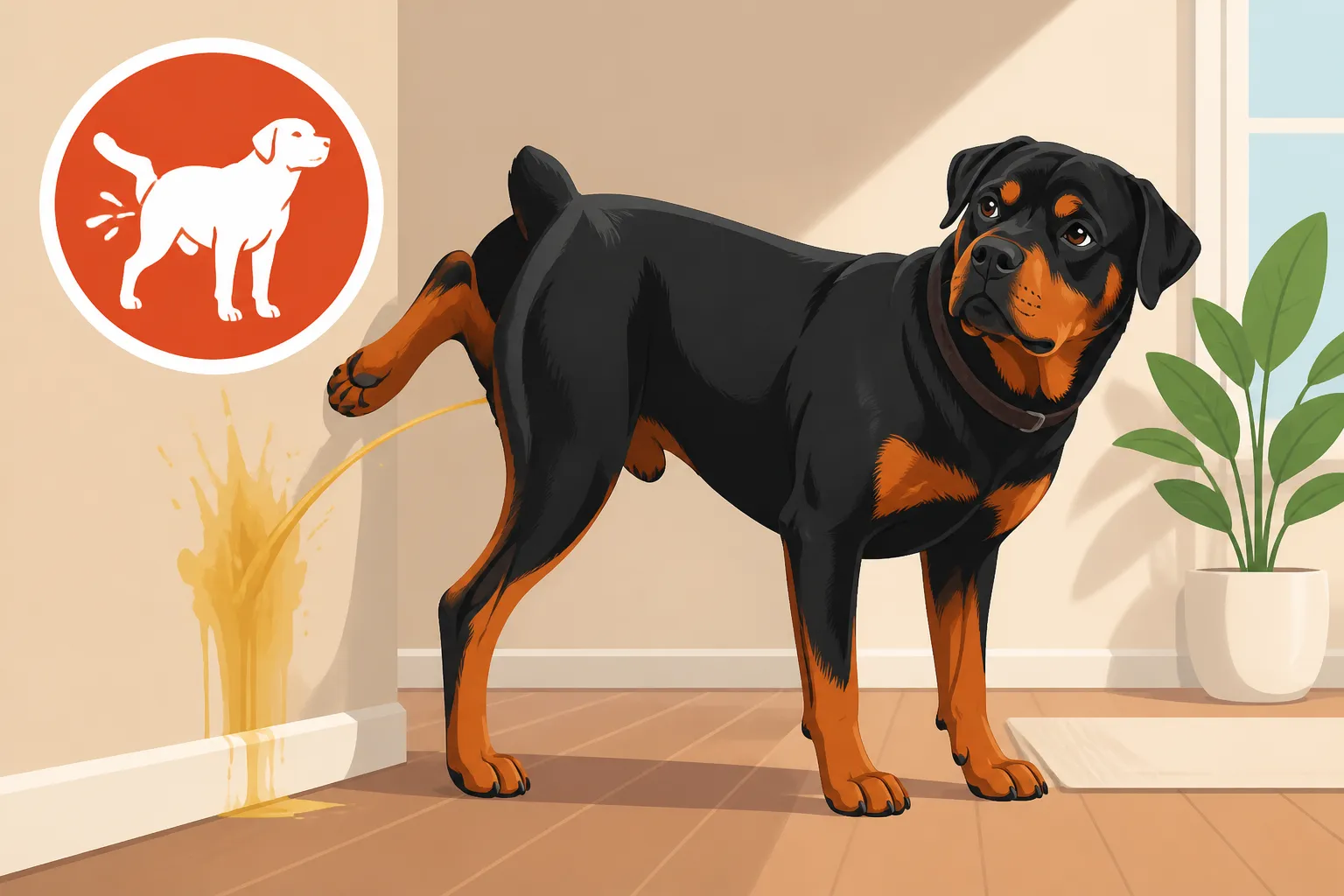
Marking Indoors by a Male Rottweiler
Finding that tell-tale puddle or spray on your favorite rug, the side of the sofa, or even a guest's suitcase, is one of the most frustrating experiences of living with a male Rottweiler. It's not just an accident; it's a deliberate statement, and it feels like a personal affront to your efforts at house-training. This comprehensive guide will walk you through the complex reasons why your male Rottweiler might be marking indoors and provide actionable, empathetic strategies to curb this challenging behavior.
Understanding Why Your Male Rottweiler Marks Indoors
When we talk about a male Rottweiler marking indoors, it’s important to distinguish it from general house-soiling. House-soiling is often about not being fully house-trained, having an insufficient potty schedule, or a medical issue. Marking, on the other hand, is usually a behavioral declaration, a way for your dog to communicate his presence and ownership of a space. It’s deeply ingrained in canine instinct, stemming from their wolf ancestors and their need to define territory. For a powerful breed like a Rottweiler, this instinct can be particularly strong.
The Role of Hormones in Marking Behavior
Undoubtedly, hormones play a massive role in indoor marking, especially in intact (unneutered) male Rottweilers. Testosterone fuels this territorial drive, making marking a very common behavior for unneutered males as they mature. They are essentially broadcasting their presence, their availability, and their dominance to any other dog (or even person) who might enter their perceived territory. This isn't necessarily about aggression, but about communication within the canine world.
Even if your Rottweiler was neutered later in life, some of those ingrained hormonal behaviors can persist. The habit of marking might have been established before the surgery, and behavioral patterns, once learned, can be hard to break, even when the hormonal trigger is largely removed. It’s like learning to ride a bike; even years later, you still remember how to balance. The behavior pathway has been laid down in their brain. So, while neutering is often the first and most effective step, it's not always a magic bullet. You might still have work to do if the behavior is already a deeply established routine.
Marking as a Territorial Statement
Beyond hormones, marking is fundamentally a territorial act. Your Rottweiler sees your home, and everything in it, as his domain, and he's simply ensuring everyone knows it. This can become especially pronounced when your dog feels his territory is being challenged or infiltrated. Imagine a new piece of furniture being brought into the house – to your Rottweiler, it's a new, unscented object that needs to be "claimed." The same goes for guests, new pets, or even objects brought in from outside that carry unfamiliar scents.
Consider a scenario where you've had houseguests with their own dog. Even after the guests and their dog have left, the lingering scent of another canine can be a huge trigger for your Rottweiler to over-mark every surface he deems important. He's saying, "This is my house, my space, and my people." This isn't malice; it's a natural, albeit inconvenient, part of canine communication. Understanding this territorial drive helps you approach the problem with more patience and less frustration. It’s not spite; it's biology.
Identifying the Triggers for Indoor Marking
Pinpointing why your Rottweiler marks is crucial, because treatment often hinges on addressing the specific trigger. It's rarely a random act; there's almost always an underlying reason, even if it's subtle to our human senses. Taking on a rescue Rottweiler with no history might make this detective work harder, but it's not impossible. Taking On a Rescue Rottweiler With No History can present many unknowns, and previous habits can be one of them.
Changes in Household Dynamics
Dogs thrive on routine and predictability. Any significant shift in your household can be a source of stress or uncertainty for your Rottweiler, leading to marking. This could be anything from a new baby arriving, a houseguest staying for an extended period, a new pet joining the family, or even a partner moving in or out. These changes disrupt their established social order and can make them feel a need to reassert their presence.
For instance, if your nephew comes to stay for a week, bringing his own scent and energy into the house, your Rottweiler might feel the need to mark his spot, especially in areas where the nephew spends a lot of time. This isn't personal; it's a canine response to perceived shifts in their environment. Your dog might be feeling anxious, or simply trying to reinforce his sense of security by spreading his scent. It’s his way of saying, "I'm still here, and this is still mine."
External Stimuli and Scent Triggers
Rottweilers have an incredible sense of smell, far more powerful than ours. What seems like a clean house to us can be a vibrant tapestry of scents to them. External stimuli, even if they never physically enter your home, can be strong marking triggers. This includes stray cats spraying near windows or doors, neighborhood dogs walking by and leaving their scent on your lawn, or even just the smell of another dog on your shoes or clothing after a walk.
Imagine walking your Rottweiler, Rottweiler Leash Manners at a Hundred Pounds, and encountering another dog marking a tree. You walk by, and then later that evening, your Rottweiler lifts his leg on your entryway rug. It’s very possible he picked up the scent of that other dog on your shoes or pants, and felt the urge to over-mark. Even the faint smell of another dog or animal from outside coming into the home can be perceived as an intrusion, prompting your Rottweiler to spray. Thorough cleaning of previously marked spots is also vital because the residual odor, imperceptible to us, is a huge invitation for re-marking.
Anxiety, Stress, and Insecurity
While marking is often territorial, it can also be a manifestation of anxiety or insecurity. A stressed or anxious Rottweiler might resort to marking as a self-soothing behavior, a way to create a more familiar and secure environment for themselves. Think about it: when they mark, they are literally surrounding themselves with their own scent, which can be comforting in an uncertain world.
This type of marking might appear when there are loud noises, like thunderstorms or fireworks, or if your routine becomes highly erratic. A Rottweiler might also mark if they're experiencing separation anxiety when left alone, even if they are perfectly house-trained otherwise. It's less about claiming territory from rivals and more about trying to calm their own nerves. Observing when and where the marking occurs can offer clues. Is it happening mostly when you're away, or during times of general commotion? If so, addressing the underlying anxiety is key to stopping the marking.
Effective Strategies to Stop Indoor Marking
Stopping indoor marking requires a multi-faceted approach that addresses both the behavioral and environmental aspects. There's no single magic wand, but a combination of consistent training, environmental management, and sometimes veterinary intervention, can make a world of difference. Patience is absolutely paramount, especially with a dog as intelligent and strong-willed as a Rottweiler.
Medical Check-Up and Neutering
Before you embark on any behavioral modification, the very first step should always be a visit to your veterinarian. It’s crucial to rule out any underlying medical conditions that could be causing or contributing to the marking behavior. Urinary tract infections, bladder stones, kidney issues, or even diabetes can all lead to increased urination and, subsequently, marking. You want to be sure you're treating the right problem.
If your male Rottweiler is intact (not neutered), neutering is often the most effective and direct solution for marking driven by hormones. While it's not 100% guaranteed to stop all marking, especially if the habit is deeply ingrained, it significantly reduces the hormonal drive behind the behavior. Your vet can discuss the optimal timing for neutering. While there's a lot of debate around neuter age and its impact on a large breed like a Rottweiler, particularly regarding growth plates, the reduction in marking behavior is a clear benefit for many owners. Whether Neuter Age Changes Rottweiler Cancer Risk is a relevant consideration here, but the behavioral impact can also be substantial.
Thorough Cleaning and Odor Elimination
This step is non-negotiable and perhaps one of the most overlooked aspects of stopping indoor marking. Dogs are drawn back to areas that smell like urine, even if we can't detect it. Standard household cleaners often only mask the odor to our noses, leaving behind scent markers that are practically neon signs for your Rottweiler. You need an enzymatic cleaner that breaks down the urine molecules.
Look for cleaners specifically designed for pet urine, readily available from retailers like Amazon. Follow the instructions carefully: saturate the area, let it sit, and then blot clean. You might need to repeat this process several times for older, deeper stains. If urine has soaked into carpet padding or floorboards, you might even need to consider replacing those sections. Otherwise, your Rottweiler will continually be cued to mark that spot again. Without truly eliminating the odor, you're fighting an uphill battle.
Crate Training and Supervised Freedom
For many behavioral challenges, limiting access and increasing supervision is key. Crate training, when done correctly, can be incredibly effective for house-training and curbing marking. Dogs are generally reluctant to soil their den, so a properly sized crate (large enough for them to stand, turn around, and lie down comfortably, but not so large that they can use one end as a bathroom) can be a powerful tool. You can find robust crates for a dog this size from retailers like Amazon. The Crate Size a Hundred Twenty Pound Rottweiler Needs is a useful guide.
When your Rottweiler is out of his crate, he needs 100% supervision. This means tethering him to you with a leash, keeping him in the same room, or using baby gates to restrict him to non-carpeted, easy-to-clean areas. The moment you see him sniffing suspiciously or exhibiting pre-marking behavior (like circling, intense sniffing, or lifting a leg), immediately interrupt him with a clap or a sharp "No!" and take him outside to his designated potty spot. Reward him heavily with treats and praise when he eliminates outside. This teaches him that outside is the only acceptable place to go.
Reinforcing Potty Training and Outdoor Marking
Even if your Rottweiler was previously house-trained, indoor marking calls for a refresher course in potty training, focusing on consistently rewarding outdoor elimination. Take him out frequently, especially after waking up, after meals, and before bedtime. When he marks or urinates outside, celebrate it! Use high-value treats, enthusiastic praise, and even a little play. You want to make eliminating outside the most rewarding thing he does all day.
You can also encourage outdoor marking in appropriate areas. If you have a specific spot in the yard you'd prefer him to use, take him there on a leash every time. Praise him when he uses it. The goal is to redirect the marking instinct to acceptable outdoor locations. Remember, a Rottweiler's marking drive is natural; we just need to guide where it happens. Consistency is paramount. Don't assume he "knows better"; assume he needs constant positive reinforcement for the desired behavior.
Managing Anxiety and Environmental Stressors
If anxiety or stress is a significant trigger, you need to address those underlying emotions. This might involve creating a more predictable daily routine, providing a safe "den" space (like his crate or a specific dog bed in a quiet corner), and using calming aids. Some Rottweilers respond well to calming pheromone diffusers or collars. Others might benefit from calming supplements, which you should always discuss with your vet first.
Enrichment toys and activities can also help reduce stress and boredom. Puzzle feeders, long-lasting chews (like those often found on Amazon), or even short training sessions with positive reinforcement can keep his mind engaged and reduce anxious energy. Consider enrolling in an online training program like BAXTER & Bella, which often provides guidance on managing common behavioral issues and building confidence in your dog. A confident, relaxed Rottweiler is less likely to feel the need to mark his territory defensively or anxiously. Rottweiler Separation Anxiety in the First Month is a prime example where managing stress is crucial.
Managing the Environment and Preventing Relapse
Stopping marking isn't a one-and-done deal. It's an ongoing process of management and reinforcement. Relapses can happen, especially if you let your guard down, but with consistent effort, you can minimize the chances and ensure your home remains mark-free.
Limiting Access to Problem Areas
Once you've identified the "hot spots" where your Rottweiler tends to mark, your immediate goal is to prevent him from accessing them unsupervised. This might mean using baby gates to block off certain rooms, keeping doors closed, or even temporarily putting up furniture covers on items that have been marked. The idea is to break the habit loop. If he can't get to the spot, he can't mark it, and over time, the association between that spot and marking will weaken.
This can be a challenge in a large home with a large dog, but it's a critical step. Imagine your living room rug has been a frequent target. For a period, perhaps weeks or even months, your Rottweiler should not be allowed in the living room unless he is on a leash with you, actively engaging in a positive activity, and has just relieved himself outside. This management isn't a permanent solution, but it buys you time to retrain and clean effectively.
Supervised Interactions and Introductions
If marking is triggered by new people or pets, careful management of introductions is essential. When guests come over, especially those with their own pets, ensure your Rottweiler has had a recent potty break outside. Keep him on a leash initially, allowing him to greet calmly, or even put him in his crate with a special chew toy if he tends to get overstimulated. This prevents him from feeling overwhelmed and resorting to marking.
When introducing a new pet, do so gradually and under controlled circumstances, following established guidelines for safe introductions. Ensure each animal has its own space, food bowls, and bedding, minimizing any perceived competition for resources. For Rottweilers and other household pets, like cats, Whether a Rottweiler Can Live With a Cat is something to address carefully. Slowly integrate them, always supervising interactions, and ensuring positive experiences.
Consistent Routine and Training Reinforcement
Consistency is the bedrock of all successful dog training, and marking behavior is no exception. Maintain a predictable daily schedule for feeding, walks, and potty breaks. Dogs thrive on routine, and a stable schedule reduces anxiety and reinforces appropriate behaviors. Continue to reward outdoor elimination lavishly, even once you think the problem is "solved."
Regular training sessions, even short ones, help to reinforce your bond with your Rottweiler and remind him of boundaries and expectations. Use positive reinforcement to reward calm, compliant behavior indoors. This helps build a sense of security and a clear understanding of what is expected of him within the home. Commands like "leave it" or "go to your place" can be invaluable for redirecting him if you see him sniffing a potential marking spot. Remember, training a Rottweiler, Training a Rottweiler Before It Outweighs You, is a continuous effort throughout their lives.
Here's a quick look at common reasons for marking and typical solutions:
| Reason for Marking | Primary Solution | Additional Strategies | Key Takeaway |
|---|---|---|---|
| Hormonal (Intact Male) | Neutering (vet consultation) | Environmental cleaning, consistent potty breaks | Reduces primary drive, but habits may persist. |
| Territorial Assertion | Thorough enzymatic cleaning | Restricted access, increased supervision, outdoor rewards | Eliminate scent triggers, redefine boundaries. |
| Anxiety/Stress | Identify and address stressors | Safe space (crate), calming aids, enrichment toys, routine | Address underlying emotional discomfort. |
| Incomplete House-Training | Re-establish potty routine/training | Crate training, consistent outdoor rewards, supervision | Reinforce that indoor elimination is never acceptable. |
| External Scent Triggers | Block access, clean doorways/windows | Redirect outdoor marking, check shoes for outdoor scents | Your dog smells things you don't. Clean aggressively. |
Long-Term Management and Patience
Eliminating indoor marking can take time and requires significant commitment. It's not uncommon for a dog to have a "slip-up" weeks or even months after you thought the behavior was under control. Don't get discouraged! A relapse isn't a failure; it's a signal to revisit your strategies and reinforce your training.
Continue to be vigilant about cleaning, supervision, and rewarding appropriate outdoor behavior. For some Rottweilers, especially those with deeply ingrained habits or high anxiety, this might be a lifelong management task. Consider consulting with a certified professional dog trainer or veterinary behaviorist if you're struggling to make progress. They can offer personalized insights and strategies tailored to your specific situation and your Rottweiler's temperament. Remember, your Rottweiler isn't doing this to spite you; he's communicating in the only way he knows how. With understanding, patience, and consistent effort, you can help him learn better habits and enjoy a clean, harmonious home together.
Disclaimer
This article is for general informational purposes only and does not constitute professional advice. Laws, prices and regulations vary by location and change over time. Consult a qualified professional for guidance on your specific situation.