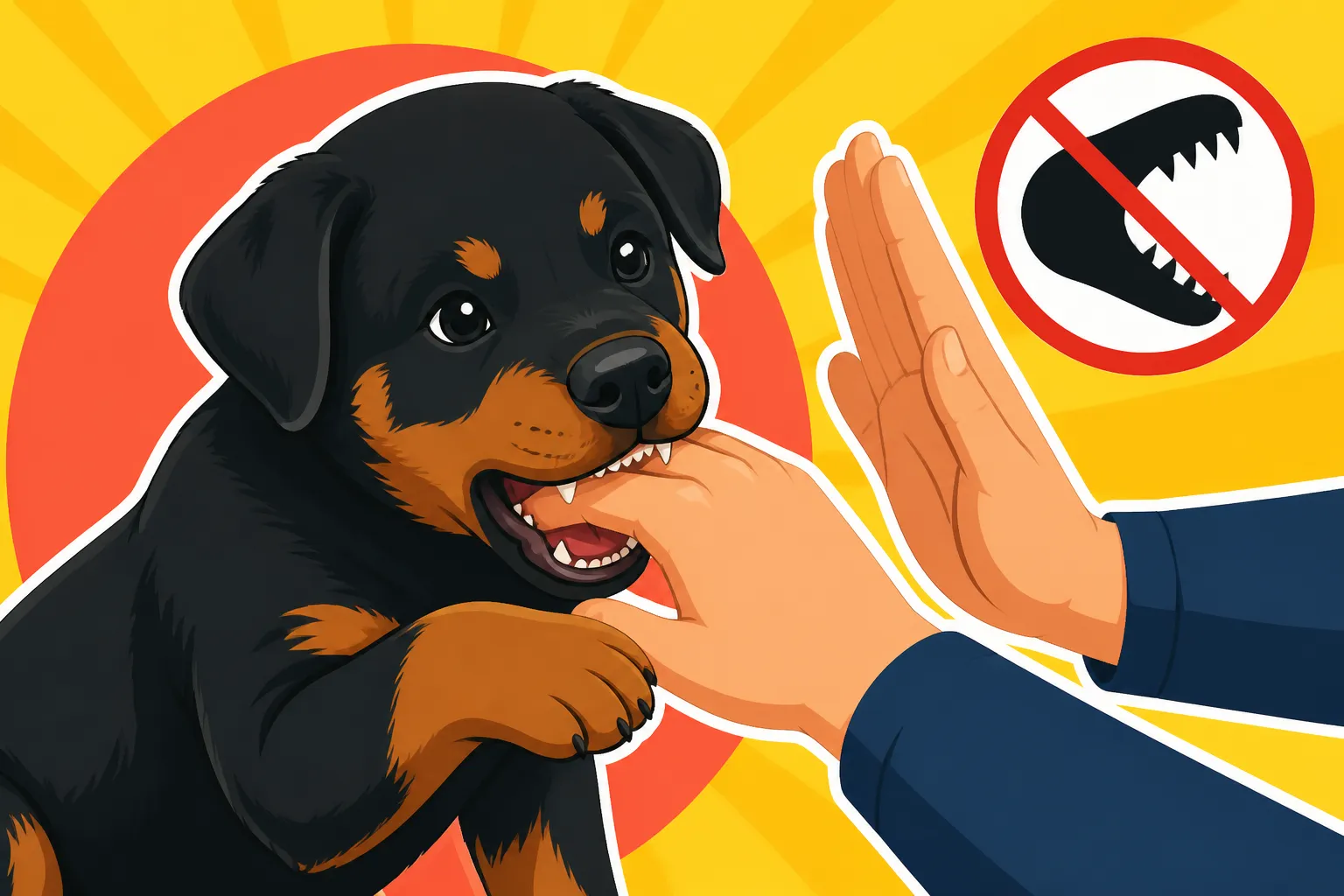
Teaching a Rottweiler Puppy That Teeth Hurt
Oh, the joy of a new Rottweiler puppy! Those adorable little bundles of fur with their big paws and even bigger hearts. But then, those tiny, needle-sharp teeth come out, and suddenly your hands look like you've been wrestling a porcupine. It’s a common frustration for so many new Rottweiler owners: how do you teach that energetic, mouthy pup that human skin isn't a chew toy? This guide is here to walk you through exactly how to establish clear boundaries, redirect that natural puppy biting, and help your Rottweiler develop a soft, gentle mouth for life.
Understanding Why Rottweiler Puppies Bite So Much
Let's get one thing straight: your Rottweiler puppy isn't trying to be malicious when they nip and mouth. They're not being aggressive; they're just being a puppy, and a Rottweiler puppy at that! This breed, like many others, goes through distinct developmental stages where mouthing is a completely normal, instinctual behavior. Understanding why they do it is the first step in addressing it effectively.
The Natural Instinct to Mouth and Explore
From the moment they're born, puppies explore the world with their mouths. It's how they learn about textures, boundaries, and how hard they can bite their littermates without getting a yelp in return. Think of it like a human baby using their hands to touch everything; a puppy uses its mouth. For a Rottweiler, a breed with a naturally strong jaw and an instinct to use its mouth in various tasks, this oral exploration is even more pronounced. They're constantly testing their environment, and unfortunately for your skin, your hands and feet are part of that environment.
When a puppy plays with its littermates, a significant part of that play involves mouthing, wrestling, and nipping. If one puppy bites too hard, the other will yelp, and the biting puppy learns to lighten up. This is a crucial lesson in Teaching Bite Inhibition to a Rottweiler Puppy. When they come to live with us, we become their new "littermates," and they continue this pattern of play. It’s not aggression, but rather a playful invitation that, without proper guidance, can quickly become painful for us. They simply don't understand yet that our skin is much more fragile than their siblings' fur.
This instinct to mouth is particularly strong in a breed like the Rottweiler, which historically was involved in herding and guarding livestock. These roles often required a dog to use its mouth for gripping or guiding animals, albeit in a controlled manner. While modern Rottweilers are far removed from those direct tasks, some of that underlying drive can still manifest as a strong desire to mouth and hold objects, including your hands. It's an important part of their behavioral repertoire that needs to be properly channeled.
Teething Pains and Relief Seeking
Just like human babies, Rottweiler puppies go through a teething phase, and it's not a comfortable experience for them. Their sharp puppy teeth start to emerge around 3-6 weeks, and then those teeth are gradually replaced by their much larger, stronger adult teeth between 3 and 7 months of age. During this period, their gums can be sore, itchy, and just plain uncomfortable.
To alleviate this discomfort, puppies instinctively seek out things to chew on. Chewing provides pressure and stimulation to their gums, which helps to ease the pain and encourage the adult teeth to come in. If they don't have appropriate outlets, guess what becomes their go-to? Anything they can get their mouths on, and that includes your furniture, clothes, and, of course, your fingers and toes. Providing plenty of Rottweiler Chew Toys That Survive the Jaw is absolutely critical during this time.
This phase can feel relentless, and it's easy to get discouraged when your sweet puppy suddenly transforms into a biting machine. However, remember that they are genuinely trying to make themselves feel better. Their powerful jaws, even as puppies, mean they can apply significant pressure, so it’s not just annoying – it can be genuinely painful for you. Understanding this helps you approach the situation with patience, focusing on redirection and relief rather than punishment.
Play Biting as a Form of Communication
Beyond instinct and teething, play biting is also a primary way for puppies to interact and communicate. It's how they invite play, express excitement, and even test boundaries within their social structure. For a Rottweiler puppy, who is naturally boisterous and physically oriented in its play, mouthing is a big part of the fun.
Think about a game of tug-of-war. Your puppy might grab your hand in their excitement, not meaning to hurt you, but simply because it's part of how they engage. If they learn that biting hard immediately stops the game or results in a negative consequence, they start to associate that pressure with a cessation of fun. This is a key principle in teaching them Mouthy Rottweiler Puppies and Human Hands and helping them understand what's acceptable.
It’s also important to recognize that sometimes, puppies nip when they are over-tired, over-stimulated, or frustrated. A puppy that hasn't had enough sleep might be cranky and more prone to nipping. Similarly, a puppy that's been playing too intensely and is now over-aroused might use its mouth inappropriately. Learning to read your puppy's body language and understanding these underlying reasons can help you intervene before the serious mouthing begins, perhaps by initiating a calming activity or even a structured naptime.
Early Intervention: Starting Bite Inhibition Training
The most critical window for teaching bite inhibition is during puppyhood, ideally before your Rottweiler is four or five months old. The younger they are, the more receptive they are to these lessons. Waiting until your Rottweiler is older and stronger makes the task exponentially harder. Remember the mantra: Why Rottweiler Training Cannot Wait Until Six Months.
The "Yelp" Method and Its Effectiveness
One of the most widely recommended techniques for teaching bite inhibition is the "yelp" method, which mimics how littermates teach each other. When your Rottweiler puppy bites your skin too hard, let out a high-pitched, loud "YELP!" or "OW!" immediately. Make it sudden and sharp, just like a puppy would.
The instant you yelp, simultaneously withdraw your hand (or whatever body part they’ve latched onto) and immediately stop all interaction. Turn away, stand up, or even leave the room for 10-20 seconds. The key is that the fun stops instantly when their teeth make painful contact. When you return, if they mouth gently, you can continue to play. If they bite hard again, repeat the yelp and time-out. They need to understand that painful biting makes the fun disappear. This teaches them to moderate the pressure of their bite, rather than to stop biting altogether. The goal isn't to prevent all mouthing, but to teach them to have a "soft mouth" so that if they ever do accidentally mouth a person, it doesn't cause harm.
It's crucial to be consistent with this method. Every single person in the household, including children, needs to respond the same way every time. If one person allows hard biting, it sends mixed signals to your clever Rottweiler, making the learning process much longer and more confusing. This consistency reinforces the message that human skin is sensitive and not for hard biting.
The Time-Out Technique for Over-Excitement
Sometimes, a puppy gets so excited during play that they just can't control their biting. The yelp method might not be enough if they're completely overstimulated. This is where the time-out technique comes in. If your Rottweiler puppy is nipping frantically, growling, or lunging in a way that suggests they're over-aroused, a brief time-out is in order.
Instead of just yelping, say a firm "No bite!" and immediately remove yourself from the situation. Walk into another room, close a baby gate, or put your puppy in a designated "time-out" spot like their crate or a puppy-proofed pen for a minute or two. The time-out should not be a punishment in the punitive sense, but rather a consequence of their uncontrollable behavior – the removal of the rewarding play interaction. The moment they calm down (usually evidenced by them sitting, lying down, or simply disengaging), you can let them out and resume calm interaction or play.
This technique teaches them that when they lose control, the fun stops, and they get isolated. It's a powerful lesson in impulse control, which is incredibly important for a large, powerful breed like a Rottweiler. For many pups, a time-out in their Crate Training a Rottweiler That Cries at Night spot can be a great way for them to decompress and reset. Avoid using the crate as a general punishment tool, but as a place to calm down from overstimulation, it can be effective.
Consistency is Key for Rottweiler Puppies
I cannot stress this enough: consistency is the absolute cornerstone of successful bite inhibition training, especially with a smart and strong-willed breed like a Rottweiler. Every single family member, every guest, every interaction needs to follow the same rules. If Aunt Martha lets the puppy chew on her fingers because "he's just a baby," you're undermining weeks of progress.
Develop a family plan and ensure everyone understands it. This includes using the same verbal cues (e.g., "Ow!" or "No bite!"), the same withdrawal of attention, and the same redirection to appropriate chew toys. Rottweilers thrive on clear boundaries and predictable consequences. If the rules keep changing, they will become confused and default to what works for them, which is often the most exciting or instinctual behavior.
Moreover, consistency isn't just about how you react, but when you react. Don't wait until the bite is excruciating before responding. React to any bite that causes even mild discomfort. This helps your puppy learn the precise threshold for what's acceptable. The sooner they learn to gauge the pressure of their bite, the sooner you'll have a pup with a truly soft mouth. This consistent, early training sets the foundation for a well-mannered adult Rottweiler.
Redirecting Nipping Towards Appropriate Chews
Simply telling your Rottweiler puppy "no" isn't enough; you need to give them an acceptable alternative. Redirecting their natural chewing and mouthing instincts onto appropriate objects is crucial for their development and your sanity.
Providing Durable and Satisfying Chew Toys
Rottweilers have powerful jaws, even as puppies. This means you need to invest in a variety of high-quality, durable chew toys that can withstand their chewing power. Soft plush toys might be cute, but they'll be shredded in minutes, and your pup could ingest stuffing, leading to other problems. Look for toys made from hard rubber, nylon, or other tough, non-toxic materials. Brands like KONG offer a range of virtually indestructible options that can also be stuffed with treats to make them even more appealing, keeping your pup engaged for longer. Amazon has a wide selection of these.
Offer a variety of textures and shapes. Some puppies prefer smooth, hard surfaces, while others like ribbed or knobby textures that massage their gums. Rotate these toys to keep them novel and exciting. If you notice your puppy gravitating towards a specific type of toy, get more of those! The goal is to make the appropriate chew toys far more interesting and rewarding than your hands or furniture. When your puppy approaches your hand to mouth it, immediately offer a suitable chew toy. When they take it, praise them calmly and positively. This reinforces the idea that this is what you want them to chew.
It's also important to consider toys that encourage mental stimulation alongside physical chewing. Puzzle toys or slow feeders that dispense kibble can be fantastic for engaging your Rottweiler puppy's mind and fulfilling their desire to work for their food. This type of enrichment can reduce boredom and the likelihood of destructive chewing born out of pent-up energy or frustration. Remember, a tired Rottweiler is usually a well-behaved Rottweiler.
Engaging in Structured Play Without Skin Contact
Playtime is vital for a Rottweiler puppy's physical and mental development, but it needs to be structured in a way that doesn't encourage mouthing your skin. Avoid games that involve wrestling with your hands or letting your puppy bite your clothing. Instead, use toys as a barrier between their teeth and your body. Long tug ropes, fetch toys, and flirt poles (a pole with a lure on the end) are excellent choices.
When playing tug, always initiate the game with a toy, not your hands. Teach your puppy a "drop it" cue early on, so you can end the game calmly when you choose, or if their excitement starts to escalate. For retrieve games, ensure they are bringing the toy back and releasing it without mouthing your hands excessively. Teaching a Rottweiler to Take Treats Gently can also extend to how they interact with toys.
Think about games that build impulse control. Rottweiler Impulse Control Games like "leave it" or "wait" can be integrated into play sessions. For example, make your puppy wait for a moment before you toss the ball, or ask them to "leave" a toy on the ground before giving them permission to get it. These little moments of self-control add up and teach your Rottweiler to manage their excitement and respond to your cues, rather than impulsively grabbing.
Managing Over-Arousal During Playtime
Rottweiler puppies are enthusiastic, and their play can quickly escalate into over-arousal, which often leads to more intense and less inhibited mouthing. It’s your job to recognize the signs that your puppy is getting too worked up and to intervene before they lose control. Signs of over-arousal include frenetic energy, rapid panting, rigid body posture, or an inability to respond to simple cues.
When you see these signs, calmly end the play session. Don't engage in more stimulating activities. Instead, switch to a calmer activity, like a short training session focusing on known commands (sit, stay, down), or offer a stuffed KONG in their crate. Sometimes, an over-stimulated puppy just needs a forced nap in their crate to reset. Remember, especially for a large breed puppy like a Rottweiler, too much strenuous or uncontrolled play can be detrimental to their developing joints, as discussed in A Growing Rottweiler's Joints and Overexercise.
Teaching your puppy to "settle" on cue is an invaluable skill. Practice having them lie down calmly beside you, rewarding them for quiet, relaxed behavior. This helps them learn to down-regulate their own excitement. Websites like BAXTER & Bella offer comprehensive online puppy training programs that often include modules specifically on managing puppy arousal and impulse control, which can be a great resource for hands-on guidance.
Graduating to a Soft Mouth: The Goal
The ultimate goal of bite inhibition training isn't to stop your Rottweiler puppy from ever putting their mouth on you (that's unrealistic and undesirable for a dog), but to teach them to use their mouth gently. A Rottweiler with a "soft mouth" is a safer, more enjoyable companion.
When to Expect a Decrease in Mouthing
While the most intense teething and exploratory mouthing typically subsides by 6-8 months of age, it's not a switch that flips overnight. You should expect a gradual decrease in both the frequency and intensity of mouthing as your Rottweiler matures and consistently learns the rules. During the peak teething phase (around 3-5 months), you might feel like you're taking one step forward and two steps back. Be patient and persistent.
By the time your Rottweiler reaches 8-10 months, the hard, painful nipping should be largely a thing of the past, provided you've been consistent. They may still mouth gently during play or when seeking attention, but it should feel like a soft pressure, not a painful bite. If you find that your Rottweiler is still nipping hard or aggressively after 6 months, it's a sign that you need to re-evaluate your training methods or seek professional help. Rottweiler Puppy Play Biting With Children requires particular vigilance, as children's skin is more delicate, and they may inadvertently reinforce bad habits.
It's important to remember that every puppy is an individual. Some Rottweilers will learn faster than others. Don't compare your puppy's progress too closely to others, but instead focus on consistent daily practice. The reward for your patience will be a large, powerful dog that knows how to interact gently with humans.
Continued Reinforcement and Advanced Training
Even after your Rottweiler puppy has developed a softer mouth, the lessons of bite inhibition need continued reinforcement. As they grow into adolescents (around 8-18 months), they might test boundaries again. This is a normal part of adolescence for any breed, including Rottweilers. Stay consistent with your rules: a yelp and time-out for any painful bite, and redirection to toys for appropriate chewing.
Consider enrolling in advanced obedience classes or even working towards titles like the Canine Good Citizen (CGC). These programs further reinforce good manners, impulse control, and appropriate interactions with people and other dogs. The structure and challenges of these classes can be incredibly beneficial for a growing Rottweiler, solidifying their training and building their confidence.
Beyond formal classes, continue to offer appropriate chew outlets, even for adult Rottweilers. Chewing is a natural stress reliever and a source of enrichment. Regularly engage in structured play using toys, praising gentle interactions. The goal is to build a lifetime habit of gentle mouthing and appropriate chewing, ensuring your magnificent Rottweiler is a pleasure to be around in any situation.
What to Do When Mouthing Persists or Escalates
If, despite your consistent efforts, your Rottweiler's mouthing remains persistently hard, painful, or escalates into what feels like aggression, it's time to seek professional help. This isn't a sign of failure on your part, but an acknowledgment that some behaviors require expert guidance. A certified professional dog trainer or a veterinary behaviorist can assess the situation, identify underlying causes, and develop a tailored training plan.
Sometimes, what appears to be problematic mouthing can be a symptom of frustration, anxiety, or even pain. A professional can help rule out medical issues or behavioral anxieties that might be contributing to the problem. They can also observe your interactions and pinpoint subtle cues you might be missing or suggest alternative techniques that might be more effective for your specific Rottweiler. For instance, if your puppy is Redirecting a Rottweiler That Grabs Clothing, a professional can help you implement strategies to curb this specific behavior.
Never resort to physical punishment for mouthing. Hitting, tapping on the nose, or alpha rolls can severely damage your relationship with your Rottweiler, erode their trust, and potentially lead to fear-based aggression. A Rottweiler, once pushed to fear, can become genuinely dangerous. Always use positive reinforcement and management techniques. Investing in professional guidance early can save a lot of heartache (and stitches!) down the road and ensure your Rottweiler grows into a confident, well-adjusted companion.
| Method | Description | When to Use | Key Benefits |
|---|---|---|---|
| The "Yelp" Method | High-pitched "OW!" or "YELP!" followed by immediate withdrawal of attention | For any painful bite on human skin | Teaches bite pressure inhibition, mimics canine communication |
| Time-Out Technique | Immediately remove self or puppy to a separate, calm area for 1-2 minutes | When puppy is over-excited and can't control biting with yelp alone | Teaches impulse control, breaks cycle of over-arousal, consequences |
| Redirection | Offer an appropriate chew toy the instant puppy mouths inappropriately | Constantly, during any mouthing attempt | Channels natural chewing instinct, provides acceptable alternative |
| Structured Play | Play with toys (tug, fetch, flirt pole) instead of hands/body | During all active play sessions | Avoids reinforcing skin contact, encourages toy interaction |
| "Leave It"/"Drop It" | Training commands to teach puppy to release or ignore items on cue | Integrated into daily play and training sessions | Builds impulse control, gives owner control over objects |
| Management | Using crates, pens, baby gates to prevent access to undesirable items | When supervision is not 100% possible | Prevents unwanted behaviors, keeps puppy safe |
Disclaimer
This article is for general informational purposes only and does not constitute professional advice. Laws, prices and regulations vary by location and change over time. Consult a qualified professional for guidance on your specific situation.