Rottweiler Prey Drive Around Cats
The dream of a harmonious household where your majestic Rottweiler and your agile cat coexist peacefully can feel like a distant fantasy, especially when you witness that intense stare or sudden chase. Many Rottweiler owners grapple with the very real challenge of their dog's natural prey drive, and when a quick-moving feline enters the picture, it's not just a nuisance – it's a serious safety concern. This guide is here to walk you through understanding, managing, and, with patience, successfully integrating your Rottweiler into a home with cats, turning those fears into calm, controlled interactions.
Understanding Rottweiler Prey Drive
Rottweilers, by their very nature, are powerful dogs with a rich history of working alongside humans. But sometimes, those instincts manifest in ways that are challenging in a modern home, particularly when it comes to smaller, faster-moving creatures like cats. It’s not about malice; it’s about instinct, and understanding that instinct is the first step toward managing it effectively.
The Historical Context of Prey Drive
To truly grasp why your Rottweiler might be so fixated on your cat, we need to rewind a bit. Rottweilers descended from Roman drover dogs, powerful canines used to herd and guard cattle across vast distances. While their primary role was herding, which involves controlling movement, and guarding, which involves protecting, a strong sense of drive was essential. This isn't the same as hunting for food, but it shares roots in the instinct to pursue and control movement. Generations of selective breeding for certain traits, including the ability to respond to movement and protect resources, have ingrained these instincts deeply. While modern Rottweilers aren't typically used for droving cattle anymore, that ancestral programming doesn't just vanish. They might not be chasing a stray cow, but a darting squirrel or, yes, a scurrying cat, can easily trigger that ancient instinct.
What this means for you, the owner, is that you're not dealing with a misbehaving dog as much as you are with a dog whose inherent wiring is being activated. It's not personal, it's biological. Expecting a Rottweiler to simply "ignore" a cat without any intervention is like expecting a bird not to fly; it goes against their fundamental programming.
What Prey Drive Looks Like in a Rottweiler
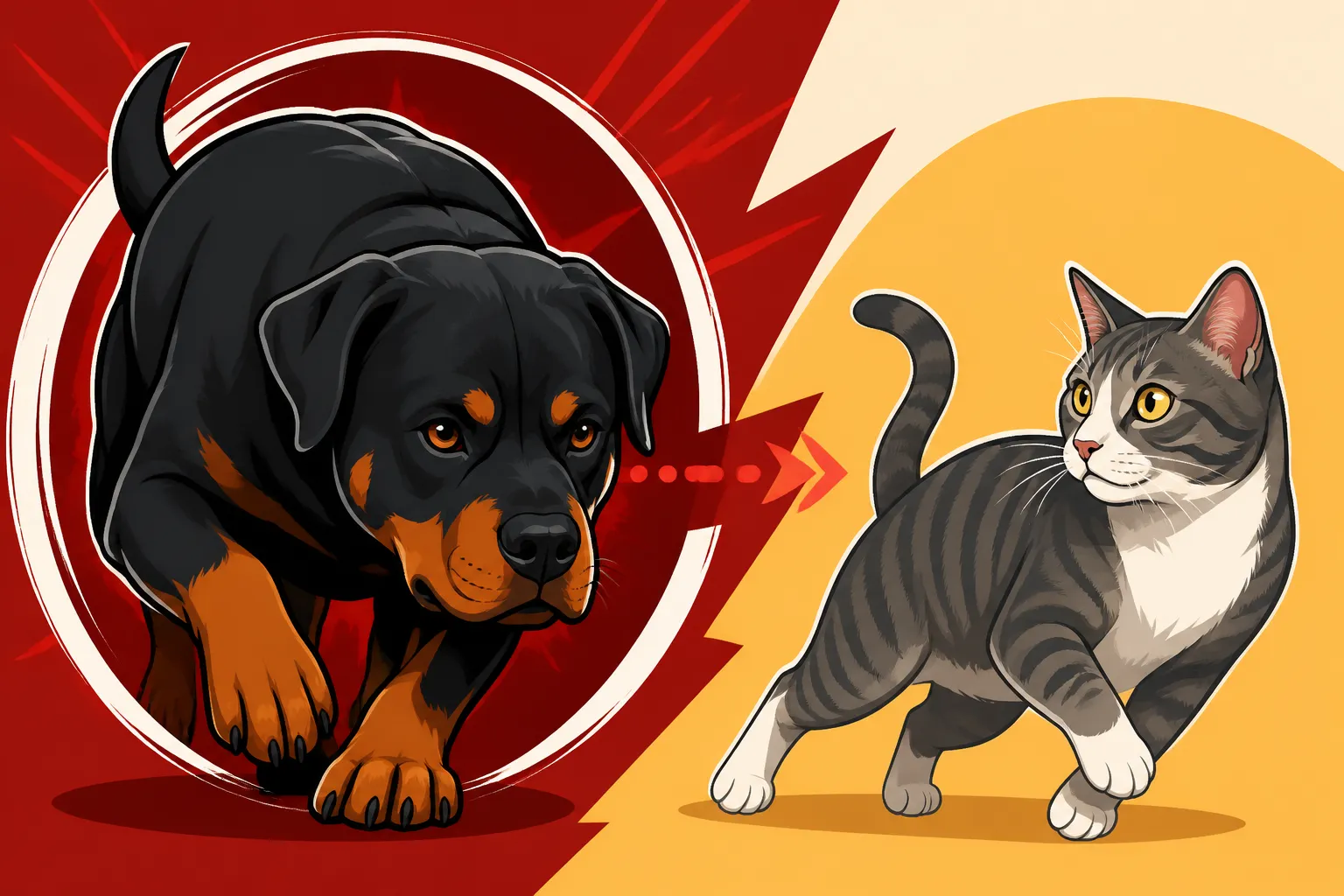
So, what does prey drive actually look like when a Rottweiler fixates on a cat? It’s often much more intense than just curiosity. You might see a sudden stiffening of the body, eyes narrowed and intensely focused, often accompanied by a low, silent stalk. The tail might be held rigid, not wagging in a friendly way. Then comes the chase – a sudden burst of speed, sometimes with a distinctive deep-chested woof or bark, designed to startle and pursue. This isn't just playful frolicking; it's a deeply ingrained behavioral sequence that can escalate quickly. Even if your Rottweiler has no intention of harming the cat, the sheer size and power difference mean that a "playful" pounce could result in serious injury for the cat.
It’s also important to note that this isn't always a full-blown attack. Sometimes, it manifests as obsessive staring through a window at a neighborhood cat, or an inability to relax if a cat is in the same room, even if the cat is stationary. This constant vigilance is mentally exhausting for both the dog and, let's be honest, for you. Recognizing these subtle signs, the prelude to the chase, is critical for intervention.
Distinguishing Prey Drive from Aggression
This is a crucial distinction that often gets muddled. While the outcome of uncontrolled prey drive can tragically lead to aggression or injury, the underlying motivation is different. Prey drive is about pursuing, catching, and sometimes, dispatching. Aggression, on the other hand, is usually motivated by fear, territoriality, pain, or resource guarding. A dog acting out of prey drive might be silent and focused, whereas an aggressive dog might display growling, lip-lifting, snapping, or a more overtly confrontational body posture. A Rottweiler might pursue a cat not because it fears the cat or wants to protect its food bowl from it, but simply because the cat's movement triggers a deep-seated instinct to chase.
Understanding this difference isn't just academic; it informs your training approach. If it's pure prey drive, you'll focus on impulse control, redirection, and creating safe separation. If it's aggression (perhaps a Rottweiler guarding a toy from a cat, which can happen), your strategy might involve different management and counter-conditioning techniques. It's possible to have both elements at play, which makes professional guidance even more valuable. For a deeper look into typical Rottweiler behaviors, you might find our article on Rottweiler Aloofness and Why It Reads as Cold insightful, as it touches on how they perceive and interact with the world around them.
Assessing Your Rottweiler's Instincts
Before you can even think about introducing your Rottweiler to a cat, or if you're already living with both and struggling, you need to realistically assess your dog's current level of prey drive. This isn't about blaming your dog, but understanding its baseline behavior so you can implement the right strategies.
Observing Early Warning Signs
Many Rottweiler owners see the signs of high prey drive long before a cat ever enters the picture. Have you noticed how your dog reacts to squirrels, rabbits, or even birds in the yard? Do they instantly lock on, stiffen, and try to give chase? Is it impossible to get their attention once they've fixated on something moving? These are all indicators that their prey drive is strong. If your Rottweiler shows a strong desire to chase cars, bicycles, or even children running past your fence, that's another big clue. For puppies, it might manifest as relentless chasing of moving toys, or a very intense, hard bite during play that goes beyond normal Teaching Bite Inhibition to a Rottweiler Puppy.
Pay close attention to how they respond to sudden movements. A high-prey-drive dog might startle, then immediately orient towards and track the movement with intense focus. Even if they don't immediately "kill" the stimulus, that level of arousal needs to be taken seriously. Ignoring these early warning signs can lead to dangerous situations down the line.
Testing Your Rottweiler's Reactions
It's never a good idea to "test" your Rottweiler's reaction to a cat by just throwing them together. That's a recipe for disaster. Instead, you can gauge their instincts through controlled, safe means. Start with high-value toys that mimic prey. Does your Rottweiler shred soft toys instantly, or show an intense "shake and kill" behavior with squeaky ones? Does a remote-control car or a laser pointer (used carefully, not to frustrate) trigger an immediate, unshakeable pursuit? Observe their body language during these activities. Is there that intense focus, stiff body, and low head carriage characteristic of a predator?
Another safe way to gauge their reaction is to expose them to scent without direct interaction. Introduce a blanket or toy that a cat has recently slept on into your home. How does your Rottweiler react to the scent? Do they become agitated, curious, or do they seem indifferent? These are all pieces of the puzzle that help you understand the depth of their instinctual response. Remember, the goal here is observation and understanding, not confrontation.
Factors That Influence Prey Drive
Several factors can influence the intensity of a Rottweiler's prey drive. Genetics play a huge role; some lines simply have stronger working drives, which can include prey drive. The dog's individual personality and past experiences also matter. A Rottweiler who had negative experiences with cats as a puppy, or was never properly socialized to smaller animals, might have a heightened or fearful prey response. Age is another factor; younger, adolescent Rottweilers often have higher energy and more pronounced prey drive, while some older dogs may mellow. However, never assume an older Rottweiler is "safe" without proper management.
Furthermore, a Rottweiler's physical and mental stimulation levels can greatly impact how their prey drive manifests. A bored, under-exercised Rottweiler is much more likely to seek an outlet for its energy, and a running cat can be an irresistible target. Ensuring your Rottweiler gets plenty of appropriate physical exercise and mental enrichment, like puzzle toys found on Amazon, can help channel some of that natural drive into acceptable activities, rather than focusing it on your feline friends. Proper Rottweiler Socialization Before Sixteen Weeks also plays a massive role in shaping how they perceive other creatures.
Introducing a Rottweiler to a Cat Safely
This is where the rubber meets the road. If you're bringing a new cat into a Rottweiler's home, or vice versa, safety and meticulous planning are paramount. Rushing this process can have devastating consequences. Slow and steady wins the race, and for a Rottweiler, "slow" means weeks, even months, of careful management.
Controlled, Supervised Encounters
The golden rule for introducing a Rottweiler to a cat is absolute control and supervision, always. This means no free-roaming until you are 100% confident in their interactions, and even then, supervision should be ongoing. Start with scent swapping, as mentioned before. Then, move to visual introductions through a secure barrier, like a baby gate or a sturdy crate. Make sure the barrier is Rottweiler-proof – they are strong, and a flimsy gate won't cut it. Heavy-duty safety gates, readily available on Amazon, are essential here. Keep initial visual sessions short, perhaps just a few minutes, with the Rottweiler on a leash. The goal is for both animals to calmly acknowledge each other's presence without intense staring or arousal.
During these initial encounters, use high-value treats to reward calm behavior from your Rottweiler. Every time they look at the cat and then look away, or lie down calmly, reward them. The cat also needs positive experiences – treats, gentle praise. If either animal shows signs of stress (hissing, growling, lunging, stiff body language), end the session immediately and try again later. This is a marathon, not a sprint. Consider if Rottweiler Play Style With Smaller Dogs is appropriate at all; for cats, it's generally not.
Creating Safe Zones and Retreats
While you're working on controlled introductions, it's absolutely non-negotiable to create distinct safe zones where your cat can completely escape from your Rottweiler. This means vertical spaces (cat trees, shelves), rooms with cat doors only accessible by the cat, or even rooms where the Rottweiler is never allowed. Your cat must have the ability to retreat and feel secure. This isn't just for their physical safety; it's for their mental well-being. A constantly stressed cat will likely never adapt, and stress can lead to behavioral issues for both pets.
Ensure the cat's food, water, and litter box are in these Rottweiler-free zones. This prevents resource guarding issues and gives the cat peace of mind. For the Rottweiler, having a comfortable crate or a designated "place" where they can relax and be rewarded for calm behavior is also vital. This helps build a routine and reinforces that good things happen when they are settled. You might find our discussion on The Crate Size a Hundred Twenty Pound Rottweiler Needs useful for ensuring your dog's safe space is appropriate.
Positive Reinforcement and Desensitization
The core of successful integration lies in positive reinforcement and desensitization. You want your Rottweiler to associate the presence of the cat with positive experiences, not just neutral ones. This means treats, praise, and gentle interaction from you every time the cat is in view and your Rottweiler is calm. Desensitization means gradually exposing your Rottweiler to the cat at increasing levels of proximity and duration, always below their reaction threshold. Start with the cat far away, behind a gate, and gradually decrease the distance as your Rottweiler remains calm.
For example, if your Rottweiler normally goes wild when the cat runs, start by having the cat walk calmly in the distance, rewarding your Rottweiler for not reacting. Eventually, you might progress to the cat being allowed to walk across the room while the Rottweiler is on a leash and mat. For complex training tasks like this, online resources can be incredibly helpful. Platforms like BAXTER & Bella offer structured programs and support for teaching impulse control and polite greetings, which are crucial for this process. Always remember to praise and reward the absence of the desired behavior (chasing) and the presence of calm, appropriate behavior.
Managing Prey Drive in a Multi-Pet Home
Even with the best training, managing a Rottweiler's prey drive around cats is an ongoing commitment. It's not a "fix it and forget it" situation. You're working with a powerful instinct, and consistent management is key to long-term success and safety.
Crate and Management Strategies
Crates and physical barriers are your best friends in a multi-pet household with a high-prey-drive Rottweiler. Whenever you cannot actively supervise your dog – even if you just step out of the room for a minute – your Rottweiler should be safely contained. This might mean crating them, putting them in a securely gated room, or ensuring the cat is in its own safe zone. It might sound restrictive, but it's about preventing dangerous incidents and building habits of safety. This is especially true for A Rottweiler Chasing the Family Cat when you are not there to intervene.
Using leashes and harnesses indoors is also a valid management strategy, particularly during initial integration phases or if your dog's impulse control is still developing. A properly fitted harness and a leash can give you immediate control if your Rottweiler suddenly fixates on the cat. Remember, the goal is to prevent the chase behavior from ever being practiced, because every time a dog successfully chases something, that behavior is reinforced.
Structured Routines and Exercise
A bored Rottweiler with pent-up energy is a recipe for disaster when there's a cat around. Rottweilers need significant physical and mental exercise to be well-adjusted companions. A structured daily routine that includes walks, playtime, and mental stimulation will go a long way in reducing the likelihood of their prey drive being directed at the cat. Think about engaging activities like long walks (after their growth plates have closed, of course – see Rottweiler Growth Plates Closing at Eighteen to Twenty-Four Months), fetch in a secure yard, or even scent work games that engage their minds.
Beyond physical activity, mental stimulation is critical. Rottweilers are intelligent dogs who thrive on having a "job." Training sessions that incorporate impulse control games, obedience work, and puzzle feeders can tire them out mentally. Look for durable, large-breed appropriate puzzle feeders on Amazon that can stand up to a Rottweiler's powerful jaws. A Rottweiler that has had its physical and mental needs met is generally a calmer, more amenable dog.
Enrichment to Redirect Instincts
Instead of trying to suppress prey drive entirely (which is impossible and unfair to the dog), focus on redirecting it into appropriate outlets. This is where enrichment comes in. Provide toys that allow your Rottweiler to satisfy their natural instincts in a safe, controlled way. Tug toys, durable chew toys, and flirt poles (used carefully and not near the cat) can all be great options. The flirt pole, in particular, mimics the erratic movement of prey, allowing your Rottweiler to chase and "catch" an object without any risk to your cat.
You can also use training to redirect their focus. When your Rottweiler shows signs of fixating on the cat, immediately interrupt with a known command like "sit," "stay," or a strong "leave it." Reward heavily when they comply. This teaches them that engaging with you, rather than pursuing the cat, leads to positive outcomes. Building strong Rottweiler Impulse Control Games into your daily routine can make a huge difference in these moments.
| Prey Drive Warning Signs | Management Strategies | Training Focus |
|---|---|---|
| Intense staring, stalking | Secure gates, crates, leashes indoors | "Leave It" command |
| Stiff body, raised hackles | Separate rooms, cat-only zones | "Watch Me" command |
| Sudden bursts of chase, pouncing | Constant supervision, no unsupervised access | Impulse control games |
| Fixation on small, fast movements | High-value redirection toys (flirt pole) | Reward calm behavior near cat |
| Obsessive tracking of cat | Structured routine, ample exercise & mental stimulation | Counter-conditioning (cat = good things) |
When to Seek Professional Help
Even with dedicated effort, some Rottweilers will exhibit a prey drive so strong that it requires more than just home management. Knowing when to call in the cavalry – a professional trainer or behaviorist – is crucial for both your pets' safety and your peace of mind.
Identifying Escalating Behaviors
While a mild chase instinct can sometimes be managed with diligent owners, certain escalating behaviors should signal an immediate need for professional intervention. If your Rottweiler is causing physical harm to the cat, even accidentally, or if their chasing is accompanied by growling, snapping, or resource guarding (e.g., trying to prevent the cat from going to its food or litter box), you're past the point of self-help. Any instance where the cat is genuinely terrified, showing signs of extreme stress, or sustaining injuries, is a clear indicator that professional help is needed.
Also, if you feel constantly anxious, stressed, or are struggling to maintain a safe environment despite your best efforts, it's time to reach out. Your mental health matters too, and living in a constant state of vigilance isn't sustainable. A professional can help you objectively assess the situation and determine the most effective path forward.
Working with a Certified Professional
When seeking help, look for a certified professional dog trainer or a veterinary behaviorist who has experience with large guardian breeds and prey drive issues. A certified professional will use humane, evidence-based methods focused on positive reinforcement and safety. They can observe your Rottweiler's specific behaviors, assess the dynamics in your home, and create a tailored plan that addresses your unique challenges. They can also help you refine your timing, consistency, and technique in a way that's hard to do on your own.
A professional might implement structured desensitization and counter-conditioning protocols, teach you advanced impulse control exercises, and help you set up your home for optimal success. They can also differentiate between pure prey drive and other underlying behavioral issues, such as anxiety or territorial aggression, which might require different approaches. Don't hesitate to seek out Finding a Rottweiler-Experienced Trainer Near You if you're struggling.
Long-Term Management and Realistic Expectations
It's vital to set realistic expectations. While it is entirely possible for a Rottweiler and a cat to coexist peacefully, it might not always look like the idyllic pictures you see online. Some Rottweilers may never be safe to leave unsupervised with a cat, even after extensive training. In these cases, diligent, lifelong management (crates, gates, separate spaces) will be necessary. The goal is to ensure the safety and well-being of both animals, even if that means they lead largely separate lives in the same home.
The journey of managing a Rottweiler's prey drive around cats is often long and requires immense patience, consistency, and a proactive approach. Celebrate small victories, like your Rottweiler calmly lying down while the cat walks by. Remember that you are responsible for both pets' safety and happiness. With the right strategies and, if needed, professional guidance, you can create a secure and, hopefully, harmonious environment for everyone in your household. Our article on Whether a Rottweiler Can Live With a Cat offers more perspective on the general compatibility of these two species.
Disclaimer
This article is for general informational purposes only and does not constitute professional advice. Laws, prices and regulations vary by location and change over time. Consult a qualified professional for guidance on your specific situation.