Fencing Requirements That Apply to a Rottweiler
Owning a Rottweiler is an incredibly rewarding experience, but let's be honest: their sheer size, intelligence, and protective instincts mean that a standard picket fence just isn't going to cut it. Many new and even experienced Rottweiler owners find themselves frustrated by their dog's uncanny ability to test boundaries, dig under fences, or even scale what seems like an impenetrable barrier. This guide is here to walk you through the real-world fencing requirements for a Rottweiler, helping you create a safe and secure environment for your powerful companion and peace of mind for yourself.
Understanding Your Rottweiler's Containment Needs
Before we even talk about specific fence types or materials, it's crucial to understand why Rottweilers need robust containment. It's not about them being "bad dogs"; it's about respecting their inherent breed traits and physical capabilities. You're dealing with a powerful, intelligent, and often very driven animal, and what might contain a smaller, less determined breed simply won't suffice for a Rottweiler.
The Instinct to Patrol and Protect
Rottweilers were originally bred in Germany as drover dogs, herding cattle and guarding their butcher owners' money as they traveled between markets. This history instilled a strong drive to patrol a territory and protect their family and property. When you put a Rottweiler in a yard, their instinct kicks in: they see it as their domain to oversee.
This means that if they see something interesting or potentially threatening outside that perceived boundary – a squirrel, a delivery driver, another dog walking by, or even just a leaf blowing across the street – their natural inclination is to investigate or deter. A flimsy fence or one that allows too much visibility can become a constant source of stimulation, encouraging them to test its limits. They aren't trying to escape you; they're trying to do the job they were bred for, even if that job is just chasing a rabbit off "their" lawn. This strong impulse means that even a well-trained Rottweiler might momentarily forget their manners if something truly triggers their protective or prey drive, making a secure physical barrier paramount.
Strength and Determination
Let's not mince words: Rottweilers are strong. A male Rottweiler can easily weigh over 100 pounds, with some reaching 130 or even 140 pounds. Females, while typically smaller, are still incredibly muscular and powerful. This physical prowess, combined with their intelligence and determination, makes them formidable opponents for any fence. Many owners have stories of their Rottweiler finding the single weak spot in a fence, patiently digging under it over several days, or even bending a chain-link fence to squeeze through.
It's not just about brute force; it's about their problem-solving ability. They will learn the vulnerabilities of your fence faster than you might expect. If there's a loose board, they'll lean on it. If the gate latch isn't secure, they'll nudge it open. If a section of fence isn't deeply buried, they'll start digging. This is why you can't rely on a fence that merely looks sturdy. It needs to be genuinely reinforced against a dog that sees containment as a puzzle to solve. This innate strength also highlights why proper leash training is vital from a young age, even if you have a great fence. A Rottweiler that pulls at 100 pounds can be a real challenge for anyone, emphasizing why early training is non-negotiable. If you're struggling with a strong puller, you might find valuable insights in our article on Rottweiler Leash Manners at a Hundred Pounds.
Essential Fencing Features for Rottweilers
When planning a fence for your Rottweiler, you need to think like a Rottweiler. Where are the weak spots? What would tempt them to try to get out? How can you make it as unappealing as possible for them to attempt an escape?
Height and Material Matters
The old adage "good fences make good neighbors" is particularly true when you own a Rottweiler, and "good fences" for a Rottweiler mean a minimum height and robust materials.
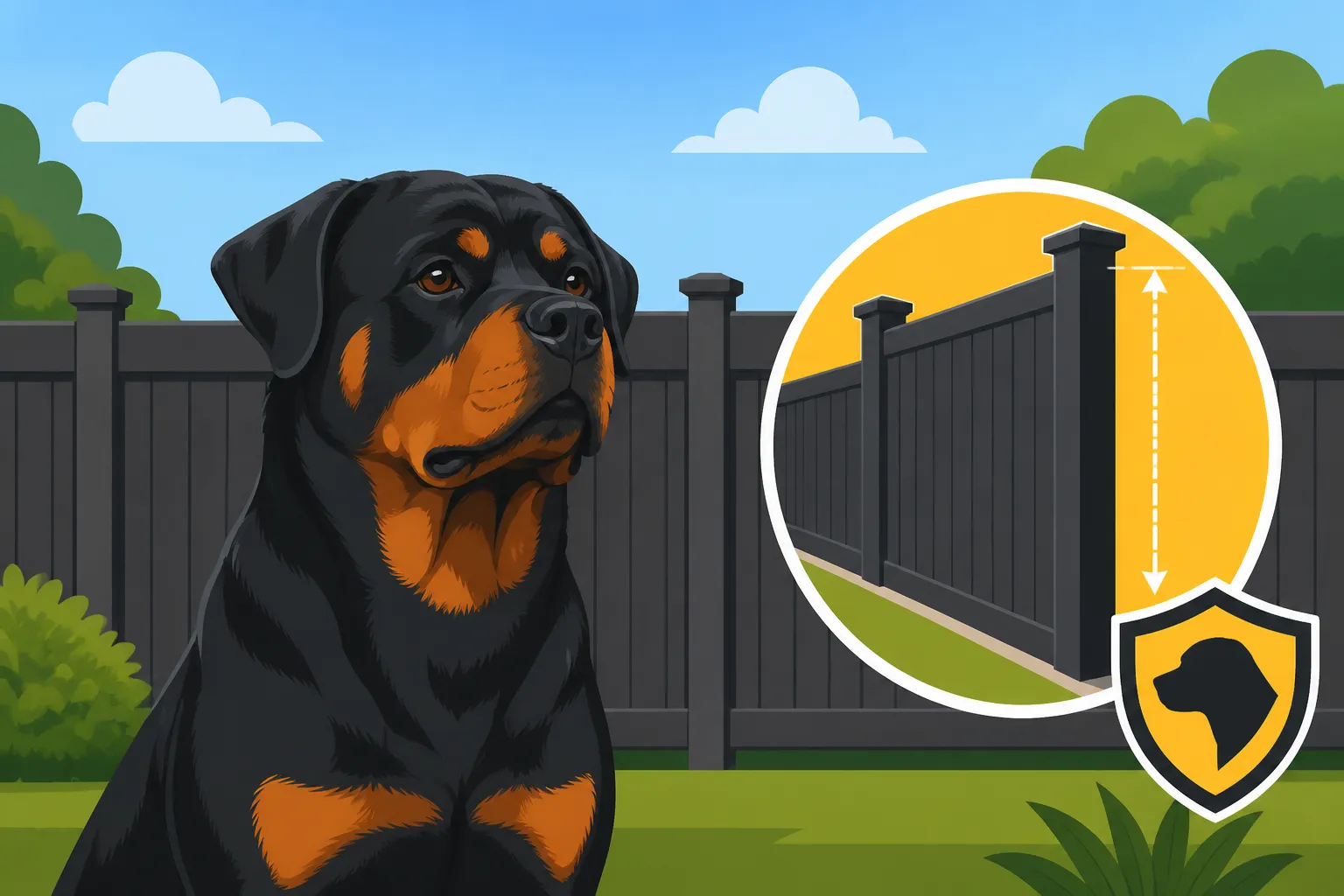
Firstly, height. For most Rottweilers, a standard 4-foot fence simply isn't enough. Many adult Rottweilers can easily clear a 4-foot fence if motivated. Even a 5-foot fence can be scaled or jumped by a determined or athletic individual. A minimum of 6 feet is highly recommended, and in some cases, 7 or even 8 feet might be necessary for serious jumpers or escape artists. It's about creating a psychological barrier as much as a physical one – the higher the fence, the less likely they are to even try to jump it.
Secondly, material. This is where many owners underestimate their Rottweiler.
- Chain Link: While seemingly robust, chain link can be a climber's paradise for a Rottweiler. Their strong paws can find purchase in the links, allowing them to scale it surprisingly quickly. A heavy-gauge chain link is better than light gauge, but it's still often not the ideal solution. It also offers no visual barrier, meaning your Rottweiler will constantly be stimulated by everything happening outside the yard, potentially leading to excessive barking. If your Rottweiler barks at everything that moves, our post on Rottweiler Barking and When It Means Something might offer some good insights.
- Wood: A solid wood privacy fence, typically 6 feet tall, is a much better option. The lack of visibility means fewer external triggers, and the smooth surface makes it harder to climb. However, wood fences require regular maintenance. Boards can warp, rot, or come loose over time, creating weak spots that a Rottweiler will quickly exploit. You'll need to check it frequently for signs of wear and tear.
- Vinyl: Similar to wood in terms of privacy and smooth surface, vinyl fences offer excellent durability and minimal maintenance. They tend to be more expensive upfront but can be a great long-term solution. Again, ensure the panels are securely anchored.
- Masonry/Brick/Stone: These are the gold standard for security, offering unparalleled strength and privacy. A solid brick wall is virtually impossible for a Rottweiler to breach. However, they are also the most expensive and labor-intensive to install.
No matter the material, ensure it's securely anchored into the ground. A fence that sways or has loose posts is an invitation for a Rottweiler to lean into it and test its integrity.
Preventing Digging and Jumping
A Rottweiler's escape attempts often involve either going under, over, or through. We've covered "through" with material, so let's tackle "under" and "over."
Preventing Digging: Rottweilers, like many working breeds, can be surprisingly adept diggers. If they find a soft spot or a gap at the base of the fence, they'll go to work. To prevent this:
- Bury the fence line: Extend your fence material at least 12-18 inches below ground. This is a significant undertaking but highly effective.
- L-footers: These involve attaching a section of fencing (often welded wire or hardware cloth) horizontally along the ground, perpendicular to the main fence, extending outwards by about 12-24 inches. This creates an "L" shape. When your dog tries to dig near the fence, they hit this buried barrier.
- Concrete Aprons: For ultimate digging prevention, a concrete footer poured along the entire fence line, extending both below ground and a few inches above, is practically impenetrable.
- Large rocks or landscaping timbers: Less secure than the above, but placing heavy rocks or timbers along the inside base of the fence can deter casual digging. However, a determined Rottweiler might just move them.
Preventing Jumping: For those athletic Rottweilers who see a 6-foot fence as a challenge rather than a barrier, you might need additional measures.
- Coyote Rollers: These are PVC pipes or similar rolling mechanisms installed along the top of the fence. If a dog tries to jump up and grab the top, the roller spins, preventing them from getting a grip and pulling themselves over. These are highly effective for jumpers.
- Inward-Sloping Extensions: Another option is to extend the fence inwards at a 45-degree angle at the top. This makes it impossible for the dog to clear the top and provides an additional visual deterrent.
- Strategic Planting: Planting dense, thorny bushes along the inside perimeter of the fence can also deter jumping attempts, though this requires careful selection to ensure plants aren't toxic.
Remember, the goal is to make it genuinely easier for your Rottweiler to stay inside the fence than to try to get out. If your Rottweiler has already successfully made an escape, you'll want to read up on strategies discussed in A Rottweiler That Escapes a Fenced Yard for more specific advice.
Legal and Community Considerations
Beyond the practical aspects of building a secure fence, you absolutely must consider the legal and community implications of owning a Rottweiler and the fencing requirements that may come with it. Ignoring these can lead to fines, legal battles, or even the forced removal of your beloved dog.
Local Ordinances and Breed-Specific Laws
This is a critical, often overlooked step for any Rottweiler owner. Fencing requirements aren't just about your personal preference; they are frequently dictated by local laws. What's acceptable in one town might be completely inadequate, or even illegal, in another.
Breed-Specific Legislation (BSL): Many cities, counties, and even entire states have breed-specific legislation that targets certain breeds, and Rottweilers are frequently on that list. BSL can range from outright bans on owning a Rottweiler to mandating specific containment requirements that go far beyond what's expected for other breeds. This might include:
- Minimum fence heights (often 6 feet or more).
- Specific materials (e.g., solid privacy fences rather than chain link).
- Requirements for concrete footers to prevent digging.
- Double-fencing requirements, meaning you need an inner and outer fence.
- Secure locking mechanisms on all gates.
- Signage warning of a "dangerous dog" on the property.
It is absolutely imperative that you contact your local animal control office, county clerk, or city planning department before you even bring a Rottweiler home, or certainly before you begin construction on a fence. Ask specific questions about breed-specific ordinances, zoning laws for dog containment, and any permits required for fence installation. Ignorance of these laws is rarely considered an excuse. You'll find more detailed information about how these restrictions can vary in our guide, Rottweiler Restrictions by City and County.
Homeowners Insurance and Liability
Your homeowners insurance policy is another vital area where your Rottweiler and your fencing intersect. Many insurance carriers have specific clauses regarding certain dog breeds, including Rottweilers, due to perceived liability risks.
The Impact on Your Policy:
- Increased Premiums: Simply owning a Rottweiler can cause your homeowners insurance premiums to increase significantly.
- Breed Restrictions/Exclusions: Some insurance companies flat out refuse to cover homes with Rottweilers. Others might cover your home but specifically exclude any liability claims arising from your dog, leaving you personally responsible for potentially massive legal and medical bills if your dog ever causes harm.
- Fencing Requirements for Coverage: To even get coverage, or to avoid breed-specific exclusions, your insurer might mandate specific fencing requirements. They might require a securely fenced yard, a specific fence height, or even a locked gate at all times. Failure to comply could lead to your policy being canceled or a claim being denied.
When shopping for insurance, be completely honest about owning a Rottweiler. Ask prospective insurers about their breed policies and any fencing requirements they have. Companies like State Farm and USAA are often cited as being more lenient with breed restrictions, but policies vary. It's not uncommon for owners to need to seek out specialized canine liability insurance or an umbrella policy to ensure adequate protection. An umbrella policy, for instance, provides additional liability coverage above and beyond your standard homeowners policy limits, which can be a real lifesaver if your Rottweiler is ever involved in an incident. You can delve deeper into how your dog's reputation impacts coverage in The Rottweiler Reputation That Reaches Insurers, and get more general information from Homeowners Insurance When You Own a Rottweiler or Umbrella Liability Cover for a Rottweiler Owner. Always keep meticulous records of your fence installation and maintenance, as well as your dog's training history; this documentation can be invaluable if a liability claim ever arises.
Beyond the Physical Fence: Training and Management
While a strong, secure physical fence is your first line of defense, it's never the only solution. No fence, no matter how robust, is 100% foolproof against a determined Rottweiler, especially if they lack proper training and enrichment. Think of your fence as part of a multi-layered approach to containment and safety.
The Role of Training and Supervision
A fence provides a boundary, but consistent training teaches your Rottweiler respect for that boundary and obedience within it.
- Boundary Training: Even with a physical fence, teaching your Rottweiler "stay" or "leave it" when they approach the fence line can be incredibly beneficial. This reinforces that the fence is a barrier they should not challenge. Work on these commands regularly, rewarding them with high-value treats (perhaps some delicious options from Ollie) when they comply.
- Recall is King: Accidents happen. Gates can be left ajar, a latch can fail, or a board can unexpectedly give way. A rock-solid recall, where your Rottweiler immediately comes when called, could literally be a lifesaver. Practice recall daily, both inside and outside the fenced yard, gradually increasing distractions. If your Rottweiler makes it out, a reliable recall means you can quickly get them back to safety. Our article, Rottweiler Recall Training That Holds, offers excellent strategies for building this essential command.
- Supervision is Non-Negotiable: Especially with a new puppy or a new fence, never leave your Rottweiler unsupervised in the yard for extended periods. This is particularly true during the initial stages where they might be testing the boundaries. An unsupervised dog is much more likely to find and exploit a weakness. Being present allows you to interrupt unwanted behaviors like digging or fence-jumping attempts immediately. Starting their training early, even before they become too big to physically handle, is vital. You can get a head start by learning more about Training a Rottweiler Before It Outweighs You.
Enrichment and Mental Stimulation
A bored Rottweiler is often a destructive Rottweiler, and a destructive Rottweiler is a creative escape artist. If your dog isn't getting enough physical exercise or mental stimulation, they will find ways to entertain themselves, and those ways often involve testing the limits of their environment.
- Physical Exercise: Rottweilers need regular, structured exercise. This doesn't just mean letting them out into the yard. It means walks, runs (once their growth plates have closed, usually around 18-24 months), and active play sessions with you. A tired Rottweiler is a good Rottweiler, and a good Rottweiler is less likely to have the energy or inclination to escape.
- Mental Stimulation: Rottweilers are intelligent dogs who thrive on having a "job" to do. Incorporate puzzle toys, scent work games, obedience training sessions, and even trick training into their daily routine. This wears out their mind as much as, or even more than, physical exercise. You can find a huge variety of durable puzzle toys and enrichment tools on Chewy, perfect for keeping a Rottweiler engaged.
- Structured Playdates: If your Rottweiler is well-socialized, supervised playdates with other appropriate dogs can be a fantastic way to burn off energy and provide mental stimulation.
- Preventing Destructive Behaviors: Provide plenty of appropriate chew toys. If your Rottweiler has something engaging and safe to chew on, they're less likely to turn their attention to your fence posts. Rotate toys to keep things fresh.
Remember, a secure fence is a tool to keep your Rottweiler safe, but it works best when combined with responsible ownership, consistent training, and ample mental and physical enrichment. For more ideas on keeping your Rottweiler engaged, check out Rottweiler Enrichment Beyond Walks.
Here's a quick comparison of common fencing options for a Rottweiler:
| Fence Type | Pros | Cons | Suitability for Rottweiler (1-5, 5 being best) |
|---|---|---|---|
| Chain Link | Affordable, easy to install, high visibility | Climbers can scale, no privacy (visual triggers), can be bent/cut | 2 |
| Wood Privacy | Good privacy, harder to climb | Requires maintenance, can rot/warp, potential for weak spots | 3 |
| Vinyl Privacy | Durable, low maintenance, good privacy | Higher upfront cost, can be damaged by extreme force | 4 |
| Wrought Iron | Strong, durable, aesthetically pleasing | Very expensive, provides no privacy (visual triggers), climbable | 3 (needs anti-climb features) |
| Masonry (Brick/Stone/Concrete) | Extremely strong, durable, excellent privacy, no climbing/digging | Very expensive, labor-intensive, permanent | 5 |
| Electric/Invisible | Low visual impact, flexible boundary | Not a physical barrier, relies on deterrent, can fail, not BSL-compliant | 1 (never as primary containment) |
Ultimately, securing your property for a Rottweiler is a comprehensive endeavor. It demands thoughtful planning, often a significant investment, and an ongoing commitment to maintenance and supervision. By understanding your Rottweiler's powerful instincts and combining a robust physical barrier with consistent training and enrichment, you can ensure a safe, happy, and well-contained life for your cherished companion.
Disclaimer
This article is for general informational purposes only and does not constitute professional advice. Laws, prices and regulations vary by location and change over time. Consult a qualified professional for guidance on your specific situation.