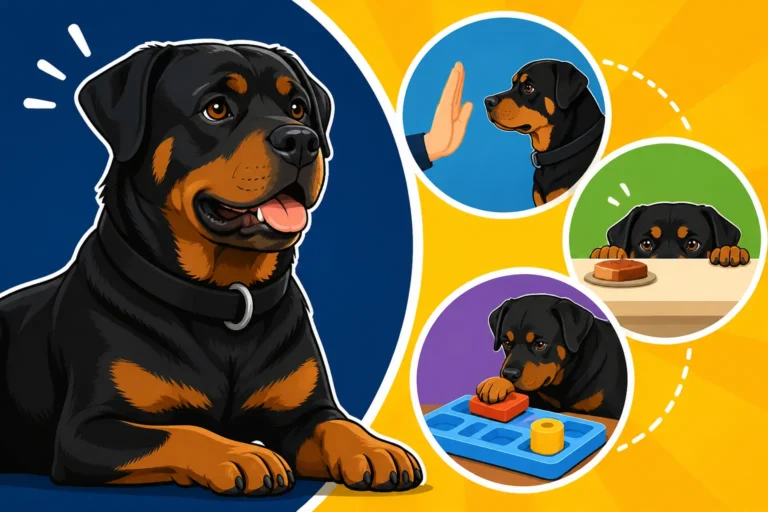
Rottweiler Bite Inhibition and the Adult Mouth
Few things are quite as delightful as a Rottweiler puppy, all soft fur and clumsy paws. But then those needle-sharp puppy teeth come out, and suddenly your hand is a chew toy, your ankles are targets, and you're left wondering how you're ever going to manage this powerful animal when it's fully grown. The fear is real: a Rottweiler has a formidable bite, and ensuring they understand how to use their mouth gently is one of the most critical lessons you can teach. This comprehensive guide will walk you through the nuances of Rottweiler bite inhibition, from puppy mouthing to maintaining a soft mouth in adulthood, so you can raise a confident, gentle giant.
Understanding the Rottweiler Jaw and Bite Force
Let's not shy away from the facts: a Rottweiler's jaw is incredibly powerful. They were bred for jobs that required strength and presence, like driving cattle and guarding property. Understanding the sheer physical capability of their bite is not meant to instill fear, but rather a healthy respect for the responsibility of training them.
The Power Behind the Rottweiler Bite
While specific numbers can vary and are often debated, the general consensus is that a fully grown Rottweiler possesses one of the strongest bite forces among dog breeds. We're talking about a force that, if unchecked, could cause serious damage. Imagine for a moment, the force required to hold a bull or protect a herd – that's the ancestral capability bred into your furry companion. This isn't just about sharp teeth; it's about jaw structure, muscle density, and the sheer leverage they can apply. It underscores precisely why early and consistent bite inhibition training is not just a good idea, but an absolute necessity for every Rottweiler owner.
What this means for you, practically speaking, is that even unintentional nips from an adult Rottweiler can be significant. A playful grab for a toy that misses, or an over-excited mouth greeting that isn't soft, has the potential to cause pain or injury. This isn't because your Rottweiler is malicious, but simply because their physical capacity is immense. Without proper training, they literally don't understand the consequences of using their jaws on human skin. It's our job to teach them this critical lesson, laying the groundwork from the very first days you bring your puppy home. If you've ever wondered about the raw power, you might consider reading more about What 328 Pounds of Bite Pressure Actually Does.
Natural Instincts vs. Aggression
It's crucial to distinguish between a Rottweiler's natural instincts and true aggression. A puppy mouthing, even quite roughly, is almost never a sign of aggression. It's how they explore their world, play with their littermates, and learn about boundaries. Their ancestors used their mouths for working, not necessarily for fighting humans. The problem arises when these natural, exploratory behaviors are not properly guided and shaped. An adult Rottweiler who bites hard might be acting on instinct, but an instinct that has not been inhibited, rather than out of innate malice.
Aggression, on the other hand, typically stems from fear, resource guarding, pain, or poor socialization, and manifests with other body language cues like growling, snarling, raised hackles, or a stiff posture. If you see these signs alongside biting, you're dealing with something more serious than a lack of bite inhibition. This guide focuses on teaching puppies how to control their bite pressure, but if you ever suspect true aggression, it’s imperative to seek immediate professional help. The goal is to channel their natural instincts into appropriate outlets and ensure their powerful jaws are always used gently on people.
The Importance of Early Control
Given their size and power, controlling a Rottweiler's mouth from the earliest possible age is paramount. What's cute and manageable in an eight-week-old puppy becomes a significant problem in a six-month-old adolescent who is already pushing 60-70 pounds, let alone a full-grown adult. The window for truly effective bite inhibition training is primarily during puppyhood, specifically before they reach around 4-5 months of age. During this time, puppies are most receptive to learning about bite pressure from their littermates and, crucially, from their human families.
Every gentle interaction, every correction, and every redirection during these formative weeks builds the foundation for an adult dog who understands soft mouthing. Delaying this training means you'll be trying to teach an animal with significant physical strength to undo deeply ingrained habits, which is a much harder task. Think of it like teaching a child to read; the earlier they start, the easier it is. For a large, powerful breed like a Rottweiler, "later" can be a very challenging place to be. This is why many experienced owners emphasize Training a Rottweiler Before It Outweighs You.
Why Puppy Mouthing is Normal (and Necessary)
Puppy mouthing, while sometimes painful, is a completely natural and necessary part of canine development. It's how puppies learn about the world, how they communicate, and how they develop crucial social skills. Understanding this can help you approach training with patience rather than frustration.
Learning About Their Mouths
Just like human babies explore the world by putting everything in their mouths, puppies use their mouths as their primary tool for investigation. Their paws aren't as dexterous as human hands, so everything from toys to furniture to your fingers goes straight into their jaws for examination. They're learning about texture, pressure, and the limits of their own strength. This is their way of mapping out their world, understanding what's hard, what's soft, what gives, and what resists.
During this stage, a puppy often doesn't realize how much pressure they're exerting. Their tiny, razor-sharp teeth are designed for tearing at food, not for gentle interaction with delicate human skin. They're simply practicing, experimenting, and gathering information. Your job as their human is to provide the feedback they need to understand that human skin is extremely fragile compared to a chew toy or another puppy's thick fur. This foundational learning is key to developing a dog with a "soft mouth."
Socializing with Littermates
One of the most important places a puppy learns bite inhibition is from their littermates and mother. When a puppy bites another puppy too hard during play, the bitten puppy will yelp loudly and often disengage from play, sometimes completely. This immediate, negative feedback teaches the biting puppy that excessive pressure ends the fun. The mother dog also plays a crucial role, often giving a sharp correction if her pups are too rough.
This natural feedback loop is what we try to emulate in human-led bite inhibition training. A puppy who is removed from their litter too early often misses out on these vital lessons, making the human's job even more critical. They haven't had the chance to understand the social consequences of a hard bite. When your Rottweiler puppy plays, watch how they interact with other well-socialized dogs if you have the opportunity. You'll see this learning process in action, with yelps and pauses teaching invaluable lessons about appropriate play.
Testing Boundaries with Humans
As your Rottweiler puppy grows, they'll inevitably test boundaries with you. Mouthing is one of the primary ways they do this. They'll mouth your hands, your arms, and your clothing. Sometimes it's playful, sometimes it's attention-seeking, and sometimes it's simply a puppy asserting themselves. This is a normal part of their development and isn't necessarily a sign of aggression, but rather a gauge of your reactions.
How you respond to these boundary tests is critical. If you allow excessive mouthing, even when it hurts a little, your puppy learns that it's acceptable. They won't understand that certain levels of pressure are painful or inappropriate. It's a bit like a child pushing their luck with a parent – they need consistent, clear rules to understand what's acceptable and what's not. Establishing these boundaries around mouthing early on helps build a respectful relationship where your Rottweiler understands and respects your physical limits.
Teaching Bite Inhibition: The Foundation of Safe Interactions
Teaching bite inhibition means teaching your Rottweiler puppy to control the pressure of their bite. It's not about stopping them from ever putting their mouth on you (which isn't realistic), but about ensuring that when they do, it's gentle and doesn't cause pain. This is arguably the most important lesson you will teach your young Rottweiler.
The "Yelp" Method
The "yelp" method is a widely recommended technique that mimics how puppies learn from each other. When your Rottweiler puppy bites your hand or skin too hard during play, let out a high-pitched "yelp" or "ouch!" as if you were another puppy. Immediately withdraw your hand and end the play session for a brief period. The key here is the sound and the immediate consequence. The yelp startles them and communicates "that hurt!" in a language they inherently understand, while withdrawing your attention teaches them that hard biting makes the fun stop.
It's important to be consistent with this. Every single time your puppy bites too hard, the yelp and withdrawal must follow. Don't be too dramatic or loud, as you don't want to scare them, but make it clear. After a few seconds, you can re-engage in play. If they bite too hard again, repeat the process. Over time, your puppy will start to associate the pressure of their bite with your yelp and the cessation of play, and they'll naturally begin to soften their mouth. This technique is a cornerstone of Teaching Bite Inhibition to a Rottweiler Puppy.
Time-Outs and Redirection
If the yelp method alone isn't quite cutting it, or if your puppy gets more excited by your yelp (some do!), a brief time-out can be very effective. When your puppy bites too hard, give a firm "No bite!" and immediately remove yourself from the situation. Walk into another room and close the door behind you, or put your puppy in a designated "time-out" area (like a crate or a playpen) for 30-60 seconds. The important thing is that the fun and attention stop instantly.
After the time-out, approach them calmly. If they re-engage gently, reward that behavior. If they immediately go back to biting hard, another time-out is in order. This teaches them that biting hard results in isolation and the loss of what they want most – your presence and play. Parallel to this, redirection is vital. Always have appropriate chew toys on hand. When your puppy starts to mouth you, immediately offer a suitable toy instead, praising them warmly when they take to it. This teaches them what they can chew, rather than just what they can't. You can find a wide variety of durable options on platforms like Amazon.
Consistency is Key
I cannot stress this enough: consistency is the absolute cornerstone of successful bite inhibition training. Every member of the household, from adults to older children, needs to be on the same page and apply the same methods every single time. If one person allows hard biting and another corrects it, your Rottweiler puppy will become confused and the learning process will be significantly delayed, if not derailed entirely. They need clear, predictable boundaries to understand what's expected of them.
This means discussing the chosen methods with everyone who interacts with the puppy and ensuring they understand why it's so important for a Rottweiler to have a soft mouth. It's not about punishing the puppy, but about teaching them vital life skills for safe cohabitation. A puppy program, such as the one offered by BAXTER & Bella, can be invaluable here, providing a structured curriculum that all family members can follow, ensuring everyone is on the same consistent path. Without consistency, you're sending mixed signals, and a large, intelligent dog like a Rottweiler will struggle to understand what you want.
Common Challenges and How to Address Them
Even with consistent training, you're bound to encounter some bumps in the road. Rottweiler puppies are intelligent and spirited, and their natural exuberance can sometimes make bite inhibition a bit more challenging. Understanding these common hurdles can help you prepare and respond effectively.
Over-Excited Biting
Rottweiler puppies, especially when they're overtired or overstimulated, can become very mouthy and "bitey." They might lunge, nip, and grab with more force than usual. This isn't usually aggressive; it's often a sign that they're losing impulse control, much like a toddler having a meltdown. They literally don't know how to calm themselves down, and their default response is often to use their mouth.
When you notice your puppy becoming excessively mouthy and excited, it's usually a sign that they need a break. Immediately redirect them to a quiet space, like their crate or a designated calm area, for a short "nap time" or quiet chew session. A good rule of thumb is to enforce calm periods before they reach this over-stimulated state. Regular, scheduled naps, especially for young puppies, can significantly reduce instances of over-excited biting. Rather than trying to train them through the frenzy, preempt it by managing their energy levels and ensuring they get enough quality rest.
Resource Guarding and Biting
Resource guarding is a distinct issue from simple puppy mouthing, but it's important to address early as it can involve biting. This is when a dog becomes possessive over certain items – food, toys, sleeping spots, or even people – and may growl, snarl, or bite if someone approaches their perceived valuable item. With a breed as protective as a Rottweiler, understanding and managing this is crucial. You might notice your puppy freezing over a high-value chew, or perhaps giving a slight growl if you reach for their food bowl.
To address this, start early with "trading up." While your puppy is eating or has a toy, approach them calmly and offer an even higher value treat. When they release their current item to take the treat, praise them and then give their original item back (or an even better one!). This teaches them that humans approaching their resources results in good things, not loss. Never scold or punish a growl, as this teaches them to skip the warning and go straight to biting. If you see early signs of significant resource guarding, especially if it involves a bite, seeking professional help from a qualified behaviorist is paramount. For severe cases, it can be a serious Rottweiler Guarding That Needs a Behaviorist.
Nipping at Children or Vulnerable Family Members
One of the most concerning forms of puppy biting is when it's directed at children, the elderly, or other vulnerable family members. Children, with their quick movements, high-pitched voices, and often inconsistent interactions, can inadvertently trigger a puppy's play drive or cause them anxiety. Their size also puts them more at risk of injury from even "playful" nips.
The golden rule here is never to leave a Rottweiler puppy unsupervised with young children. This isn't a reflection on the puppy's character, but a vital safety measure. Teach children how to interact gently and calmly with the puppy, and how to "be a tree" (stand still and quiet) if the puppy becomes too mouthy. Practice the "yelp" method and time-outs consistently, and always supervise. Ensure the puppy has plenty of appropriate chew toys. If nipping at children persists despite diligent training, or if you're concerned about Rottweiler Puppy Play Biting With Children, consider enrolling in specialized training classes or consulting with a professional trainer who has experience with both large breeds and families. It might also be worth reviewing Redirecting a Rottweiler That Grabs Clothing for practical tips.
Tools and Techniques to Aid Bite Inhibition Training
Effective bite inhibition training often goes beyond just verbal corrections and time-outs. There are various tools and techniques that can support your efforts and provide your Rottweiler puppy with appropriate outlets for their natural chewing and mouthing behaviors.
Appropriate Chew Toys
Having a wide assortment of appropriate and durable chew toys is absolutely non-negotiable for a Rottweiler. These dogs have strong jaws, and if they don't have suitable items to chew on, they will find something else – and it's often your furniture, shoes, or hands. The key is "appropriate" and "durable." Look for toys specifically designed for power chewers or large breeds. Soft plush toys might last five minutes, but robust rubber, nylon, or hard dental chews can withstand their impressive jaws and provide long-lasting satisfaction.
Rotate these toys regularly to keep them interesting, and consider puzzle toys that dispense treats, which can keep your puppy mentally engaged while they chew. Freezing some chew toys or Kongs filled with peanut butter (check ingredients for xylitol!) or plain yogurt can provide an extra challenge and soothing relief for teething puppies. A quick search on Amazon for "tough dog toys for large breeds" will give you plenty of options. Remember, the goal is to always have a readily available alternative to your hands when your puppy starts to mouth. This topic is so important that we often dedicate whole articles to it, such as Rottweiler Chew Toys That Survive the Jaw.
Using Leashes and Barriers
Sometimes, a direct time-out by leaving the room isn't practical, or your puppy might be too excited to settle. In these situations, a leash and barriers can be invaluable training aids. Keeping your puppy on a leash in the house during active training periods allows you to immediately manage their behavior. If they start to mouth too hard, you can use the leash to gently guide them away from you or to their designated time-out spot without having to physically handle a mouthy puppy.
Barriers, such as baby gates or playpens, are also excellent for creating safe spaces or managing interactions. You can use a baby gate to create a temporary boundary between your puppy and a child, allowing them to see and get used to each other without direct physical interaction that might lead to nipping. A playpen offers a contained space for your puppy to play with appropriate toys independently, or to have a calm time-out when they're overstimulated. These tools aren't meant to isolate your puppy but to provide structure and control during critical learning phases.
Professional Training Aids
While hands-on training and consistent effort are always primary, certain professional training aids and programs can significantly bolster your efforts. Online puppy training courses, like those offered by BAXTER & Bella, provide structured guidance, video tutorials, and often access to trainers for personalized advice. These programs can be especially helpful for first-time Rottweiler owners or those who feel overwhelmed by the sheer size and drive of their puppy. They offer step-by-step instructions for bite inhibition and a host of other foundational behaviors.
Additionally, certain training tools, when used correctly, can assist. For instance, a comfortable, well-fitting muzzle (known as muzzle training) can be introduced proactively and positively, not as a punishment. It teaches the dog to be comfortable with it for future vet visits, grooming, or even as a temporary management tool during supervised interactions if bite inhibition is still a work in progress. Remember, the goal with any aid is to facilitate learning and safety, not to replace thoughtful, positive training. You can explore more on the importance of Muzzle Training a Rottweiler Before You Need It.
Beyond Puppyhood: Maintaining Good Bite Inhibition in Adult Rottweilers
Just because your Rottweiler has grown out of their puppy phase doesn't mean bite inhibition training ends. It's an ongoing process to reinforce gentle mouth habits and ensure your adult dog continues to be a safe and well-mannered member of your family and community.
Reinforcing Gentle Mouth Habits
For an adult Rottweiler, reinforcing gentle mouth habits means praising and rewarding calm, soft interactions. If your adult Rottweiler takes a treat gently from your hand, offer effusive praise. If they lean against you affectionately without any mouthing, acknowledge it. When you play fetch or tug, and they release the toy on command, that's another opportunity to reinforce good mouth control. The idea is to make gentle interactions highly rewarding.
You can also incorporate games that encourage gentleness. For instance, playing "find it" with small treats where they have to gently sniff and pick up the treat without snapping. Or practicing "take it" and "leave it" commands with various objects, ensuring they understand when and how to use their mouth. These seemingly small daily interactions add up, cementing the understanding that a soft mouth is always the preferred behavior. Continue to be vigilant; even a small regression should be met with a calm, consistent correction or redirection.
Handling Exercises and Body Sensitivity
An adult Rottweiler needs to be comfortable with being handled all over their body – for vet visits, grooming, or just general affection. This includes touching their paws, ears, tail, and, yes, their mouth. Start by gently touching your dog's muzzle, gradually progressing to briefly holding their muzzle, looking at their teeth, and gently running your fingers inside their mouth. Pair these touches with high-value treats and calm praise. The goal is for them to associate handling with positive experiences, reducing any potential for a snap or bite out of discomfort or surprise.
This practice builds body sensitivity and trust, teaching your Rottweiler that human hands are not a threat, even when they're in sensitive areas. It's a critical component of ensuring they remain safe and manageable throughout their lives. If they're comfortable with being handled, they're less likely to react defensively with their mouth if, for example, a child accidentally pulls an ear or a vet needs to examine a sore spot. Regular handling sessions, even short ones, are an excellent investment in your Rottweiler's overall demeanor and safety.
Preventing Regression
Regression in bite inhibition can happen, especially if routines change, or if the dog experiences stress, pain, or insufficient exercise and mental stimulation. An adult Rottweiler who suddenly starts mouthing more or with increased pressure might be trying to tell you something. Perhaps they're bored, in pain, or feeling anxious. Before you assume a behavioral problem, rule out any underlying medical issues with a vet visit.
To prevent regression, maintain consistent rules, provide ample physical exercise and mental enrichment (puzzle toys, training sessions, scent work). A bored or under-stimulated Rottweiler is more likely to engage in undesirable behaviors, including excessive mouthing. If you notice any signs of regression, go back to basics: re-implement the "yelp" method for harder bites, enforce time-outs, and ensure everyone in the household is being consistent. Early intervention at the first sign of regression is much easier than trying to correct a deeply re-established bad habit. This ongoing effort is part of the broader commitment to Rottweiler Puppy Training Through the First Year and beyond.
When to Seek Professional Help
While many bite inhibition issues can be resolved with consistent at-home training, there are times when professional intervention is not just helpful but absolutely necessary. Recognizing these red flags can be the difference between a manageable issue and a serious safety concern.
Recognizing Serious Biting
You've tried the yelp method, time-outs, redirection, and consistency, but your Rottweiler puppy or adolescent continues to bite hard, draw blood, or shows signs that go beyond playful mouthing. These might include:
- Biting that escalates rapidly: From a gentle mouth to a hard bite with little warning.
- Persistent growling or snarling accompanying bites: These are clear warning signs that the dog feels threatened or possessive.
- Biting in specific contexts: For instance, only when approached while eating, or when someone tries to take a toy. This points to resource guarding or other specific triggers.
- Difficulty interrupting the biting: If your dog doesn't stop biting even with verbal cues or attempts to disengage.
- Biting directed at specific individuals without provocation: Especially children or those perceived as weaker.
- Lack of a "soft mouth" even with repeated training: If they simply aren't learning to inhibit their pressure.
Any of these signs, especially in an adolescent or adult Rottweiler, warrant immediate professional evaluation. These are not minor "puppy issues" and need serious attention to prevent them from escalating into more dangerous situations. Such issues can be early indicators of Rottweiler Behavior Problems That Start Small.
Finding a Qualified Trainer or Behaviorist
If you've identified serious biting behaviors, the next step is to find a qualified professional. Look for:
- Certified Professional Dog Trainers (CPDT-KA): These individuals have demonstrated knowledge and experience in dog training.
- Certified Dog Behavior Consultants (CDBC) or Veterinary Behaviorists (Diplomate ACVB): These specialists have advanced education and experience in addressing complex behavioral issues, including aggression. Veterinary behaviorists are veterinarians who have specialized in animal behavior, allowing them to consider medical causes for behavioral changes and prescribe medication if necessary.
When choosing a professional, always ask about their methods. Look for those who use positive reinforcement, force-free, and science-based techniques. Avoid trainers who advocate for harsh corrections, intimidation, or punishment-based methods, especially with a powerful breed like a Rottweiler, as these can exacerbate fear-based aggression and damage your relationship with your dog. A good professional will involve you heavily in the training process, explain the why behind their recommendations, and set realistic expectations for behavior modification.
The Dangers of Delaying Intervention
Delaying professional intervention for serious biting behaviors in a Rottweiler is incredibly risky. What starts as a concerning habit in a young dog can become a dangerous liability in a powerful adult. As Rottweilers mature, their physical strength increases exponentially, and ingrained behavioral patterns become much harder to change. The longer you wait, the more deeply embedded the behavior becomes, and the more difficult and time-consuming it will be to modify.
Moreover, delaying intervention increases the risk of serious injury to family members, other pets, or members of the public. A single serious bite incident can lead to legal ramifications, mandatory euthanasia, or the heartbreaking decision to rehome your beloved dog – often to a shelter that may struggle to find them a suitable new home due to their bite history. Acting swiftly, seeking expert guidance, and committing to a structured behavior modification plan is the best and safest course of action for both your Rottweiler and everyone around them.
| Training Method | Target Behavior | Key Principles | Effectiveness (Puppy) | Effectiveness (Adult) |
|---|---|---|---|---|
| "Yelp" Method | Hard play biting | Mimics littermate feedback; immediate consequence | High | Low (less sensitive) |
| Time-Out | Over-excited, persistent biting | Removes attention/fun; temporary isolation | High | Moderate |
| Redirection | Mouthing hands/inappropriate items | Provides acceptable chewing outlet | High | High |
| Trade-Up | Resource guarding | Positive association with human approach | High | High |
| Crate/Pen Use | Over-stimulation, lack of self-control | Safe space for calm; managed isolation | High | Moderate |
| Consistent Handling | Fear/defensiveness with touch | Positive association with touch; builds trust | High | High |
| Professional Help | Aggression, unresolved issues | Expert assessment, tailored behavior modification | Critical | Critical |
Disclaimer
This article is for general informational purposes only and does not constitute professional advice. Laws, prices and regulations vary by location and change over time. Consult a qualified professional for guidance on your specific situation.