What a JLPP Carrier Rottweiler Can Be Bred To
Discovering that your beloved Rottweiler is a carrier for Juvenile Laryngeal Paralysis & Polyneuropathy (JLPP) can be a moment of real concern, especially if you're involved in responsible breeding. It’s natural to feel a mix of confusion and worry about what this means for your dog and for any future litters. This guide will walk you through exactly what a JLPP carrier Rottweiler is, why it matters, and precisely what breeding decisions you can make to ensure healthy puppies while contributing positively to the breed's future.
Understanding JLPP in Rottweilers
Let's cut right to the chase: JLPP is a serious genetic condition that can profoundly impact a Rottweiler puppy's quality of life. Knowing your dog's status is the first step in being a truly responsible breeder.
What is JLPP and How is it Inherited?
Juvenile Laryngeal Paralysis & Polyneuropathy, or JLPP, is a hereditary neurological disorder specific to Rottweilers. It's an autosomal recessive condition, which means a puppy must inherit two copies of the defective gene—one from each parent—to be affected. If a puppy inherits only one copy, they are considered a "carrier" and will not develop the disease themselves. They will, however, carry the potential to pass that gene on to their own offspring. This disease manifests early in a puppy's life, often between 3 and 18 months of age, and can lead to difficulties with barking, swallowing, and coordination. You can learn more about exactly what JLPP actually does to a Rottweiler if you're interested in the deeper medical specifics.
The affected gene is known as RAB3GAP1. Dogs with two normal copies are "clear," dogs with one normal and one affected copy are "carriers," and dogs with two affected copies are "affected." A carrier Rottweiler will typically show no signs of the disease, living a completely normal, healthy life. This is why testing is so incredibly important; without it, you'd never know your seemingly healthy dog carries this potential risk.
The Importance of Genetic Testing
Genetic testing for JLPP has become an indispensable tool for ethical Rottweiler breeders. Before this test was widely available, breeders were essentially flying blind, sometimes unknowingly producing affected puppies simply because they didn't have the information to make informed decisions. Now, a simple cheek swab or blood sample can definitively tell you your dog's JLPP status: clear, carrier, or affected.
For any Rottweiler intended for breeding, this test is non-negotiable. It allows breeders to make educated choices about pairings, drastically reducing the incidence of JLPP in the breed. Imagine the heartache of owning a puppy that begins to show early JLPP signs in a Rottweiler puppy; genetic testing helps prevent this suffering. This is why it's universally recommended that you understand the thorough testing that goes into ensuring sound progeny, reflecting the core principle of why one Rottweiler parent must test clear when breeding.
Breeding Strategies for a JLPP Carrier Rottweiler
So, you have a JLPP carrier. Does this mean your dog can never be bred? Absolutely not! It simply means you must be exceptionally careful and thoughtful about who you choose as a mate.
The 'Clear to Carrier' Breeding Rule
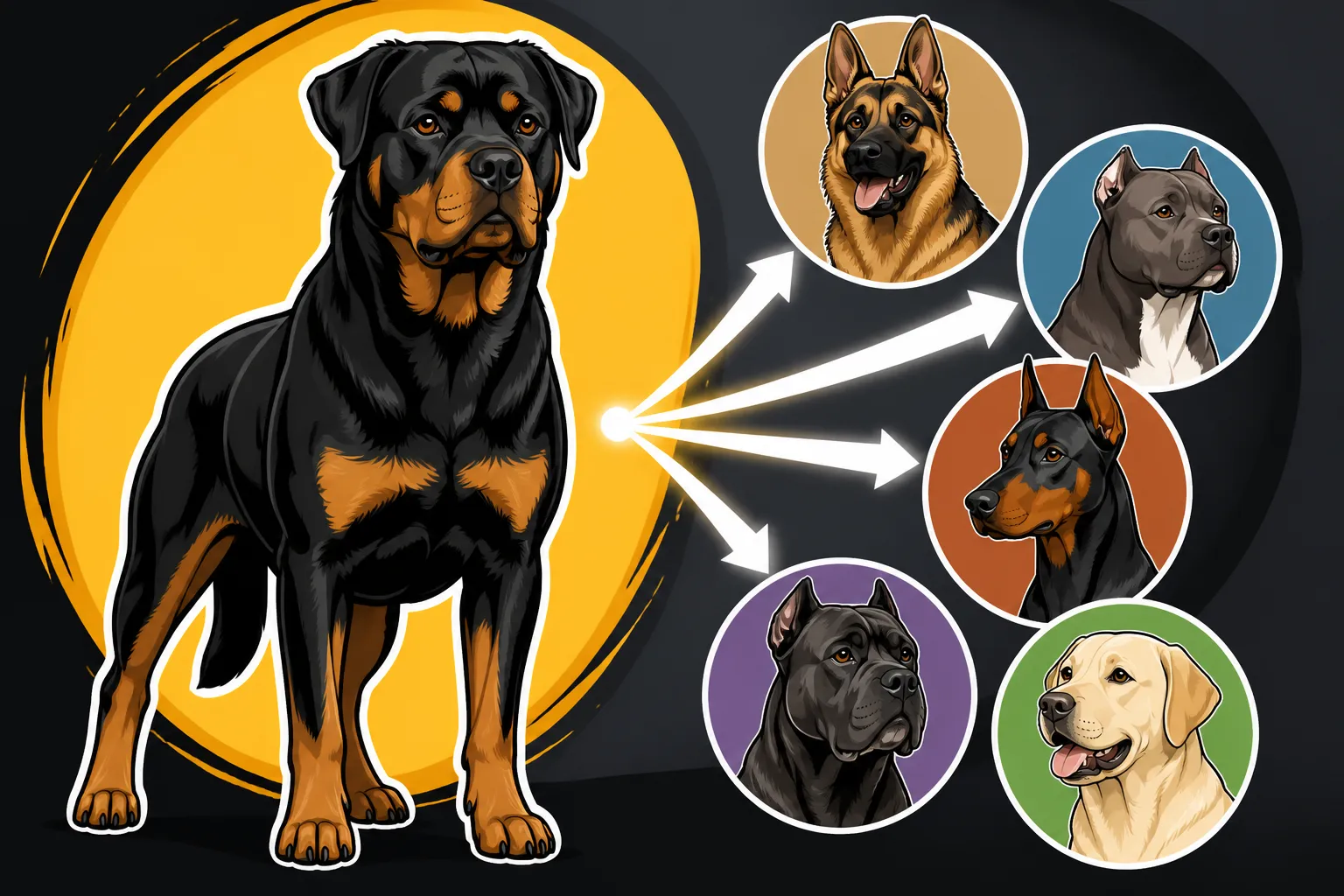
The golden rule when breeding a JLPP carrier Rottweiler is this: a carrier must only be bred to a Rottweiler that is genetically clear of JLPP. This pairing is the cornerstone of responsible breeding when a carrier is involved because it guarantees that no affected puppies will be produced.
Let's break down the genetics with a simple Punnett square, which you might remember from biology class:
- Carrier Parent (C/A): Has one normal gene copy (C) and one affected gene copy (A).
- Clear Parent (C/C): Has two normal gene copies (C).
| Parent 2 (C) | Parent 2 (C) | |
|---|---|---|
| P1 (C) | C/C (Clear) | C/C (Clear) |
| P1 (A) | C/A (Carrier) | C/A (Carrier) |
As you can see from this table, every puppy in such a litter will inherit at least one normal gene copy (C) from the clear parent. Therefore, no puppy will ever inherit two copies of the affected gene (A/A), which means no puppy will be affected by JLPP. The statistical outcome is roughly 50% clear puppies (C/C) and 50% carrier puppies (C/A). Both clear and carrier puppies from this pairing will be phenotypically healthy, meaning they will not show symptoms of JLPP. This allows you to responsibly utilize a valuable carrier in a breeding program without producing sick offspring. The RAB3GAP1 test and what clear means is vital to confirming these statuses.
Avoiding 'Carrier to Carrier' or 'Carrier to Affected' Pairings
Now, it's crucial to understand why other pairings are absolutely off-limits if you have a JLPP carrier. These combinations carry a significant risk of producing affected puppies, which, as a responsible breeder, is something you must always strive to avoid.
-
Carrier to Carrier Pairing (C/A x C/A):
If you breed two JLPP carriers together, the genetic outcome is starkly different.Parent 2 (C) Parent 2 (A) P1 (C) C/C (Clear) C/A (Carrier) P1 (A) C/A (Carrier) A/A (Affected) In this scenario, there's a 25% chance of producing a clear puppy, a 50% chance of producing a carrier puppy, and a very disheartening 25% chance of producing an affected puppy (A/A). These affected puppies would develop JLPP, leading to severe health issues and a dramatically shortened, often painful, life. This is precisely the outcome responsible breeders work diligently to prevent.
-
Carrier to Affected Pairing (C/A x A/A):
This pairing is even more problematic. While rare for an affected dog to be used in breeding due to their health issues, if such a mating were to occur:Parent 2 (A) Parent 2 (A) P1 (C) C/A (Carrier) C/A (Carrier) P1 (A) A/A (Affected) A/A (Affected) Every single puppy from this pairing would either be a carrier (50%) or affected (50%). There would be no clear puppies. This is an entirely unethical pairing that would knowingly produce suffering.
By understanding these probabilities, you can see why the 'clear to carrier' rule is so critically important. It allows for the controlled and ethical breeding of carriers, preserving valuable genetics in the breed without propagating the disease.
Responsible Breeding and Puppy Outcomes
Breeding a JLPP carrier responsibly doesn't just stop at selecting the right mate; it extends to how you manage the litter and inform future puppy owners. Transparency and education are key.
Explaining Results to Puppy Buyers
When you've bred a JLPP carrier to a clear Rottweiler, you will have a litter where some puppies are clear and some are carriers. It is your ethical responsibility as a breeder to perform JLPP genetic testing on all puppies before they go to their new homes and to clearly communicate their status to prospective buyers.
Imagine a new owner bringing home their puppy, full of dreams for a healthy, happy life. They deserve to know if their puppy is a carrier, even if it will never develop the disease itself. This information is crucial for them if they ever consider breeding their dog in the future (though most reputable breeders require pet owners to spay/neuter). If a puppy is a carrier, the new owner needs to understand that their dog, while healthy, carries the gene. This ensures that the cycle of responsible breeding continues if that dog is ever bred. Good breeders provide comprehensive health papers to ask a Rottweiler breeder for, including these genetic test results.
This transparency builds trust and helps to educate the wider public about responsible pet ownership and the importance of genetic health screening. It's not about hiding information; it's about empowering owners with knowledge.
The Broader Impact on the Breed
Using JLPP carriers responsibly in a breeding program can actually be beneficial for the overall health and genetic diversity of the Rottweiler breed. While the immediate goal is to eliminate affected individuals, completely removing all carriers from the breeding pool too quickly can sometimes lead to an undesirable narrowing of the gene pool.
Think about it: if a carrier dog has many desirable traits (excellent temperament, conformation, working drive, longevity), removing it entirely could mean losing those valuable genes from the breed. By breeding carriers carefully to clear dogs, you can retain those positive traits while preventing affected offspring. Over generations, with diligent testing and selective breeding, the percentage of carriers in the population can be gradually reduced without sacrificing genetic diversity. This contributes to a healthier, more robust breed in the long run. It's part of a larger picture of ensuring that the Rottweiler lifespan and the eight to ten year average is met with quality of life.
Maintaining genetic diversity is a balancing act. Diseases like JLPP are serious, but sometimes carriers can contribute other valuable traits that are important for the breed's future. Responsible breeding allows for this nuanced approach.
JLPP Breeding Outcome Summary
To make it even clearer, here's a quick summary of possible pairings and their outcomes for JLPP:
| Parent 1 Status | Parent 2 Status | Outcome: Clear Puppies | Outcome: Carrier Puppies | Outcome: Affected Puppies | Recommendation |
|---|---|---|---|---|---|
| Clear (C/C) | Clear (C/C) | 100% | 0% | 0% | Ideal |
| Clear (C/C) | Carrier (C/A) | 50% | 50% | 0% | Recommended |
| Clear (C/C) | Affected (A/A) | 0% | 100% | 0% | Not ethical (affected dogs are ill) |
| Carrier (C/A) | Carrier (C/A) | 25% | 50% | 25% | Avoid |
| Carrier (C/A) | Affected (A/A) | 0% | 50% | 50% | Strongly Avoid (produces affected) |
| Affected (A/A) | Affected (A/A) | 0% | 0% | 100% | Never Ethical (produces affected) |
Remember, the goal is always to avoid producing affected puppies, ensuring that every Rottweiler brought into the world has the best possible chance at a long, healthy life. This also applies to other hereditary conditions like Rottweiler heart disease and subaortic stenosis, where careful breeding is paramount. Thoughtful choices ensure the health of our beloved breed. For those considering a puppy, asking a breeder about The Five Clearances a Rottweiler Breeder Must Have is a crucial step to ensuring a healthy start. Similarly, understanding Rottweiler Growth Plates and Why They Close So Late helps new owners manage their puppy's development. And of course, getting a healthy start is essential to a long life, so consider topics like Rottweiler Growth Plates Closing at Eighteen to Twenty-Four Months and Rottweiler Heart Disease and Subaortic Stenosis. Finally, knowing about What a JLPP Carrier Rottweiler Can Be Bred To will help ensure the longevity of future generations.
Disclaimer
The information provided in this article is for educational and informational purposes only and does not constitute veterinary advice. Always consult with a qualified veterinarian or a certified canine reproduction specialist for personalized advice regarding your specific Rottweiler's health and breeding plan. Genetic testing results and breeding decisions should be made in consultation with professionals.