Rottweiler Markings That Are Too Large to Pass
It’s a common scenario: you’re absolutely smitten with your Rottweiler, perhaps even notice a unique splash of rust coloring that really sets them apart. You might wonder if those extra-bold leg markings or that wider chest blaze make your dog even more special. While every Rottweiler is special in our hearts, when it comes to the breed ring, the Rottweiler standard is quite specific about where those beautiful rust markings should fall and, crucially, how large they should be. It’s not just about color; it’s about pattern and proportion, and sometimes, those charmingly generous markings can actually be considered "too large to pass" in the formal world of conformation. This guide will delve into the nuances of Rottweiler markings, explaining what the breed standard looks for and why certain deviations, no matter how lovely to us, might mean your dog isn't destined for a champion ribbon.
Understanding the Rottweiler Breed Standard for Markings
The Rottweiler breed standard, as set by organizations like the American Kennel Club (AKC) or the Allgemeine Deutsche Rottweiler-Klub (ADRK) in Germany, is a detailed blueprint of the ideal Rottweiler. It describes everything from head shape and bone structure to gait and, yes, coat color and markings. For a breed steeped in history, like the Rottweiler, these standards aren't just arbitrary rules; they're designed to preserve the physical and temperamental traits that define the breed.
The Ideal 'Rust' Markings
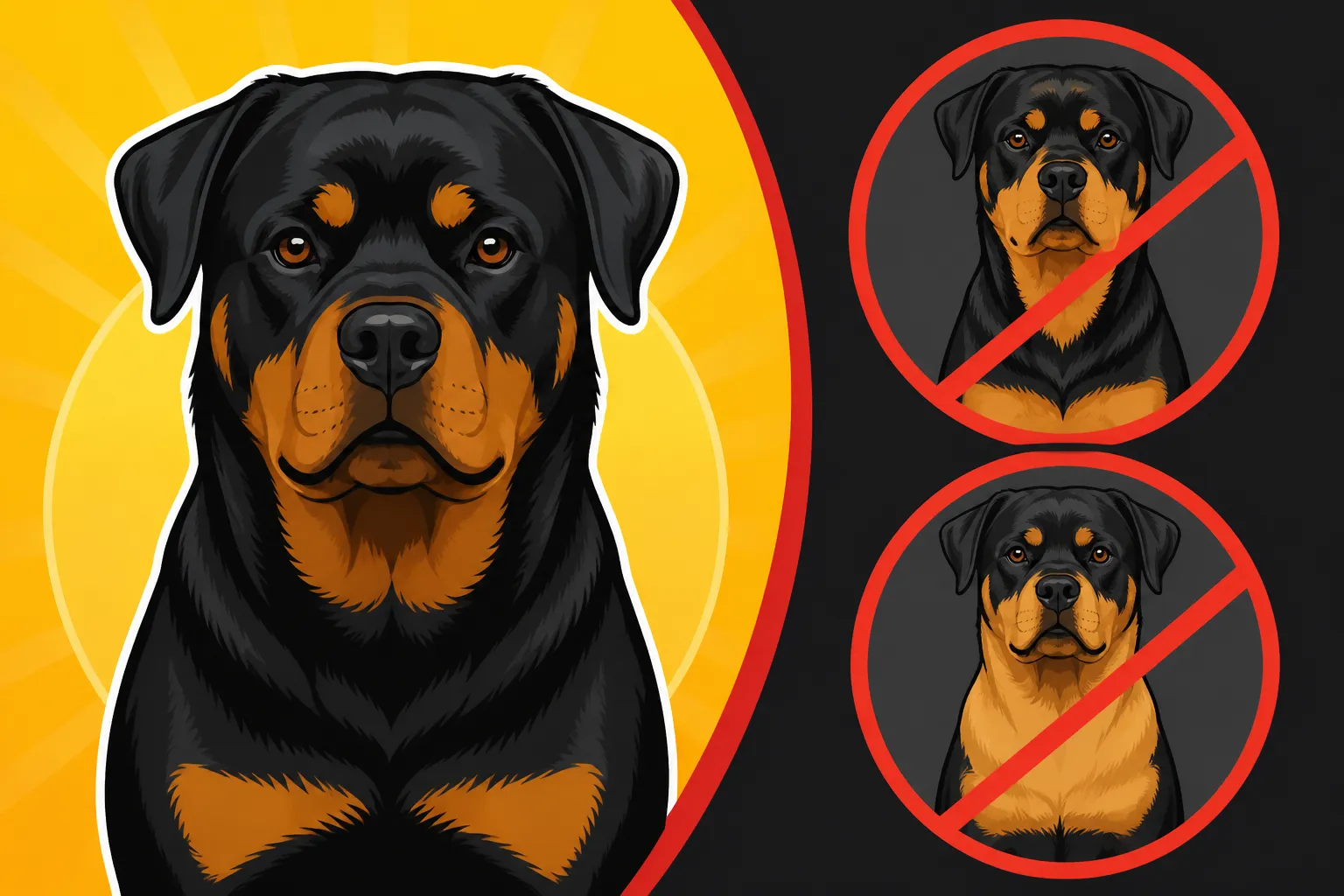
The Rottweiler is famously a black dog with distinct tan or rust markings. The standard calls for specific locations for these markings, often referred to as "rust" for their rich, warm reddish-brown hue. You'll typically find them above each eye, on the cheeks, on either side of the muzzle, on the throat, and in two triangular areas on the chest. They also appear on the forelegs and hind legs (from the carpus/hock down to the toes), and beneath the tail.
Think of it like a carefully placed set of accents on a classic design. The markings should be clearly defined, not smudged or mixed into the black. Their size and placement are critical to the overall appearance. For instance, the spots above the eyes shouldn't extend too far up the forehead, nor should the muzzle markings creep up too high towards the eyes. The chest markings should form clear triangles, not a massive bib. It's all about balance and proportion, ensuring the dog still presents as primarily black with these striking, well-defined rust points. You can read more about The Black and Rust Rottweiler Coat to get a better sense of the desired look.
Why Markings Matter in the Show Ring
In the world of dog shows, judges are looking for how closely an individual dog conforms to its breed standard. Every trait, including coat markings, is evaluated against this ideal. The purpose of breed standards is to maintain the distinct characteristics of each breed, ensuring that Rottweilers continue to look and behave like Rottweilers for generations to come. When markings deviate significantly from the standard, it suggests a departure from the desired type.
For a breeder, adhering to the standard is a professional and ethical commitment. They strive to produce puppies that embody the breed's best qualities, both in health and appearance. A dog with "faulty" markings might still be a wonderful pet, but it doesn't contribute to the goal of breeding to standard. It’s a very different mindset from simply choosing a family companion; in the show ring, precision matters.
What Constitutes "Too Large" in Rottweiler Markings
When we talk about markings being "too large," we're essentially discussing deviations from the prescribed size and placement in the breed standard. It's not about the color itself, but about the extent of its spread on the dog's black coat. These variations can be subtle or quite pronounced, and a judge's experienced eye will spot them immediately.
Markings Beyond Acceptable Bounds
Let's get specific about where markings commonly become "too large" and attract a judge's unfavorable attention:
- On the Face: The rust spots above the eyes are usually small and distinct. If they merge with the cheek markings, extend too far up the forehead, or connect across the bridge of the nose, they might be considered too large. Similarly, muzzle markings should be well-defined on the sides and under the jaw, not spreading extensively over the top of the muzzle, giving the appearance of a primarily rust-colored face.
- On the Chest: The standard asks for two distinct triangular markings on the chest. When these triangles merge into one large patch, or extend far down the sternum, almost forming a solid rust bib, they are deemed too extensive. You'll see this quite often in pet-quality dogs, where the chest blaze is a wide, continuous swath of rust.
- On the Legs: The rust on the forelegs should be on the front and sides of the legs, from the carpus (wrist) down to the toes. On the hind legs, it’s from the hock down. If the rust extends significantly further up the leg, particularly onto the elbows or hocks, or if it spreads too far up the thigh or shoulder, it would be considered oversized. Some dogs might even have rust markings that extend high onto their belly.
- Under the Tail: The rust under the tail is usually a small, distinct patch. If it covers a large portion of the underside of the tail or creeps up the sides of the tail base, it falls outside the standard's preference.
These are just a few examples, but the common thread is the expansion of the rust areas beyond their defined boundaries, encroaching on the black coat that is the hallmark of the breed. For a more detailed look at what can cause a judge to fault a dog, consider reading Rottweiler Markings That Fault in the Ring.
The Impact of Oversized Markings on Show Potential
For a Rottweiler being evaluated in a conformation show, oversized markings are typically considered a fault. Depending on the severity and extent of the deviation, it can range from a minor fault to a serious one. A minor fault might reduce a dog's placement in a class, while a serious fault could mean they don't place at all, or even, in extreme cases, be disqualified if the markings are so atypical that they fundamentally alter the breed's appearance.
Judges are trained to meticulously assess every aspect of a dog against the standard. A Rottweiler with an otherwise excellent structure and temperament might still be passed over for one with "correct" markings, even if the difference is subtle. The goal is to reward dogs that are the truest representatives of the breed ideal. So, while your Rottweiler's big, beautiful chest marking might be a charming feature to you, it could very well be the reason they don't earn a ribbon in the show ring.
Genetic Factors and Breeder Responsibility
Understanding why some Rottweilers have markings considered "too large" often leads back to genetics. Just like eye color or height, coat color and pattern are inherited traits. Responsible breeding plays a huge role in minimizing these deviations from the standard.
The Genetics Behind Markings Variation
The specific genes responsible for the precise size and distribution of tan/rust points in Rottweilers are complex, involving multiple genes working together. While a dog may have the basic "black and tan" genetic blueprint, modifier genes can influence how extensively that tan appears. Sometimes, a dog might inherit genes that cause the tan markings to spread more widely than desired, resulting in those "oversized" patterns. This isn't necessarily a sign of a "bad" gene, but rather a variation that doesn't align with the specific aesthetic demands of the breed standard.
It's also worth noting that some other breeds, like certain types of German Shepherds, can have much more extensive tan or sable markings, and occasionally, a distant ancestor with such genes might subtly influence a Rottweiler's coat, even if both parents appear standard. A good breeder understands these possibilities and makes informed decisions to ensure they're producing dogs that fit the standard as closely as possible.
Reputable Breeders and Standard Adherence
This is where the dedication of a reputable Rottweiler breeder truly shines. They don't just breed two healthy dogs; they carefully select breeding pairs whose pedigrees and individual characteristics suggest they will produce offspring that conform well to the breed standard. This includes evaluating markings. A responsible breeder will:
- Study Pedigrees: They'll look at the markings of ancestors to understand genetic predispositions.
- Assess Parents: They’ll ensure both parent dogs have correct markings according to the standard.
- Mentor and Learn: They are often part of breed clubs and have mentors who help them understand the nuances of the standard, including subtle marking issues.
- Prioritize Health and Temperament: While markings are important for conformation, a truly ethical breeder will always put health and temperament first. However, they strive to achieve all aspects of the standard.
When you're looking for a puppy, asking a breeder about their dogs' markings and their commitment to the standard is a valid question, especially if you have any interest in showing. This commitment to the standard is one of the many reasons Why Health-Tested Rottweiler Parents Raise the Price – because good breeding isn't just about health tests, but about a holistic approach to preserving the breed. Many reputable breeders also register their dogs with organizations that track these details.
Living with a Rottweiler with Non-Standard Markings
So, what if your beloved Rottweiler has those charming, slightly-too-large markings? The good news is, for the vast majority of Rottweiler owners, this is absolutely nothing to worry about. The breed standard is primarily for those involved in conformation showing. For a family companion, these details are aesthetic, not functional.
Pet Quality Versus Show Quality
It’s crucial to understand the distinction between "show quality" and "pet quality." A "show quality" Rottweiler is one that very closely adheres to the breed standard in all aspects, making it a strong contender in the conformation ring. These puppies often come with a higher price tag and specific contracts from breeders who invest heavily in achieving this ideal.
A "pet quality" Rottweiler, on the other hand, might have minor deviations from the standard that prevent it from being competitive in shows, such as markings that are too large, an incorrect bite, or perhaps being slightly over or under the ideal height. These dogs are still purebred Rottweilers, often from the same litters as show-quality pups, and are every bit as loving, loyal, and capable of being fantastic family members. They are typically sold at a lower price point and with contracts specifying that they are not to be shown in conformation. Many wonderful Rottweilers fall into the "pet quality" category, and their "flaws" are often endearing quirks to their owners. If you're comparing costs, you might find interesting information in Show Quality Against Pet Quality Rottweiler Prices.
Health and Temperament Are What Truly Count
Ultimately, for the average family, your Rottweiler's markings are purely cosmetic. What truly matters for a happy, long life together are health and temperament. A dog with perfectly standard markings but a questionable temperament or underlying health issues is far less desirable than a Rottweiler with slightly oversized rust that is robust, friendly, and stable.
When choosing a Rottweiler, whether for pet or show, prioritize:
- Health Clearances: Ensure the parents have all relevant health clearances for hips, elbows, heart, and eyes, and have been tested for JLPP. This helps mitigate the risk of common Rottweiler health issues. You should always ask for Health Papers to Ask a Rottweiler Breeder For.
- Temperament: Observe the parents' temperament. Are they calm, confident, and self-assured, as the breed standard describes for The Temperament Clause in the Rottweiler Standard? A well-socialized, stable temperament is paramount, especially for a large, powerful breed like the Rottweiler.
- Responsible Breeding Practices: Choose a breeder who prioritizes the well-being of their dogs, provides a clean environment, and screens potential owners carefully.
No matter the size of their markings, your Rottweiler needs good nutrition, regular exercise, and consistent training. For example, ensuring they get appropriate, high-quality food, which you can easily find on platforms like Chewy, will contribute far more to their well-being than the precise shade or size of their rust patches. Products like durable chew toys, also available from Chewy, will keep them mentally stimulated and happy. Focus on their overall health and happiness, and embrace their unique appearance – it makes them your Rottweiler.
Disclaimer
This article is for general informational purposes only and does not constitute professional advice. Laws, prices and regulations vary by location and change over time. Consult a qualified professional for guidance on your specific situation.