How Much a Rottweiler Puppy Eats at Each Meal
Bringing home a Rottweiler puppy is an exciting, joyful time, but it also comes with a lot of big questions, especially around feeding. You’re looking at this tiny, adorable fluffball knowing it's going to grow into a majestic, powerful dog, and you desperately want to get its nutrition right. It's easy to feel overwhelmed by conflicting advice, endless food options, and the sheer responsibility of ensuring your pup grows up healthy and strong, not too fast, not too slow, but just right. This comprehensive guide is here to unravel the mystery of how much to feed your Rottweiler puppy at each meal, providing clear, actionable insights to help you navigate this critical period.
Understanding Your Rottweiler Puppy's Unique Nutritional Needs
When you're feeding a Rottweiler puppy, you're not just filling a bowl; you're literally building a dog from the ground up. These magnificent creatures grow incredibly fast, but it's a marathon, not a sprint. Their nutritional needs are distinct, demanding a careful balance to support their massive skeletal and muscular development without putting undue stress on their still-forming joints. Ignoring these specifics can lead to lifelong health issues, which is exactly what we want to avoid.
Why Large Breed Puppy Food is Non-Negotiable
This is perhaps the most crucial distinction you'll make when choosing food for your Rottweiler puppy. You absolutely must choose a high-quality, specifically formulated large breed puppy food. Why? Because regular puppy food, while great for smaller breeds, often contains higher levels of calcium and phosphorus, and more calories than is healthy for a rapidly growing giant breed like a Rottweiler. This might seem counterintuitive – shouldn't a bigger dog need more calcium? In reality, too much calcium can accelerate bone growth and lead to serious developmental orthopedic diseases like osteochondrosis (OCD) and hip and elbow dysplasia.
Imagine a construction project: you want a strong, stable foundation, but if you try to make the concrete cure too quickly or add too much binding agent, it becomes brittle and prone to cracking under stress. It's similar for a Rottweiler puppy's bones. Their growth plates, those soft areas at the ends of long bones, are open for much longer than in smaller breeds – sometimes up to 18-24 months. Rapid growth induced by inappropriate nutrition can cause these plates to develop abnormally, leading to painful and debilitating conditions. Look for foods that specifically state "large breed puppy formula" and carefully check the guaranteed analysis. For specific guidance, you'll want to review Calcium Percentages to Look For on a Rottweiler Bag, as maintaining that precise ratio is paramount for healthy bone development.
The Critical Balance of Calories and Nutrients
Beyond calcium, the overall caloric content and nutrient balance in a large breed puppy food are meticulously designed to support controlled growth. This means providing sufficient energy for your puppy's playful antics and rapid development without encouraging them to become overweight or grow too quickly. A chubby Rottweiler puppy might look adorable, but it's actually at a higher risk for orthopedic problems, as that extra weight puts added strain on vulnerable joints.
A good large breed puppy formula will also provide appropriate levels of protein and fat, which are essential for muscle development and energy. Protein levels, for instance, are important for building that strong Rottweiler physique, but they need to be within a specific range. Generally, a protein content of Protein Between Twenty-Two and Twenty-Six Percent is considered ideal for a growing Rottweiler. This ensures they get the building blocks they need without putting excessive strain on their kidneys. Brands like Purina Pro Plan, Royal Canin, or Eukanuba are often recommended for their research into large breed nutrition. You can find these specialized formulas readily available from online retailers such as Chewy or Amazon, which often offer a wider selection than local pet stores.
Decoding the Feeding Chart: How Much Per Meal
So, you've chosen the right food – fantastic! Now comes the daily dance of measuring. It’s not just about a daily total; it's about how that total is divided across the day to support digestion and steady energy levels. Rottweiler puppies, especially when very young, need to eat more frequently than adult dogs.
Starting Points: Manufacturer Guidelines and Age-Based Feeding
The very first place to start is the feeding guide printed on your chosen large breed puppy food bag. Manufacturers invest significant research into these recommendations, and they typically provide a chart based on your puppy's age and current weight. For instance, a 3-month-old Rottweiler puppy might need a different amount than a 6-month-old, even if their weights are similar due to individual growth rates. This chart will give you a daily total, and from there, you'll divide it into meals.
Let's consider an example. A food bag might suggest a 20-pound, 3-month-old Rottweiler puppy needs about 3-4 cups of kibble per day. If you're feeding four meals a day, that translates to roughly 3/4 to 1 cup per meal. As they grow, say to 50 pounds at 6 months, that daily total might jump to 5-6 cups, and if you've transitioned to three meals, you'd be looking at 1.5-2 cups per meal. Remember, these are starting points – every puppy is an individual. This is where your keen observation skills come in. You can usually find these large bags of food, sometimes at a discount, through retailers like Amazon, making it easier to manage the budget for a hungry growing pup.
Adjusting for Individual Puppy Growth and Activity
Here’s where the art of feeding meets the science. Those bag recommendations are averages. Your Rottweiler puppy is unique. Factors like their individual metabolism, activity level, and growth spurts will all influence how much they truly need. A puppy that's particularly active or going through a rapid growth phase might need a little more, while a more sedate pup might do better with slightly less. The key is to monitor your puppy’s body condition, not just the numbers on the scale. For a deeper dive into calorie requirements at different stages, refer to Daily Calories for a Rottweiler Puppy at Four Months.
You should be able to easily feel your puppy's ribs with slight pressure, but they shouldn't be visibly prominent. When viewed from above, your puppy should have a discernible waist. From the side, their tummy should tuck up slightly after the rib cage. If you can't feel their ribs, or if they look round and plump, you're likely overfeeding. If their ribs are very visible, or they seem too thin, they might need a bit more. Adjust meal portions by about 1/4 to 1/2 cup increments, wait a few days, and reassess. Consistency in monitoring is vital throughout their growth.
Transitioning Meal Frequency: From Four Meals to Two
Rottweiler puppies start out needing more frequent meals, partly because their small stomachs can't hold a huge volume of food, and partly to maintain steady blood sugar levels and energy.
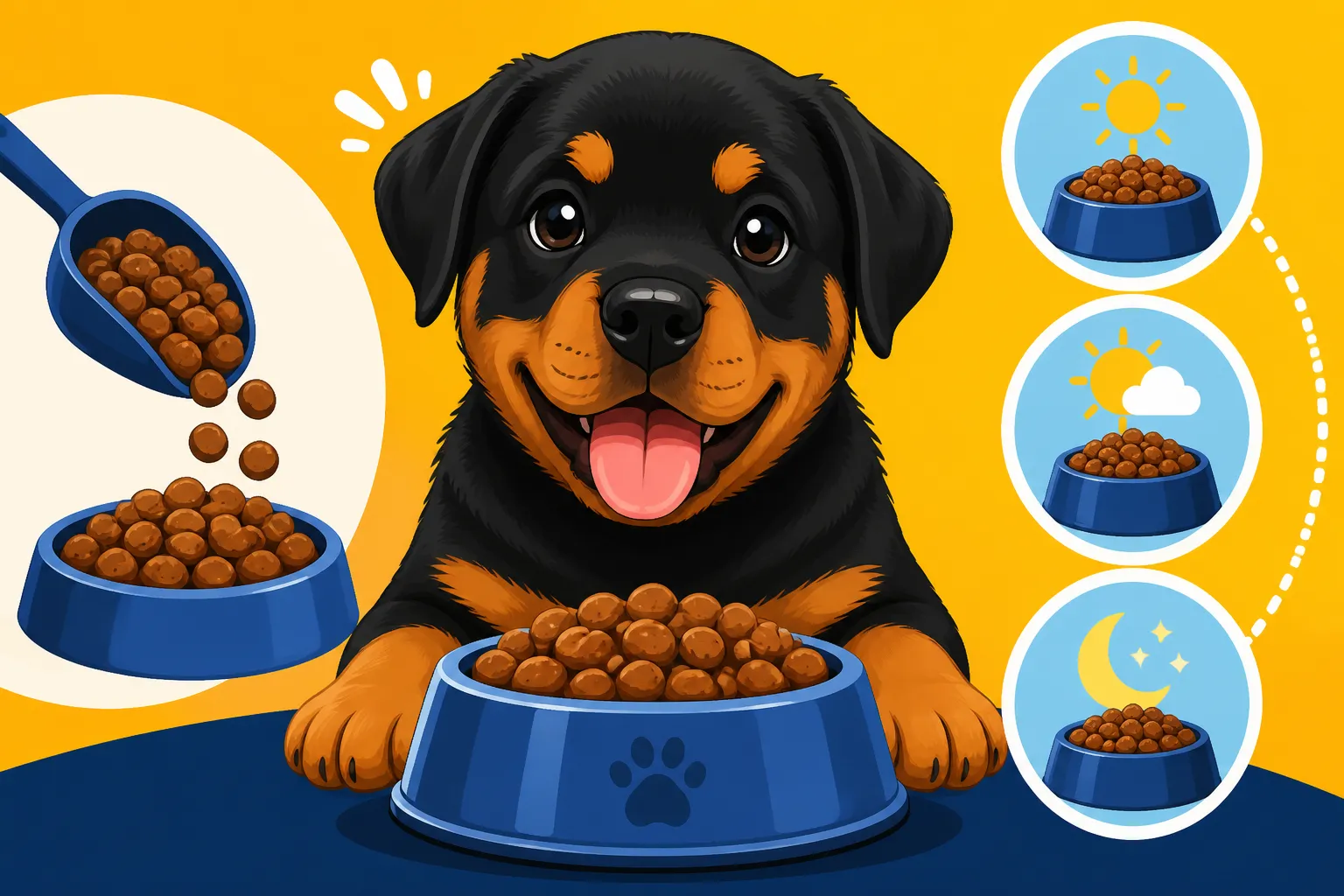
- 8 weeks to 4 months: Most Rottweiler puppies thrive on four meals a day. This typically means dividing their daily recommended amount into four equal portions. This schedule helps with digestion and prevents them from becoming too hungry between meals, which can sometimes lead to gulping their food down too quickly.
- 4 to 6 months: As your puppy gets a little older and their digestive system matures, you can typically reduce to three meals a day. This is a gradual transition, not a sudden switch. Over about a week, you might slowly increase the size of the remaining three meals while eliminating one. This aligns with advice on Dropping a Rottweiler From Four Meals to Three.
- 6 months to adult (around 18-24 months): Many Rottweilers do well on two meals a day once they reach this age, especially once their growth rate starts to slow down significantly. This is also covered in The Age a Rottweiler Moves to Two Meals a Day. Again, make this transition slowly. Two meals a day can be beneficial for reducing the risk of bloat later in life, a serious concern for large, deep-chested breeds.
A consistent feeding schedule is also crucial. Dogs thrive on routine, and knowing when their next meal is coming helps regulate their metabolism and makes house training easier. Try to feed at roughly the same times each day.
| Age Range (Approx.) | Typical Meal Frequency Per Day | Example Portion Size (Daily Total / Frequency) | Key Considerations |
|---|---|---|---|
| 8 weeks – 4 months | 4 meals | 3/4 – 1 cup per meal | Supports rapid growth, small stomach capacity, steady energy |
| 4 months – 6 months | 3 meals | 1.5 – 2 cups per meal | Maturing digestive system, sustained energy |
| 6 months – 18+ months | 2 meals | 2 – 3.5+ cups per meal | Slowing growth, preparing for adult feeding routine |
Note: All portion sizes are examples and vary widely based on specific food, puppy's weight, and activity level. Always consult your food's packaging and your veterinarian.
Beyond the Bowl: Ensuring Healthy Feeding Habits
Feeding a Rottweiler puppy isn't just about the quantity of food; it's about the overall approach. How you feed, where you feed, and what else goes into their diet all play a significant role in their long-term health and well-being.
Monitoring Body Condition and Growth Plate Protection
This is where you become your puppy's best health monitor. Regularly assessing their body condition is far more important than strictly adhering to a feeding chart. Remember, the goal is slow, steady growth, not chunky cuteness. A lean Rottweiler puppy is a healthy Rottweiler puppy, especially while those growth plates are still open. As discussed in Keeping a Rottweiler Puppy Lean on Purpose, a slightly lean puppy will place less stress on its developing joints.
To assess body condition, run your hands along your puppy’s sides. You should be able to feel their ribs without pressing hard, like feeling the back of your hand. If you can see their ribs without any effort, they might be too thin. If you have to search for them, they're carrying too much weight. Similarly, look down at your puppy from above: they should have a definite waist that tapers in from their rib cage. When viewed from the side, their abdomen should tuck up, not sag. This hands-on approach helps you make precise adjustments to their meal portions. It's also crucial to pair this careful feeding with appropriate exercise levels, as over-exercising a growing pup can cause just as much damage as incorrect nutrition. Be mindful of Exercise Limits for a Rottweiler Puppy Under Six Months to protect those vulnerable joints.
The Role of Treats and Supplements
Treats are an invaluable tool for training, especially with a smart, motivated Rottweiler puppy. However, they are also extra calories that need to be accounted for. It's easy for treats to quickly add up and sabotage your careful feeding plan. Choose small, low-calorie treats, or break larger ones into tiny pieces. When you're in an intensive training period, you might even consider reducing your puppy's regular meal portions slightly to compensate for the treat intake. For ideas on managing this, look into Treat Allowance for a Rottweiler in Daily Training.
Regarding supplements, generally, if you are feeding a high-quality, complete, and balanced large breed puppy food, additional supplements are unnecessary and can even be harmful. This goes back to the calcium issue – adding more calcium can throw off the crucial balance in their specialized diet. Avoid giving vitamin or mineral supplements unless specifically advised by your veterinarian for a diagnosed deficiency. The only common "supplement" often considered beneficial, even if not strictly necessary, might be a good quality fish oil for omega-3 fatty acids, which can support skin, coat, and cognitive development. Always discuss any potential supplements with your vet before introducing them. This is especially important as Why Calcium Supplements Damage a Rottweiler Puppy highlights the dangers of well-meaning but ill-advised supplementation.
Hydration and Feeding Environment
Water is just as vital as food for your growing Rottweiler puppy. Always ensure they have access to fresh, clean water, especially after meals and exercise. A large, sturdy bowl that won't tip over easily is a must. Remember, Rottweilers can drink a surprising amount, so frequent refills might be necessary, particularly on warmer days. Understanding Water Intake for a Rottweiler on a Hot Day can help you recognize if your pup is getting enough.
The feeding environment also matters. Establish a consistent, quiet place for your puppy to eat, away from the hustle and bustle of family life or other pets. This helps them feel secure and allows them to focus on their meal, promoting better digestion. If you have multiple pets, feed them separately to prevent resource guarding issues. While some people use raised bowls, particularly for larger breeds, the scientific consensus on their benefit for bloat prevention is mixed. If you choose to use one, ensure it's at a comfortable height for your puppy, preventing them from stooping too much. However, the primary focus should be on consistent feeding times and avoiding strenuous exercise immediately before or after meals to minimize bloat risk later in life.
By diligently following these guidelines, choosing appropriate food, monitoring their growth, and creating a supportive feeding routine, you'll be giving your Rottweiler puppy the very best start in life. It's an investment in their future health and happiness, ensuring they grow into the strong, confident, and beloved family member they're meant to be.
Disclaimer
This article is for general informational purposes only and does not constitute professional advice. Laws, prices and regulations vary by location and change over time. Consult a qualified professional for guidance on your specific situation.