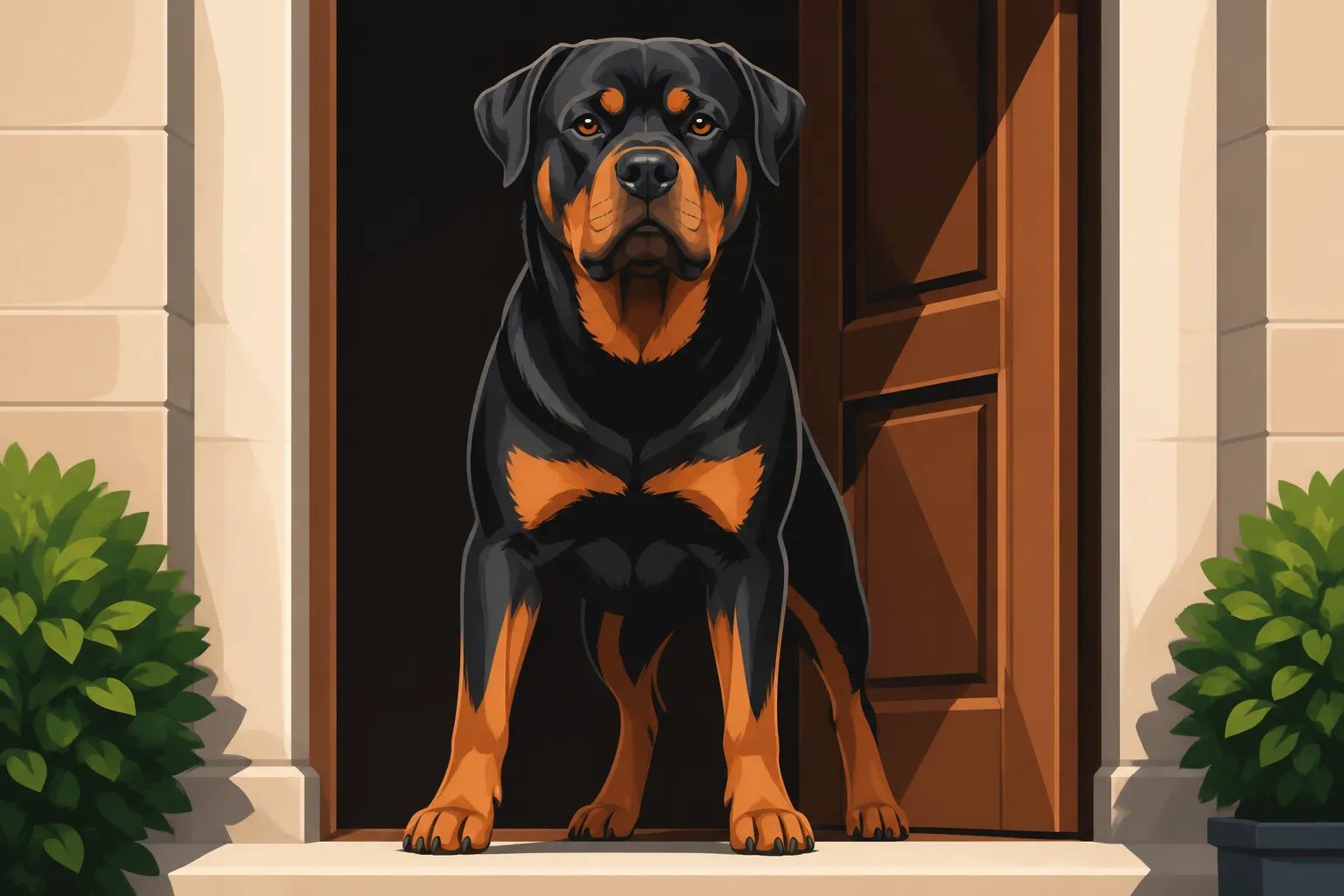
A Rottweiler That Guards a Doorway
It's incredibly frustrating, and honestly, a little embarrassing, when your beloved Rottweiler decides that a doorway in your own home is their personal, unassailable fortress. You just want to walk into the kitchen, or let a friend through the front door, and suddenly you're met with a stiff body, a low rumble, or even a snap – it's alarming, to say the least. This guide is all about peeling back the layers of this behavior, understanding why your big, confident Rottie might feel the need to guard an entryway, and giving you concrete, empathetic steps to help them (and you!) move past it.
Understanding Why Your Rottweiler Guards Doorways
When your Rottweiler starts acting like the door warden, it's easy to jump to conclusions, often negative ones. But before we can address the behavior, we have to try to understand it from their perspective. It’s rarely about malice or being "dominant" in the human sense; it's almost always rooted in instinct, insecurity, or a misunderstanding of their role in the household.
The Instinctual Roots of Doorway Guarding
Rottweilers were originally bred to be working dogs, herding cattle and guarding property and coin for butchers in Germany. This strong guarding instinct is hardwired into their DNA. They are naturally alert, watchful, and possessive of their family and territory. A doorway, whether it's the front entrance, a bedroom door, or even a threshold between rooms, represents a transition point, a portal between "inside" (safe, mine) and "outside" (potential threat, unknown). For a dog with strong guarding tendencies, these points become strategic locations to monitor and control. It's their ancestral job, in their minds, to decide who or what gets to pass.
Consider how a Rottweiler naturally positions itself; they often like to be in a spot where they can see everything, a central command post. A doorway provides an excellent vantage point, allowing them to survey the landscape and quickly respond to any perceived intrusion. This isn't always aggressive; sometimes it's simply intense observation, but it can quickly escalate if their boundaries are challenged or if they feel their "post" is being threatened by your movement or the approach of a guest. It's critical to differentiate between a natural watchfulness and an unhealthy, stress-driven guarding behavior.
Resource Guarding and the "Territory"
Doorway guarding is often a manifestation of resource guarding, but instead of a toy or food bowl, the "resource" is the physical space itself, or even the people within that space. Your Rottweiler might perceive the entryway, the room beyond it, or even you standing near the door, as something to protect from others. This behavior can be particularly pronounced if your dog hasn't been properly socialized or if they've had negative experiences with strangers entering their space. They see the doorway as an extension of their personal bubble, and anyone attempting to cross it is infringing on their perceived ownership.
This isn't necessarily a sign of a bad dog; it's often a sign of a dog that feels insecure or misunderstood. They might have learned that stiffening, growling, or barking effectively makes people back off, reinforcing the behavior. This is especially true if previous attempts to manage the situation involved shouting or physically pushing the dog away, which can inadvertently teach them that they need to escalate their warnings. It becomes a self-fulfilling prophecy where the dog believes they must guard, because they've successfully "driven off" the "intruder" before. Think about a game of tug-of-war for a minute: if every time you pull, your dog pulls harder and "wins," they learn that pulling is effective. The same applies to guarding behaviors.
Anxiety, Fear, or Lack of Socialization
Sometimes, doorway guarding isn't about protecting territory as much as it is about profound anxiety or fear. A Rottweiler who wasn't adequately socialized during their critical puppyhood window (roughly 3-16 weeks) might be genuinely fearful of new people, strange objects, or sudden movements. When these perceived threats approach a doorway, the dog might react defensively. The doorway becomes a choke point, trapping them or forcing confrontation. Rottweiler Socialization Before Sixteen Weeks is crucial for preventing these anxieties from solidifying.
A Rottweiler who lacks confidence might feel overwhelmed by the unpredictable nature of visitors or the hustle and bustle associated with entrances. Their guarding behavior is a desperate attempt to create distance and control an environment they find threatening. This can be exacerbated by underlying health issues, pain, or even poor eyesight in older dogs, making them more prone to startling and reacting defensively. It’s worth ruling out any physical discomfort with your vet, especially if the behavior suddenly appears or worsens.
Recognizing the Signs of Doorway Guarding
It’s one thing to understand why your Rottweiler might guard a doorway, but it’s another to accurately identify the specific signals they're sending. This isn't just about growling or snapping; dogs communicate in a rich tapestry of body language, and catching the subtle cues early can prevent escalation and help you intervene more effectively.
Subtle Cues Versus Overt Aggression
Before your Rottweiler lets out a full-throated growl or a snarl, they're likely giving off a host of more subtle signals. These can include a stiffening of their body, a direct, hard stare, lowered head, a slight forward lean, or a slow wagging of a docked tail that is rigid rather than loose and happy. Their ears might be slightly back or to the side, and their lips might be tightly closed, or you might see a slight wrinkle around their muzzle. Rottweiler Whale Eye and Other Warning Signs can also be a dead giveaway – when you see the whites of their eyes, it's often a sign of stress or fear.
It's crucial to learn to "read" these early warnings. If you ignore them, or if you accidentally punish your dog for them, you teach them that their polite warnings are ineffective. This can lead to a dog who skips the subtle signals and goes straight to an overt, potentially dangerous, display of aggression. Many owners unknowingly reinforce guarding behaviors by either ignoring them until they're a big problem or by reacting with fear or anger, which only confirms the dog's belief that there's something to be wary of.
How the Behavior Escalates
Doorway guarding behavior rarely appears fully formed as overt aggression. It typically follows a ladder of escalation, starting with those subtle cues and potentially climbing to more intense displays.
Here’s a common progression:
- Observing: The dog notices someone approaching the doorway and becomes still, focused. Their body language is "closed."
- Stiffening/Staring: Their body tenses, they might lower their head slightly, and fix their gaze on the "intruder."
- Soft Growl/Rumble: A low, almost imperceptible sound emerges from their throat. This is a clear warning. The Rottweiler Grumble That Is Not a Growl can be confusing, but in this context, it's usually a warning.
- Barking/Hard Growl: The growl becomes louder, more assertive, often accompanied by a series of sharp barks.
- Lunging/Snapping: If the perceived threat persists, the dog might lunge forward, snap the air, or even make contact.
- Biting: In the most severe cases, if all previous warnings are ignored or ineffective, the dog might resort to a bite.
Understanding this ladder allows you to intervene at the lowest rung, before things get out of hand. For example, if you notice your Rottweiler stiffening and staring as someone approaches the front door, that's your cue to calmly redirect them before they feel the need to growl. Punishing a growl, by the way, is incredibly dangerous because it removes the warning system; the dog may then jump straight to a bite without warning. Always thank your dog for the growl, as it's a piece of vital information.
Practical Strategies for Managing Doorway Guarding
Successfully managing doorway guarding in a Rottweiler requires consistency, patience, and a multi-faceted approach. It's about proactive training, clear communication, and sometimes, a bit of environmental management to set everyone up for success.
Establishing Clear Boundaries and Leadership
One of the most effective ways to manage doorway guarding is by clearly establishing yourself as the calm, consistent leader of the household, especially around high-traffic areas. This doesn't mean being aggressive or dominant, but rather showing your Rottweiler that you are in control of resources and access. This includes doorways. Start by teaching a strong "place" command. Your dog should be able to go to a designated spot (like a dog bed or mat) and stay there calmly, even with distractions. Practice this far away from doorways first, then gradually move closer.
When someone approaches a door, whether it's the front door or just a room door you want to enter, ask your Rottweiler to go to their "place." Reward them lavishly for staying there. If they struggle, you might need to use a leash to guide them initially, then reward the moment they settle. Consistency is key here. Every single time a door is approached or opened, your Rottweiler should be on their place. This teaches them that you handle the doorway, and their job is to relax. This is where products like those offered by BAXTER & Bella can be really helpful; their training programs often emphasize building this kind of foundational obedience that translates into real-world scenarios.
Desensitization and Counter-Conditioning Techniques
These are powerful tools for changing your Rottweiler's emotional response to doorways and the people who use them.
Desensitization involves gradually exposing your dog to the trigger (people approaching/using the door) at a level where they don't react negatively. Start incredibly small. If your dog guards the front door, begin by having a family member stand outside the house, far enough away that your dog doesn't even notice them, or just barely notices without reacting. Then, ever so slowly, have them move closer over multiple sessions, always stopping before your dog shows any signs of guarding.
Counter-conditioning means changing your dog's negative association with the doorway into a positive one. Every time your Rottweiler sees or hears someone approaching the door (at a non-reactive distance), immediately give them a high-value treat. The sound of the doorbell, a knock, or the sight of someone at the window should become a cue for "treat time," not "guard time." Combine this with the "place" command: when the doorbell rings, your dog goes to their place and gets a treat. This helps them associate the sound and presence of visitors with good things, not threats.
Here's a simplified example of a training session:
| Step | Action | Dog's Expected Response (Goal) | Your Action/Reward |
|---|---|---|---|
| 1. Baseline: | Stand a distance from the door. | Calm, relaxed, possibly looking at you. | Click/Mark, Treat! |
| 2. Minor Trigger: | Lightly tap on the outside of the door (very quietly). | Ears perk, slight head turn, but no stiffening/growl. | Click/Mark, High-Value Treat! (Repeat until consistent) |
| 3. Moderate Trigger: | Gently knock on the outside of the door. | Alert, but remains on place, maybe a soft whine. | Click/Mark, High-Value Treat! (Repeat until consistent) |
| 4. Visual Trigger: | Family member appears in doorway, no entry. | Looks, maybe stiffens slightly, but stays. | Click/Mark, High-Value Treat! (If they react, go back to Step 3) |
| 5. Door Opening (Small Crack): | Open door a tiny crack, close immediately. | Stays on place, might watch door intensely. | Click/Mark, High-Value Treat! (Repeat, gradually widening crack) |
| 6. Door Opening (Full Entry): | Family member enters the room, ignoring dog, goes to specific spot. | Remains on place, watches calmly, no reaction. | Click/Mark, High-Value Treat! (Ensure person avoids direct eye contact with dog) |
| 7. Doorbell Sound: | Play a recording of your doorbell at a low volume. | Looks up, but remains calm or goes to place. | Click/Mark, High-Value Treat! (Gradually increase volume) |
Remember to keep sessions short, positive, and always end on a good note. If your dog reacts, you've gone too fast; back up to an easier step.
Management Tools and Environmental Control
Sometimes, training alone isn't enough, or you need immediate solutions while you're working on the long-term behavior modification. This is where management tools come in handy.
- Crates or Designated "Place": If your Rottweiler has a strong "place" command, use it! But if not, a crate can be invaluable. Crates provide a safe, secure space where your dog can feel contained and cannot physically practice guarding the doorway. Set the crate up in a quiet area, perhaps out of sight of the direct doorway if the trigger is visual, and give them a long-lasting chew or puzzle toy to keep them occupied when visitors arrive. Many durable crates suitable for a large Rottweiler can be found on Amazon. The Crate Size a Hundred Twenty Pound Rottweiler Needs is important to consider.
- Baby Gates: For internal doorways, a baby gate can provide a physical barrier, preventing your dog from accessing the guarded area while still allowing them to see and hear what's happening. This can be less isolating than a crate and allows for some passive desensitization.
- Leash Management: For training purposes, or when expecting company, keeping your Rottweiler on a leash can be a lifesaver. This gives you direct control over their movement and allows you to calmly guide them to their "place" or away from the door before they escalate. A sturdy training leash and collar are essential for a powerful breed like a Rottweiler.
- Managing Visitor Interactions: Ask visitors to completely ignore your Rottweiler when they first arrive. No eye contact, no petting, no talking. This takes the pressure off your dog, allowing them to observe without feeling challenged. Once your dog is calm, and only if they initiate polite interaction, can the visitor offer a calm greeting.
These management strategies aren't fixes in themselves, but they are crucial for preventing the problem behavior from being practiced and reinforced, buying you time to implement consistent training.
When to Seek Professional Help
While many cases of doorway guarding can be managed with consistent training and environmental control, there are definitely times when you absolutely need to bring in the pros. Knowing when to call for backup is not a sign of failure, but a sign of a responsible and caring Rottweiler owner.
Identifying Red Flags and Safety Concerns
The most important red flag is any instance of actual biting, or repeated, intense lunging and snapping that genuinely feels threatening. If your Rottweiler has broken skin, even accidentally, or consistently makes you or your guests feel unsafe, it's time to stop trying to handle it alone. Rottweiler Guarding That Needs a Behaviorist is not something to take lightly.
Other red flags include:
- Escalation despite training: If you've been consistently applying the techniques mentioned above for several weeks or months, and the behavior is not improving, or is actually getting worse, you need professional guidance.
- Fear-based aggression: If the guarding seems rooted more in profound fear or anxiety rather than simple territoriality, a behaviorist can help address the underlying emotional issues, which are often more complex to unravel.
- Injury to self or others: If your Rottweiler is becoming so stressed or agitated that they are injuring themselves (e.g., self-mutilation, panic attacks) or if you are genuinely afraid they might injure someone, immediate professional intervention is necessary.
- General aggression spreading: If the doorway guarding is just one facet of a broader pattern of aggression or resource guarding that is manifesting in other areas (e.g., guarding food, toys, specific people), a comprehensive behavioral assessment is crucial.
Never feel ashamed to reach out for help. Rottweilers are powerful dogs, and managing behavioral issues with safety in mind is paramount.
Working With a Certified Professional Dog Trainer or Behaviorist
When you decide to seek professional help, it's vital to find the right kind of professional. Look for:
- Certified Professional Dog Trainers (CPDT-KA or KPA CTP): These trainers specialize in positive reinforcement methods and can help you implement effective training protocols. They'll work with you and your dog, often in your home, to tailor a plan to your specific situation. Many trainers familiar with larger, more powerful breeds like the Rottweiler can be found through organizations like the Certification Council for Professional Dog Trainers (CCPDT) or the Karen Pryor Academy (KPA).
- Certified Applied Animal Behaviorists (CAAB or ACAAB) or Veterinary Behaviorists (DACVB): For more severe cases, especially those with underlying anxiety, fear, or complex aggression, a behaviorist is the way to go. These individuals have advanced degrees in animal behavior or veterinary medicine with a specialization in behavior. They can diagnose underlying behavioral conditions and, in the case of veterinary behaviorists, prescribe medication if necessary, as part of a holistic treatment plan.
When interviewing a professional, ask about their experience with guarding behaviors and Rottweilers specifically. Ensure they use humane, force-free methods. Anyone advocating harsh corrections, punishment, or dominance theory should be avoided, as these methods often exacerbate guarding behaviors and damage your bond with your dog. A good professional will focus on understanding the root cause of the behavior, teaching you how to communicate effectively with your dog, and implementing positive reinforcement techniques that build confidence and trust. They will also prioritize safety, guiding you on how to manage your home environment to prevent incidents while training is underway. Finding a Rottweiler-Experienced Trainer Near You is a great start.
Remember, addressing doorway guarding is a journey, not a sprint. With patience, consistency, and the right approach, you can help your Rottweiler feel secure and confident, allowing your home's doorways to be points of entry, not points of contention.
Disclaimer
This article is for general informational purposes only and does not constitute professional advice. Laws, prices and regulations vary by location and change over time. Consult a qualified professional for guidance on your specific situation.